Iran cleric warns US assets in region are 'within missile range'
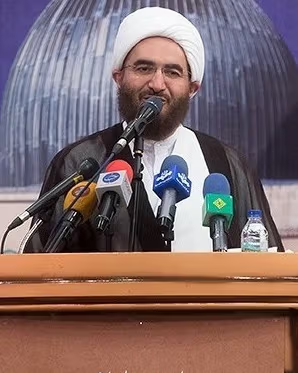

A senior Iranian cleric said US interests and military bases in the Middle East were within range of Iran’s missiles, repeating warnings often issued by officials in Tehran amid tensions with Washington.
Mohammad Javad Haj Ali-Akbari said the United States had invested what he described as one trillion dollars in the region, adding that “all of your interests and bases are clear and precise targets of our missiles,” according to state media.
“That one trillion dollars you invested in the region is under the watch of our missiles,” he said.

A senior Iranian cleric said the United States had sought to target Iran’s leadership using a model similar to Venezuela, and warned that any attack would trigger a wider regional response.
Mohammad Saeedi, who represents Supreme Leader Ali Khamenei in the city of Qom, said Iran had sent messages warning that “any aggression would be answered by involving the entire region.”
He added that Iran’s enemies had concluded the country’s leadership remained the main obstacle to US goals.
A video circulating on social media shows a man speaking inside an ambulance carrying the body of his brother, who was killed during unrest in Iran’s western city of Kermanshah.
In the footage, the man says his brother was shot multiple times.
“They tore my brother apart with bullets,” he says. “He was my support. We will get justice.”

Iran’s prosecutor general said remarks by US President Donald Trump about executions in Iran were false and said the judiciary does not take orders from foreign governments.
Mohammad Movahedi Azad said Trump had said he stopped the execution of 800 people in Iran, but said no such number existed and no such decision had been taken by Iran’s judiciary.
“The US president has said he stopped the execution of 800 people in Iran, but this is completely false,” Movahedi Azad was quoted as saying by Iranian media. “Neither does such a number exist nor has the judiciary made such a decision.”
“The judiciary is an independent institution and does not take orders from foreigners,” he said.
Trump had earlier said Iran planned to execute more than 800 protesters but halted the move after warnings from him.

An Iranian lawmaker confirmed that many people who died during recent protests were wounded individuals who did not make it to hospitals, an unusual acknowledgment by an official about the fate of the injured during the unrest.
Ahmad Fatemi, a member of parliament’s social affairs commission, said many of those who died had been injured and later died from their wounds or infections after not receiving hospital treatment.
“Some of the wounded, for various reasons, did not go to treatment centers, and many of the deaths were due to injuries and infection,” Fatemi was quoted as saying by state media.
He said the cases were under review and that no precise figures had yet been released, adding that relevant authorities would publish official statistics later.

Payam Akhavan, an Iranian-Canadian former UN prosecutor, said efforts at the United Nations to document alleged abuses in Iran could prepare the ground for future legal action.
“The scale of the crimes is unprecedented,” Akhavan told Reuters ahead of an emergency session of the UN Human Rights Council on Iran.
“We are trying to set the stage for transitional justice in Iran, for the country’s Nuremberg moment, should that come to pass,” he said, referring to the post-World War II trials of Nazi leaders.
Akhavan said documenting alleged violations now could be critical for future accountability, even if prosecutions are not immediately possible.