Iran protest crackdown toll may top 20,000, UN rapporteur says
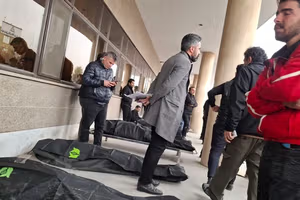
The number of civilians killed in Iran’s crackdown on protests may be more than 20,000, the UN special rapporteur on human rights in Iran said, citing reports from doctors inside the country, Bloomberg reported.
Mai Sato said earlier this week that civilian deaths were estimated at 5,000 or more, adding that medical reports suggested the toll could be far higher, at about 20,000 or more.
Israeli President Isaac Herzog said on Wednesday that the Iranian people deserved a change of leadership, describing Tehran as oppressive and accusing it of widespread abuses.
Speaking at the World Economic Forum in Davos, Herzog said: “The Iranian people are yearning for change. The Iranian people deserve change. They deserve a decent life.”
He added: “The Iranian people live under a very oppressive regime. A regime which has mowed thousands of its citizens and is torturing and is jailing and is destroying thousands of families, perhaps tens of thousands, perhaps much more all around Iran.”
Herzog said the authorities were trying to suppress what he described as basic human demands.
“They are trying to crush the natural demand of human beings for better life and for freedom,” he said.
He said he hoped Iran would undergo political change.
“I sincerely hope and pray that there will be a change in Iran because Iran deserves better, the region deserves better, the world deserves better,” Herzog said.
He said Iranians were suffering from shortages and economic hardship.
“The people are suffering tremendously. There’s shortage of food and water and so many other basic needs. The economy is in shambles,” he said.
Herzog added: “The future for the Iranian people can only be in a regime change,” saying this should ultimately be decided by Iranians themselves with international support.
“That has to be, at the end, within the realms of the Iranian people and the international community and its support,” he said.
He also said: “It’s clear to me that the Ayatollah is in quite a fragile situation.”
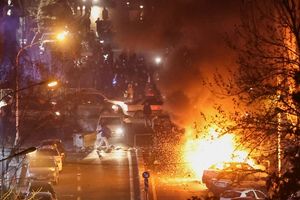
A scene of protests in Arak, Markazi province, on January 8, 2026
The number of civilians killed in Iran’s crackdown on protests may be more than 20,000, the UN special rapporteur on human rights in Iran said, citing reports from doctors inside the country, Bloomberg reported.
Mai Sato said earlier this week that civilian deaths were estimated at 5,000 or more, adding that medical reports suggested the toll could be far higher, at about 20,000 or more.
The US-based Human Rights Activist News Agency (HRANA) said it has verified 4,902 deaths since unrest erupted in late December and is reviewing a further 9,387 suspected fatalities, while more than 26,000 people have been arrested, according to a statement on its website.
Iran’s National Security Council on Wednesday issued its first official toll, reporting 3,117 deaths, including 2,427 described as “innocent,” among them members of the security forces, without providing a civilian breakdown.
Iran International reported earlier this month that more than 12,000 people were killed during the crackdown largely on January 8 and 9.
A senior commander of Iran’s Revolutionary Guards said the country would not yield to pressure from US President Donald Trump.
“Trump is accustomed to making empty and unfounded claims,” Brigadier General Ahmad Vahidi, the deputy commander of the Guards, was quoted as saying by state media.
“Our dear Iran is powerful, resilient and moving forward,” he said. “It will never back down before this kind of talk, will never surrender, and will continue its path of progress with dignity and strength.”
The US State Department said an Iranian soldier had been sentenced to death for refusing to fire on protesters, calling the case morally unjust and inhumane.
In a post on its Persian-language X account, the department said: “According to reports, Javid Khales, a young Iranian soldier, has been sentenced to death for refusing to shoot innocent protesters.”
“His refusal was not only justified, it was the only moral choice,” the post said. “The duty of soldiers is to protect the citizens of their country, and Javid did exactly that.”
The account said it was “reprehensible and inhumane” for Iran’s authorities to punish those who refuse to turn their weapons on civilians.
“No government should demand that its security forces use violence against their fellow citizens,” it said, “nor impose the harshest punishment on those who choose conscience over oppression.”
The State Department account added: “Javid stood by his conscience and fulfilled the true duty of a soldier. The Islamic Republic’s response, like many of its others, is a stain on its legitimacy.”
The European Parliament adopted a resolution condemning Iran’s violent repression of protesters, calling for an end to executions, the release of detainees and accountability for what it described as crimes by the authorities.
In the resolution, lawmakers said they stood “in full solidarity with the people of Iran and their brave and legitimate protest movement.”
Parliament said it “unconditionally demands that the Iranian authorities… immediately end violence against peaceful protesters, halt all executions, and cease the murder and repression of civilians.”
Lawmakers said they were alarmed by what they described as a shift in how Iran suppresses dissent.
“The murder of thousands of protesters signals a chilling shift… from deterrence to strategic elimination,” the resolution said.
The European Parliament also called for the designation of Iran’s Revolutionary Guards as a terrorist organisation and urged an expansion of EU sanctions, including asset freezes and visa bans.
It condemned what it called efforts by Iranian authorities to censor protests through internet shutdowns and urged the EU to boost support for tools that bypass censorship.
Addressing Iranians, the resolution said: “Even when cables are cut, we hear you. Even when blackouts fall, we see you. You are not alone.”
The parliament said any normalisation of relations with Iran should be conditional on the release of political prisoners and progress toward democracy and the rule of law.