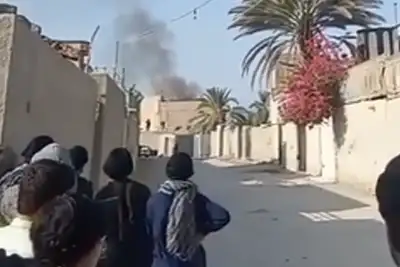
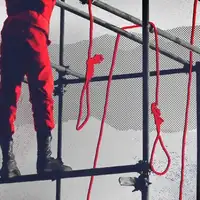
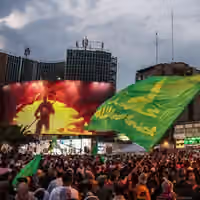
The large-scale killing of protesters may look like a panicked security response, but it is better understood as a calculated effort to destroy protest both on the streets and in people’s minds.
By deploying overwhelming force, the state is seeking to reframe protest as an act that guarantees death—so dangerous that it becomes irrational to attempt.
This logic has been reinforced by the nationwide internet shutdown. Cutting communication is not simply about hiding abuses from the outside world; it is about isolating protesters from one another, breaking networks of trust, and leaving individuals to face fear alone.
When information collapses, collective will fractures. The aim is to ensure that even before a demonstration forms, the decision to join it feels like a solitary, suicidal gamble.
The state has effectively pushed society into an impossible position, where enduring daily life is as unpleasant—and as unimaginable—as any attempt to change it. This paralysis is not accidental. It is Tehran’s endgame, and increasingly its only means of survival.
'Us against them'
The violence of January 9 and 10 served another purpose as well: consolidating power from within.
By tying the survival of the political system to the actions of those carrying out repression, the state has produced what might be called forced loyalty. Security forces and affiliated actors are drawn into violence so severe that there is no path back.
Once hands are stained with blood, survival becomes inseparable from the survival of the system itself. This creates a hardened core of enforcers whose only perceived option is to push forward, no matter the cost.
This dynamic encourages a “scorched earth” approach. The conflict is no longer managed or contained; it is framed as a total struggle between “us” and “them,” with protesters cast as enemies rather than citizens.
In such a framework, compromise is not weakness—it is betrayal. Mediation disappears. Violence becomes the only remaining language.
Murky repression
By ignoring collective demands and stripping the public of political relevance, the Islamic Republic has effectively dismantled politics itself. What remains is not governance, but a permanent security posture.
The use of plainclothes forces and paramilitary units fits squarely within this logic. By blurring the boundary between state and society, the authorities have sought to reframe repression as “people against people.”
Protesters are portrayed as violent elements within society, already dehumanized through labels such as “rioters” or “terrorists.” This allows the state to deflect responsibility while deepening social fragmentation.
Slain senior Revolutionary Guard commander Hossein Hamedani once boasted about mobilizing convicts and thugs to suppress protests. “They are not afraid of blood,” he said.
Their role is not only physical repression but also narrative production: muddying responsibility, normalizing brutality, and casting doubt on the moral legitimacy of protest itself. Their unofficial status also provides the state with plausible deniability.
Burned bridges
At the same time, the machinery of repression has become increasingly bureaucratic. Killings are absorbed into routine procedure; violence is carried out as a duty—lawful, necessary, even sacred.
Statements from military and security institutions during this period make clear that the deaths of protesters are not seen as a national loss, but as a means of preserving the political order.
This moment also exposes a deeper vulnerability. A system that securitizes everything produces nothing but control and coercion. Maintaining such a structure requires constant expenditure—of resources, manpower, and legitimacy—both at home and abroad.
A crisis in the domestic security sphere cannot remain contained indefinitely; it will eventually spill outward, generating external pressure and international consequences.
What is unfolding in Iran is therefore not a temporary crackdown. It is the outcome of a long shift from governing society to confronting it as an enemy.
It is almost impossible to predict where Iran is headed, but its rulers appear to have bet on the iron fist—suspending politics for a permanent emergency and burning all bridges back to mediation and consent.