Iranian Supreme Leader Ali Khamenei handles Islamic prayer beads in this file photo
The thank-you note from US President Donald Trump to Iran’s leadership for halting what he described as planned mass executions reveals much about his politics, but more about the rulers in Tehran who have canonised deception as a political instrument.
Trump said last week that he had it “on good authority” that Iran intended to execute 800 prisoners, a claim for which no corresponding evidence has appeared in Iranian official announcements or domestic reporting.
American media reports suggested Iran's foreign minister Abbas Araghchi had been communicating with Trump's Mideast envoy Steve Witkoff and his statements had influenced the president's thinking to relent on a mooted attack.
Trump’s apparent willingness to take the claim at face value may also reflect his own preference, at least momentarily, for de-escalation—or for deferring action he may have judged premature at that stage.
Whether the specific information circulated in this episode was exaggerated, fabricated, or misunderstood remains unclear. But if misleading claims were fed to American officials or intermediaries, such behavior would be entirely consistent with Tehran’s long-standing political logic.
Concealment as expediency
This logic does not arise from classical Islamic jurisprudence as such. In traditional Islamic legal thought, deception is generally condemned in ordinary political and social life and tightly constrained even in wartime.
The Islamic Republic, however, reconfigured this ethical boundary when its first supreme leader, Ruhollah Khomeini, argued that actions normally considered impermissible could be justified under the higher imperative of preserving Islam—and later, preserving the system itself.
Concepts such as maslahat (expediency) and political taqiyya (concealment) were thus transformed from narrowly defined exceptions into governing principles. Deception ceased to be situational and became structural.
This transformation was evident even before the Islamic Republic consolidated power. Khomeini publicly promised political pluralism, civil liberties, and limits on clerical authority. After 1979, these commitments were quietly discarded or retrospectively framed as tactical necessities of the revolutionary struggle.
What occurred was less a political reversal than the institutionalization of a widening gap between public narrative and actual intent. Decisions of lasting consequence were made offstage, while legality and transparency were preserved largely in appearance.
•
•
‘Managing’ foes
In later decades, deception became a stable feature of Iran’s foreign policy as well. Negotiations were often used not to resolve disputes but to reduce pressure, fragment opposition, and buy time.
Iran’s best-known diplomat, Mohammad Javad Zarif, boasted several years ago that his team had deliberately “managed” international perceptions. Misrepresentation was not incidental; it was strategic.
Within such a system, misleading a foreign government or manipulating a prominent political figure would be a default option, not merely a necessary evil.
Whether or not the recent execution claims were accurate, their circulation fits a familiar operational pattern: deflect scrutiny, reshape headlines, ease pressure, and gain time.
Iranians abroad staged at least 168 protests across 30 countries and 73 cities, turning the uprising inside Iran into a global wave of demonstrations that surged after internet shutdowns.
From Tokyo and Seoul in East Asia to Los Angeles and San Francisco on the US West Coast, and from Oslo, Stockholm, and Tampere in northern Europe to Melbourne and Adelaide in the Southern Hemisphere, Iranian communities took to the streets in what organizers described as coordinated expressions of solidarity with protesters inside Iran.
One of the largest gatherings took place in Toronto on January 16, where demonstrators marched despite blizzard conditions and subzero temperatures. Aerial images showed large crowds carrying Iranian national symbols and banners, making the event one of the most widely attended diaspora protests during this period.
Growth of diaspora mobilization
Large-scale mobilization among Iranians abroad is not unprecedented. Over the past 45 years, more than five million Iranians have fled the country as refugees, with an estimated additional two to four million emigrating for other reasons. By these estimates, roughly one in every 15 Iranians now lives outside the country.
The first demonstrations in this latest wave began on January 1, the fifth day of protests inside Iran. From that point through January 16, the number of gatherings increased steadily, with a marked acceleration following internet blackouts and a public call by exiled prince Reza Pahlavi for Iranians abroad to mobilize.
January 16, 10, and 9 saw the highest number of demonstrations worldwide, with 25, 24, and 23 events respectively.
Geographic distribution
More than half of all protests were held in Europe, with cities such as London, Hamburg, Frankfurt, and Stockholm among the most active.
North America accounted for roughly 25 percent of demonstrations, concentrated in cities including Toronto, Montreal, Los Angeles, New York, and Washington DC.
In Oceania, approximately 15 percent of protests took place, primarily in Sydney and Melbourne in Australia, and Auckland and Wellington in New Zealand.
Smaller demonstrations were also reported in cities such as Tbilisi, Yerevan, Tokyo, Seoul, New Delhi, and Istanbul. While Iranian populations in several Asian countries are sizable, organizers noted that legal and political restrictions made public demonstrations more difficult than in Western countries. In Turkey, some Iranian residents reported bans on holding protests.
Demonstrators hold a large "Lion and Sun" pre-Islamic Revolution national flag of Iran, during a gathering outside the Iranian embassy in support of nationwide protests in Iran, in London, Britain, January 18, 2026.
Organizers and symbols
With limited exceptions, most demonstrations were organized by nationalist and monarchist groups. Participants frequently carried pre-revolution Iranian flags featuring the lion-and-sun emblem, along with images of Reza Pahlavi and slogans echoing those used by protesters inside Iran.
A small number of rallies were organized by left-wing and feminist groups, including a modestly attended event in Toronto on January 4 and a Paris demonstration on January 16.
Clashes, attacks, and arrests
Several incidents of violence were reported during the demonstrations.
On January 10 in Los Angeles, a truck drove toward a gathering of protesters. Police intervention prevented serious injuries.
Six days later, on January 16, three individuals armed with knives attacked demonstrators at another Iranian rally, leaving two people seriously injured.
Clashes and arrests were also reported during protests in London, according to local media and eyewitness accounts.
Largest demonstrations
Official estimates of crowd sizes remain limited. In Toronto, organizers claimed attendance reached as high as 110,000 people, while official figures cited numbers exceeding 10,000.
Aerial footage showed dense crowds marching through snow-covered streets. Some Toronto residents described the event on social media as unprecedented, suggesting attendance exceeded official estimates.
In Cologne, Germany, participation was estimated at around 25,000 people. Large crowds were also reported in Hamburg.
Flag actions at diplomatic sites
Alongside street demonstrations, activists attempted to replace the Islamic Republic’s flag with the pre-1979 lion-and-sun flag at Iranian embassies and consulates worldwide.
On January 9, during a protest outside Iran’s embassy in London, a demonstrator climbed onto the embassy balcony, removed the official flag, and raised the lion-and-sun flag. The action drew strong condemnation from Iranian authorities.
On January 12 – exactly six years after a state television presenter told protesters to “pack up and leave Iran” if they rejected the government’s vision of society – Iranians demonstrated in cities including Sydney, Melbourne, Bern, Nicosia, Berlin, Genoa, The Hague, Toronto, Hamburg, London, Barcelona, Zurich, Yerevan, Lisbon, Tbilisi, and Athens.
Many demonstrators live in countries with high levels of political freedom and economic stability. Organizers said the protests were intended to signal that, despite living abroad, members of the Iranian diaspora continue to identify closely with events inside Iran.
From east to west, participants said, geography has not severed their ties to the country they left behind.
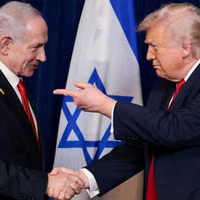
The public rancor between US President Donald Trump and Iranian Supreme Leader Ali Khamenei has gotten increasingly personal, suggesting that a standoff once mediated through proxies and carefully coded threats may be approaching a finale.
That escalation was on display last week when Trump openly questioned Khamenei’s right to rule and called him a “sick man” who kills his own people.
“It’s time to look for new leadership in Iran,” the president was quoted as saying by Politico. His blistering rhetorical intervention came after one of Khamenei's most strident speeches yet in which he, uncharacteristically, acknowledged thousands had been killed in the state's crackdown on protests this month.
"We consider the US president criminal for the casualties, damages and slander he inflicted on the Iranian nation," Khamenei said.
Iranian officials denounced Trump’s language as “offensive” and “unacceptable,” with president Masoud Pezeshkian warning that any move against Khamenei would trigger an all-out war.
The latest public spat followed widespread protests inside Iran, which were quelled through the unprecedented use of force. Speaking about the unrest last week, Khamenei once again blamed Israel and the United States for incitement, accusing Washington of fomenting terrorism and sabotage.
'The most wretched of humankind'
While the language has grown sharper, the confrontation itself is not new.
The personal animosity between Trump and Khamenei reached a decisive turning point in January 2020, when a US drone strike in Baghdad ordered by Trump killed Qassem Soleimani, the commander of Iran’s Quds Force and one of the most powerful figures in the Islamic Republic.
Khamenei described those responsible as “the most wretched of humankind” and vowed revenge. The killing transformed what had been a strategic rivalry into a deeply personal feud—one infused with symbolism, grievance, and a sense of irreversibility.
In the years that followed, Khamenei increasingly personalized his attacks on Trump. He portrayed the US president as the embodiment of American arrogance and decay, at one point calling him a “clown.”
Still, the veteran theocrat most abstained from uttering the name of his nemesis, out of contempt. Trump has done largely likewise.
'Ultimately responsible'
Even before Soleimani’s death, the two leaders had traded insults during Trump’s first term.
In June 2019, Trump imposed sanctions on Khamenei, calling him “ultimately responsible” for Tehran’s conduct. Iran’s then president, Hassan Rouhani, responded by calling the White House “mentally disabled,” a remark later endorsed by Khamenei’s office.
Trump dismissed the response as “ignorant and insulting,” saying Iran’s leaders “do not understand reality.”
A year later, when Japan’s then prime minister Shinzo Abe attempted to deliver a message from Trump to Khamenei, the Iranian leader publicly refused to accept it, telling Abe that he did not believe Trump was “worthy” of receiving a message.
Footage later showed Abe awkwardly folding the envelope away—an episode widely read as a calculated public snub.
One last dance?
Since Trump’s return to office, the exchanges have become more frequent and more explicit, often coinciding with moments of heightened tension, not least the June war between Iran and Israel.
On June 17, Trump took to social media for a rare direct attack.
“We know exactly where the so-called ‘Supreme Leader’ is hiding,” he wrote. “He is an easy target, but is safe there—we are not going to take him out, at least not for now.”
In October 2025, Khamenei described the United States under Trump as “a true manifestation of terrorism.” He compared Trump to figures such as Pharaoh and Nimrod, warning that “tyrants fall at the height of their arrogance.”
What distinguishes the current phase of their feud is not merely its volume, but its direction.
Earlier exchanges left room for ambiguity, intermediaries, or eventual de-escalation. The present rhetoric increasingly dispenses with those buffers, with Trump now speaking openly of replacement.
Whether this marks the final chapter of the confrontation remains uncertain. What is clear is that the US-Iran conflict now includes a personal clash between two leaders loath to compromise, despite the asymmetry of power between them.
Iran is ramping up its control of domestic cyberspace with a closed new state-run intranet, according to a US-based advocacy group, after a nationwide internet blackout cloaked the deadliest crackdown on protests in nearly half a century.
“Like North Korea, the Islamic Republic has been working to build an intranet, and it is scary. It will be blocking off Iran," said Neda Bolourchi, the executive director of the Public Affairs Alliance of Iranian Americans.
The Washington-based PAAIA works to amplify Iranian American voices and advocate for policy solutions on Capitol Hill.
Iran's internet blackout began on January 8 as the uprisings spread nationwide and security forces launched a sweeping crackdown.
At least 12,000 people were killed, most of them over January 8 and 9 according to medics and government sources who spoke to Iran International.
Iran’s Supreme Leader Ali Khamenei has since acknowledged that “several thousands” were killed, while doctors say most deaths occurred over just two days during what they describe as the most violent phase of repression in the Islamic Republic’s 47-year history.
With near-total internet and phone shutdowns in place, independent verification remains extremely difficult, and medical sources warn the true toll could be higher.
Where does the blackout stand now?
Bolourchi said the shutdown remains severe but not absolute, and that the small openings are not born of restraint but aim to support a bare minimum of business activity especially in the banking sector.
“We’re getting reports that landlines are sporadically available and that some of the throttling has been reduced,” she said.
A limited number of calls and messages are still getting out through platforms such as WhatsApp, though at dramatically reduced levels.
The Islamic Republic, she explained, cannot fully cut connectivity without paralyzing its own systems. Banks, hospitals and parts of the economy still depend on the internet to function, forcing authorities to allow just enough access to keep the state running while the broader population remains largely cut off.
Satellite internet, once a critical lifeline, has also come under heavy pressure. Bolourchi said authorities are using jamming equipment to disrupt Starlink connections while simultaneously confiscating receivers, which are visible and easy to locate.
She warned that possession of such tools has become increasingly dangerous, as the clerical establishment expands the use of severe charges traditionally reserved for enemies of the state.
The length of the blackout itself, Bolourchi said, points to something more permanent taking shape.
Unlike previous shutdowns that proved economically unsustainable after a few days, this current outage has persisted, suggesting the Islamic Republic has made significant progress in separating government infrastructure from public access.
That shift, she warned, could leave ordinary Iranians trapped inside a sealed digital ecosystem, unable to communicate freely with the outside world even after protests subside.
Bolourchi argued that the United States still has leverage if it chooses to use it, pointing to legislation already passed by Congress that was intended to fund internet circumvention tools for Iran, including support for satellite connectivity and VPNs.
Congress, she said, went further than requested by approving $15 million annually for these efforts.
“A lot could have been done over the past year that would be helping the people of Iran right now,” Bolourchi said, citing bureaucratic and funding delays. “Instead, we’re always in a reactive position.”
After the January 8-9 mass killing of protestors in Iran, state media broadcasts fresh snow falls and other serene scenes bearing little resemblance to the agony of many Iranians reeling from the historic violence.
Official outlets show bundled up children frolicking and families shopping, suggesting normal life restored. Eyewitness accounts from inside Iran and testimony from those who have recently left describe instead a country gripped by grief, fear and economic paralysis.
Prominent journalist Elaheh Mohammadi—whose report about Mahsa Amini, a young woman who died in morality police custody, helped trigger the widespread protests of 2022—described the mood.
“For the past day or two, our VPNs have been working only sporadically—maybe for half an hour to an hour each day—allowing us brief access to the internet. We use that time to let people know we’re still alive,” she said on X.
“The city smells of death. In all my life, I have never seen snow fall in Tehran without anyone even smiling,” she added. “Everyone is in shock; the entire country is in mourning.”
For nearly two weeks, Iran’s internet has been almost entirely shut down, with little sign it will be soon restored. Aside from a handful of government-affiliated outlets and state television, access to news has been virtually nonexistent.
Fleeing the tragedy
Those who have managed to leave Iran by land or air have become key sources of information. Yet many say that once across the border, they too fall into an information vacuum, cut off from reliable updates from home.
Mortaza, who left Iran for a neighboring country several days after the killings, says satellite television has become the primary source of news for many inside the country. Even those broadcasts, he adds, are intermittently disrupted by jamming.
Without exception, those interviewed say the scale of the killings far exceeded what many had anticipated. Violence was so widespread, they say, that almost everyone knows at least one of the dead personally.
Across neighborhoods, families and friends have erected traditional mourning displays—hejleh—decorated with flowers, candles, mirrors, lights and framed photographs of young victims.
The structures resemble wedding canopies, symbolizing lives cut short before marriage.
Banners announcing the victims’ “passing,” often accompanied by poetry or phrases such as “martyr of the homeland,” are visible throughout cities.
What tragedy?
News programs on the state broadcaster repeatedly air footage of vehicles and buildings allegedly set ablaze by protesters—now described not merely as “rioters,” but as “US- and Israel-backed terrorists.”
These segments are interspersed with televised interrogations and forced confessions of individuals who have not appeared in court, alongside images of daily life and repeated claims that foreign-backed "terrorist" plots have been thwarted.
In recent days, the judiciary has issued repeated warnings promising harsh punishment and “no leniency” for those accused of participating in the unrest.
Continued repression
The crackdown has extended well beyond those who took part in protests.
Mohammad Saedi-Nia, a prominent investor and owner of the Saeedi-Nia café chain, was arrested after closing his cafés during calls to protest by exiled Prince Reza Pahlavi. His businesses—along with those of former national footballer Voria Ghafouri—were shut down for supporting protesters.
Saeedi-Nia’s assets, estimated at around $20 million, have reportedly been confiscated.
Dozens of athletes, artists and intellectuals who expressed support for the demonstrations have also had cases opened against them; some have been detained.
The judiciary says assets have been seized to ensure that, if convictions follow, alleged damage to public or private property can be recovered.
Mostafa, who communicated with Iran International via Starlink from his workplace, says traffic in Tehran is unusually light. Only a small number of street-facing shops have opened, he said, and the gold market remains shut.
Economic standstill
Most universities are closed, with final exams moved online. Many businesses are effectively dormant: transactions have stalled because prices depend on the dollar, and the currency market has frozen without a clear exchange rate.
Eyewitnesses also report growing shortages of basic goods. Cooking oil is scarce and selling at several times its previous price when available.
Prices of staples such as rice, eggs, chicken and meat have surged, while consumers limit purchases to essentials and shopkeepers hesitate to sell non-perishable goods.
State media deny that conditions resemble martial law, but eyewitnesses insist otherwise.
Many people have deleted photos and videos of protests from their phones, fearing random stops and searches by security forces.
Some witnesses say young people have been forced to expose their bodies in public to show they bear no marks from pellet guns or rubber bullets—signs authorities use to identify those who took part in demonstrations.
A serving official at Iran’s Interior Ministry has defected from his post and joined the protests, urging US President Donald Trump to intervene against the Islamic Republic, he said in a message to Iran International.
The official said in an audio message recorded on Sunday that he stayed away from work after a call by exiled Crown Prince Reza Pahlavi.
Iran International is withholding the official’s identity for security reasons.
The official said he took part in recent demonstrations and witnessed the Islamic Republic’s use of live fire against protesters.
He said protesters were facing armed forces with no means to defend themselves. “People have done everything they can and made their demands clear,” he said, adding that security forces were deliberately targeting demonstrators with live ammunition.
The official appealed directly to Trump to act, saying many Iranians were waiting for US intervention. “People are waiting for Trump, and if he does nothing, widespread hatred toward him will emerge among Iranians,” he said.
He accused security forces of using G3 rifles against civilians and warned that patience inside Iran was running out.
The official also described what he called de facto martial law in several provinces, with traffic tightly controlled, motorcycle units deployed, and armored vehicles patrolling streets to prevent gatherings.
According to the official, the scale of protests on January 8 and 9 was unprecedented in the history of the Islamic Republic, prompting authorities to restrict internet access and block the flow of images and videos.
“The Islamic Republic is ruthless and will do anything,” he said, adding that agents were operating openly with weapons in the streets.
The Interior Ministry official said he believed Trump would ultimately act but stressed that expectations among protesters were growing as violence continued.
Trump has previously warned Tehran that if Iranian authorities fired on protesters, the United States would respond in kind. Days later, he said he had been told executions in Iran were halted following his warning.
In his most recent comments to Politico, Trump spoke openly about the need for leadership change in Iran, calling Supreme Leader Ali Khamenei “a sick man.”