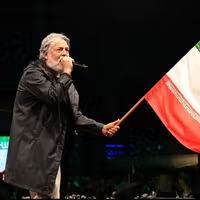
Trump says Mideast at peace, Iran no longer region's bully after June strikes
"We did our job. If we didn't do that, you would have never had peace in the Middle East," US President Donald Trump told the World Economic Forum in Davos on Wednesday, referring to US stealth bomber and submarine-launched missile attacks on Iranian nuclear sites on June 22.
An interviewer at the gathering did not ask Trump about Iran's crackdown on protests this month, the deadliest in the Islamic Republic's history, nor did the US President touch on the unrest in a lengthy speech.
"They may try again, but they're going to have to try from a different area, because that area was obliterated," he said, referring to Iranian nuclear activities. "Incredible thing we did, and because we did that, we were able to make peace."
Trump clinched a deal for a ceasefire to a nearly two-year-old war in Gaza late last year.
"They're not the bully of the Middle East anymore," Trump said of Iran.
Security forces opened fire during burials for slain protesters in at least two Iranian cities amid nationwide demonstrations, local sources told Iran International, in messages received on Wednesday.
In Abdanan, in Ilam province in western Iran, local sources said security forces attacked people after burial ceremonies and fired metal hunting pellets at mourners, leaving at least 100 people injured and around 50 blinded.
In Jahrom, in Fars province in southern Iran, local sources said security forces fired live ammunition and metal pellets during burial-related gatherings on January 8 and 9, killing at least 14 people and blinding 18 others.
Medical facilities in several Iranian cities are facing shortages of body bags as the number of people killed in nationwide protests rises, witnesses told Iran International, describing a heavy security presence at hospitals and morgues.
In messages received from inside Iran on Wednesday, sources said the shortage has led to the accumulation of protesters’ bodies in hospital halls and morgues, while security forces have intervened in the process of handing over the remains.
They said hospital entrances are being tightly controlled, medical staff and families are under pressure, and the registration of information related to the dead has been restricted, in an apparent effort to prevent the true number of those killed from becoming public.
In Khorramabad, the capital of Lorestan province in western Iran, local sources said around 200 to 250 bodies remained at Ashayer Hospital, with no capacity for proper handling or orderly release.
In Arak, in central Iran’s Markazi province, and in Gorgan, the capital of Golestan province in northeastern Iran, they said the number of those killed exceeded morgue capacity, resulting in delays and restrictions on transferring bodies.
Local sources said similar conditions were being seen in other cities, adding that the measures appeared aimed at concealing the scale of the killings and limiting the flow of information about protest casualties.
Iranian Supreme Leader Ali Khamenei handles Islamic prayer beads in this file photo
The thank-you note from US President Donald Trump to Iran’s leadership for halting what he described as planned mass executions reveals much about his politics, but more about the rulers in Tehran who have canonised deception as a political instrument.
Trump said last week that he had it “on good authority” that Iran intended to execute 800 prisoners, a claim for which no corresponding evidence has appeared in Iranian official announcements or domestic reporting.
American media reports suggested Iran's foreign minister Abbas Araghchi had been communicating with Trump's Mideast envoy Steve Witkoff and his statements had influenced the president's thinking to relent on a mooted attack.
Trump’s apparent willingness to take the claim at face value may also reflect his own preference, at least momentarily, for de-escalation—or for deferring action he may have judged premature at that stage.
Whether the specific information circulated in this episode was exaggerated, fabricated, or misunderstood remains unclear. But if misleading claims were fed to American officials or intermediaries, such behavior would be entirely consistent with Tehran’s long-standing political logic.
Concealment as expediency
This logic does not arise from classical Islamic jurisprudence as such. In traditional Islamic legal thought, deception is generally condemned in ordinary political and social life and tightly constrained even in wartime.
The Islamic Republic, however, reconfigured this ethical boundary when its first supreme leader, Ruhollah Khomeini, argued that actions normally considered impermissible could be justified under the higher imperative of preserving Islam—and later, preserving the system itself.
Concepts such as maslahat (expediency) and political taqiyya (concealment) were thus transformed from narrowly defined exceptions into governing principles. Deception ceased to be situational and became structural.
This transformation was evident even before the Islamic Republic consolidated power. Khomeini publicly promised political pluralism, civil liberties, and limits on clerical authority. After 1979, these commitments were quietly discarded or retrospectively framed as tactical necessities of the revolutionary struggle.
What occurred was less a political reversal than the institutionalization of a widening gap between public narrative and actual intent. Decisions of lasting consequence were made offstage, while legality and transparency were preserved largely in appearance.
‘Managing’ foes
In later decades, deception became a stable feature of Iran’s foreign policy as well. Negotiations were often used not to resolve disputes but to reduce pressure, fragment opposition, and buy time.
Iran’s best-known diplomat, Mohammad Javad Zarif, boasted several years ago that his team had deliberately “managed” international perceptions. Misrepresentation was not incidental; it was strategic.
Within such a system, misleading a foreign government or manipulating a prominent political figure would be a default option, not merely a necessary evil.
Whether or not the recent execution claims were accurate, their circulation fits a familiar operational pattern: deflect scrutiny, reshape headlines, ease pressure, and gain time.
People march in support of nationwide protests in Iran, Los Angeles, California, January 18, 2026.
Iranians abroad staged at least 168 protests across 30 countries and 73 cities, turning the uprising inside Iran into a global wave of demonstrations that surged after internet shutdowns.
From Tokyo and Seoul in East Asia to Los Angeles and San Francisco on the US West Coast, and from Oslo, Stockholm, and Tampere in northern Europe to Melbourne and Adelaide in the Southern Hemisphere, Iranian communities took to the streets in what organizers described as coordinated expressions of solidarity with protesters inside Iran.
One of the largest gatherings took place in Toronto on January 16, where demonstrators marched despite blizzard conditions and subzero temperatures. Aerial images showed large crowds carrying Iranian national symbols and banners, making the event one of the most widely attended diaspora protests during this period.
Growth of diaspora mobilization
Large-scale mobilization among Iranians abroad is not unprecedented. Over the past 45 years, more than five million Iranians have fled the country as refugees, with an estimated additional two to four million emigrating for other reasons. By these estimates, roughly one in every 15 Iranians now lives outside the country.
The first demonstrations in this latest wave began on January 1, the fifth day of protests inside Iran. From that point through January 16, the number of gatherings increased steadily, with a marked acceleration following internet blackouts and a public call by exiled prince Reza Pahlavi for Iranians abroad to mobilize.
January 16, 10, and 9 saw the highest number of demonstrations worldwide, with 25, 24, and 23 events respectively.
Geographic distribution
More than half of all protests were held in Europe, with cities such as London, Hamburg, Frankfurt, and Stockholm among the most active.
North America accounted for roughly 25 percent of demonstrations, concentrated in cities including Toronto, Montreal, Los Angeles, New York, and Washington DC.
In Oceania, approximately 15 percent of protests took place, primarily in Sydney and Melbourne in Australia, and Auckland and Wellington in New Zealand.
Smaller demonstrations were also reported in cities such as Tbilisi, Yerevan, Tokyo, Seoul, New Delhi, and Istanbul. While Iranian populations in several Asian countries are sizable, organizers noted that legal and political restrictions made public demonstrations more difficult than in Western countries. In Turkey, some Iranian residents reported bans on holding protests.
Demonstrators hold a large "Lion and Sun" pre-Islamic Revolution national flag of Iran, during a gathering outside the Iranian embassy in support of nationwide protests in Iran, in London, Britain, January 18, 2026.
Organizers and symbols
With limited exceptions, most demonstrations were organized by nationalist and monarchist groups. Participants frequently carried pre-revolution Iranian flags featuring the lion-and-sun emblem, along with images of Reza Pahlavi and slogans echoing those used by protesters inside Iran.
A small number of rallies were organized by left-wing and feminist groups, including a modestly attended event in Toronto on January 4 and a Paris demonstration on January 16.
Clashes, attacks, and arrests
Several incidents of violence were reported during the demonstrations.
On January 10 in Los Angeles, a truck drove toward a gathering of protesters. Police intervention prevented serious injuries.
Six days later, on January 16, three individuals armed with knives attacked demonstrators at another Iranian rally, leaving two people seriously injured.
Clashes and arrests were also reported during protests in London, according to local media and eyewitness accounts.
Largest demonstrations
Official estimates of crowd sizes remain limited. In Toronto, organizers claimed attendance reached as high as 110,000 people, while official figures cited numbers exceeding 10,000.
Aerial footage showed dense crowds marching through snow-covered streets. Some Toronto residents described the event on social media as unprecedented, suggesting attendance exceeded official estimates.
In Cologne, Germany, participation was estimated at around 25,000 people. Large crowds were also reported in Hamburg.
Flag actions at diplomatic sites
Alongside street demonstrations, activists attempted to replace the Islamic Republic’s flag with the pre-1979 lion-and-sun flag at Iranian embassies and consulates worldwide.
On January 9, during a protest outside Iran’s embassy in London, a demonstrator climbed onto the embassy balcony, removed the official flag, and raised the lion-and-sun flag. The action drew strong condemnation from Iranian authorities.
On January 12 – exactly six years after a state television presenter told protesters to “pack up and leave Iran” if they rejected the government’s vision of society – Iranians demonstrated in cities including Sydney, Melbourne, Bern, Nicosia, Berlin, Genoa, The Hague, Toronto, Hamburg, London, Barcelona, Zurich, Yerevan, Lisbon, Tbilisi, and Athens.
Many demonstrators live in countries with high levels of political freedom and economic stability. Organizers said the protests were intended to signal that, despite living abroad, members of the Iranian diaspora continue to identify closely with events inside Iran.
From east to west, participants said, geography has not severed their ties to the country they left behind.
Nasser Makarem Shirazi, a hardline cleric who holds one of the highest ranks in Iran’s Shiite religious hierarchy, said no Muslim would accept threats against the country’s supreme leader, according to state media.
“The miserable leaders of America, in a state of extreme weakness and foolishness, have spoken in the language of threats against the revered leader of the Islamic Revolution,” Makarem Shirazi said.
He said the position of the supreme leader was a sensitive and central part of Shiite belief.
“The existence of the leader as the protector of Shiism and the Islamic community is a sensitive point in our faith,” he said. “No righteous and free Muslim will tolerate such a threat.”
Makarem Shirazi called on Muslims and what he described as free people around the world to voice their support and condemn what he said were insults against the Iranian leader.
“It is necessary for Muslims and free people across the world to stress their support for him and condemn any form of disrespect,” he said, adding that this would show that “the nations of the world stand against them.”