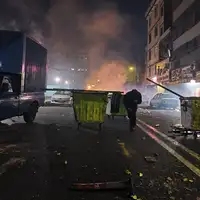
Fourteen young people were detained last week after armed plainclothes officers raided a villa outside Tehran where they had gathered to access Starlink internet and update their social media accounts, according to an activist.
The detainees, aged 23 to 38, were blindfolded, handcuffed and shackled, Golshan Fathi said, adding that officers broke cameras and seized equipment including hard drives and screens, and did not present a clear warrant before taking the group to an unknown location.
In short phone calls placed several days later from a private number, detainees were verbally told they were accused of “spying for Israel,” “cooperating with hostile media,” “propaganda against the system,” “attempting to overthrow” the government and “smuggling goods,” an apparent reference to Starlink equipment, she said.
Families have searched for their loved ones in Fashafouyeh, Qarchak and Evin prisons but they have not been told where the detainees are held.

US Ambassador to Israel Mike Huckabee said Arab states astride the Persian Gulf would welcome the fall of Iran’s current leadership, arguing that regional governments privately support efforts to replace the ruling system.
Speaking to News Nation, Huckabee said Iran posed a threat not only to the United States and Israel but also to countries across the region.
“I think everybody in the region can’t stand Iran,” Huckabee said. “It’s a threat to not just the US and Israel. Iran is a threat to anybody who would like to see normalization and peace.”
He said governments in the region might avoid saying so publicly because of security concerns, but privately supported change in Tehran.
“They may not say it publicly because they don’t want to become a target, but privately, every single Gulf state would love to see the Iranian people succeed in getting rid of this regime,” Huckabee said.
“Nobody is suggesting that the US put boots on the ground in Iran,” he said. “It’s really a matter of whether we continue the encouragement to the people of Iran.”
He said the possibility of targeted strikes could not be ruled out, but said any such decision would rest with Trump.
“That’s a decision that only the president can make."
Lufthansa will not operate flights to and from Tehran through March 29, a spokeswoman told AFP on Monday, extending a suspension as the German airline group continues to adjust operations in the region.
The spokeswoman said Austrian Airlines, which is part of the Lufthansa Group, would not run flights to Tehran until at least February 16.
Lufthansa said last week it would bypass Iranian and Iraqi airspace, but the spokeswoman said a corridor of Iraqi airspace would be used beginning Tuesday, January 20, while Iranian airspace would continue to be avoided.
Iran’s nationwide internet blackout has passed 280 hours, with traffic data now pointing to an emerging strategy of “whitelisting,” in which authorities appear to be allowing limited access to select platforms while keeping most services blocked, internet monitoring group NetBlocks said on Tuesday.
“Meanwhile, traffic on select platforms points to an emergent strategy of whitelisting,” NetBlocks wrote on X.
The blackout has left much of the country’s population of more than 90 million cut off from global communications, with families unable to check in on loved ones and news outlets struggling to report from inside Iran.
Selective access has precedent in Iran. In recent months, officials and security-linked bodies have been widely reported to use so-called “white SIM cards” – special mobile lines exempt from state filtering that allow unrestricted access to platforms blocked for most users, including Instagram, Telegram and WhatsApp.
Last year, the rollout of a location feature on X fueled public anger after it appeared to show some officials and pro-government figures connecting from inside Iran without filters, prompting accusations of unequal access.

Iranian commandos carried out a surprise nighttime massacre on protesters in the town of Rasht in northern Iran over two nights this month, an eyewitness told Iran International, killing hundreds and ultimately consigning its historic bazaar to ashes.
Now back in Germany, Bardia, an Iranian student based in Berlin who was present in Rasht during the crackdown, described the scenes on January 8 and 9 in an interview with Iran International as “a war zone."
Up until what has now been dubbed “bloody Thursday," he explained, confrontations between protesters and security forces had been subdued while demonstrations were scattered and limited.
But around 6 PM, he and his friends suddenly saw crowds pouring in from side streets and alleys, merging into a vast mass of people near the provincial governor’s office and close to where his relatives live.
He said the massive crowd began chanting slogans in support of Prince Reza Pahlavi, who had called for nationwide protests on January 8 and 9.
“There were people from all age groups. I saw individuals joining with walkers and even wheelchairs. Many had come as families, from grandparents to grandchildren. The number of people who had turned out was simply unbelievable.”
A city 'in the hands of the people'
According to Bardia, initially, the demonstrations were relatively calm.
Young protesters—mostly dressed in black and wearing masks—were armed with nothing more than stones. In some areas, they tore down street barriers and set trash bins on fire.
“At this stage, the entire city was in the hands of the people,” Bardia said.
Protesters also attacked places where detainees were being taken by the state's domestic enforcement militia the Basij, including some mosques, freeing those held there and, in some cases, setting the buildings ablaze.
Other witnesses have also said that protesters targeted locations linked to the Islamic Revolutionary Guard Corps (IRGC), such as an IRGC intelligence domestic spying center, or places used to detain arrested protesters.
Some activists pointed to the presence of snipers on rooftops as another reason for attacking the sites.
Bardia said that attacks on government buildings and mosques were aimed at freeing detainees, not simply targeting state facilities.
Security forces appeared visibly frightened, he said, and retreated in the face of the crowd. Police fired pellet guns and rubber bullets, but despite the presence of Basij members—some as young as 15 or 16 and armed with Kalashnikov rifles—there was still no use of live ammunition, suggesting they had not yet received orders to shoot.
Rasht bazaar consumed by flames
Not too far from this scene, around 300 shops in Rasht’s historic bazaar were destroyed by fire on the same evening. Some activists accused the authorities of deliberately burning the market to punish shopkeepers who had gone on strike.
Bardia said the fire began at a mosque that protesters had set ablaze to free detained friends. However, security forces blocked access routes and prevented fire engines from reaching the area, allowing the blaze to spread.
As a result, the fire engulfed large sections of the ancient commercial hub, destroying the livelihoods of merchants—many of whom had been on strike.
“They blocked the street leading to the burning bazaar to arrest protesters,” he said. “People had no way forward or back—the fire was behind them, and security forces were charging from the front.”
The army enters: live fire begins
Non-IRGC military units rarely intervene directly in suppressing protests. But on Thursday night, acting on orders from the provincial security council, the army entered the crackdown in Rasht.
According to Bardia, live fire began when protesters closed in on the governor’s office and the state broadcaster.
At this point, marine commandos from the navy housed at a nearby base entered the scene and opened fire on people in the streets around the governor’s office—even though protesters had not yet entered the building.
“They shot only at heads and hearts,” he said. “Those killed were of all ages, but most were young people under 30.”
“We witnessed the massacre”
As the killings began around midnight, Bardia and his friends took shelter in a house overlooking a street leading to the governor’s office and did not leave until morning. “We witnessed the massacre with our own eyes,” he said.
They turned off the lights and watched in the darkness as bodies were collected before dawn. “We couldn’t go outside because they were shooting at anything that moved.”
“Street cleaners were brought in the early hours to erase all traces. They swept the streets, collected shell casings, and washed the blood away with fire trucks," he added.
Killing to terrorize
Despite the killings, protests continued on Friday although, according to Bardia, but unlike on Thursday, security forces opened fire with live ammunition from the outset, shooting at anyone who was on the streets by early evening and killing many more.
Bardia said he heard from a municipal employee that most victims were shot in the head or heart, indicating an intent to kill and terrorize.
“People working in the civil registry and hospitals told me the number of those killed in Rasht was around 600. All hospitals were full of the wounded.”
Other witnesses say the death toll may be as high as 3,000 over the two days of unrest.
The events echoed earlier mass killings, such as during November 2019 unrest against fuel price hikes, when Revolutionary Guards forces killed at least 100 protesters in the marshes around the southwestern city of Mahshahr.
In Rasht, residents say, a policy slogan encapsulated in a slogan forcefully but rarely mooted by some hardline Iranian officials of al-nasr bil-ru‘b, or victory through terror, was put into full force.
Iran’s Intelligence Ministry and the Revolutionary Guards have warned journalists inside the country against reporting on the national uprising, threatening arrests and heavy sentences, journalists inside Iran told Iran International.
Several reporters said they had been directly warned that any coverage of the uprising would lead to detention and harsh punishment.
Some journalists were told: “Do not do something you will regret; your family will mourn,” Iran International has learned.
The warnings come as authorities have moved to tighten control over information, including through a nationwide internet blackout and increased pressure on domestic media.