A large crowd marching down a main road in Iran's second largest city, Mashhad, January 8, 2026
After returning from Iran to Canada, Mona Bolouri said the unity and size of protests she witnessed firsthand convinced her that the Islamic Republic was doomed after she left the country a day before a deadly crackdown.
“I know it’s over,” Bolouri said, referring to the Islamic Republic. “I’m not afraid to say this openly, because I believe the regime will be a different regime.”
Bolouri, a 40-year-old Iranian Canadian, traveled to Iran in late December to visit family and was in Mashhad as protests erupted on January 8.
What she witnessed, she said, was unlike anything she had seen during earlier protest waves.
“It was the most magnificent thing I’ve ever seen,” Bolouri said. “The crowd was so huge that I couldn’t even get to the front line.”
She described Vekilabad Boulevard, one of Mashhad’s largest and most prominent central avenues, filled shoulder to shoulder with demonstrators chanting slogans against Supreme Leader Ali Khamenei and calling for the return of Reza Pahlavi, the son of Iran’s deposed Shah.
The scale of the turnout initially made her feel safe, she said, despite the city’s reputation as a conservative stronghold and its symbolic closeness to Khamenei’s power base.
That sense of safety quickly evaporated as security forces moved in. Live gunfire and tear gas intensified as protesters pushed forward, with the gas becoming so thick it left people disoriented and unable to see.
She recalled being helped away by strangers after losing her vision and struggling to breathe amid the chaos.
What struck her most, she said, was the bravery of younger protesters who repeatedly surged toward security forces even as shots rang out.
“I am a brave person, but they are on a next-level brave,” she said. “Aren’t they afraid of their lives?”
As night fell, Iran’s internet was cut, severing communication and access to the outside world. Bolouri said she realized her messages were no longer sending and feared her parents would be unable to reach her.
“It’s a different city now,” she recalled telling her family once she was back home.
She described streets stripped of traffic signs and surveillance cameras, pulled down by protesters to block motorcycle units and avoid identification. Fires burned at sites linked to the security apparatus, including banks associated with the Islamic Revolutionary Guard Corps.
The damage, she said, was deliberate and defensive rather than random.
One moment, she said, stayed with her. An ambulance drove toward the crowd—the only vehicle moving against the flow. At first, she thought it was responding to a medical emergency.
“I was like, why is it coming this way?” Bolouri said. “Why wouldn’t it go around? The other streets were still open for cars.”
She soon realized that ambulances were being used to transport security forces. “That’s when it made sense,” she said.
Although she did not personally witness fatalities, Bolouri said she saw multiple injured protesters being carried away as gunfire flashed through clouds of tear gas.
She later learned from relatives that the violence intensified the following night.
Her uncle, who remained in Mashhad, told her that from early evening until nearly midnight, the sound of continuous gunfire echoed through residential neighborhoods.
“They were crying at home,” she said, describing how older family members panicked simply from the noise, aware that something terrible was unfolding outside.
Bolouri’s flight out of Iran was canceled, but she managed to leave via a domestic route to Istanbul. Her family believed she might not survive if she stayed another night.
Now back in Canada, she says the experience has left her unexpectedly hopeful. Comparing the protests she witnessed in Iran with rallies abroad, Bolouri said what stood out inside the country was unity and certainty.
“In Iran, there was no hesitation,” she said. “Everybody was on the same page.”
Despite the violence and mass killings, she believes the uprising marked a turning point.
The scale of participation, the open calls for regime change, and the willingness of protesters to face live fire convinced her that this movement had gone beyond anything she had previously witnessed.
Bolouri said she would normally avoid speaking publicly about her experience, out of concern for being able to return to Iran, but decided to speak out because she firmly believes the Islamic Republic is finished.
Iranians calling Iran International’s phone-in said security forces killed and removed bodies; some reported families pressured into quiet burials and Arabic-speaking forces on the streets, as the crackdown pushed protests to window chants and fueled calls for foreign backing.
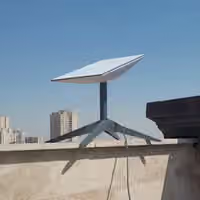
Monday night’s call-in show The Program unfolded through broken connections, Starlink links, and brief windows of limited access.
From Tehran, Mashhad, Shiraz, and smaller cities, callers described nights shaped by gunfire, bodies taken away, families disappearing after hospital notifications, and what several people called an urgent need for outside backing as the crackdown intensifies.
Many callers placed their accounts around Thursday and Friday, January 8 and 9, when a public call for protests gave way in the following days to chants from windows and rooftops as streets became harder to enter.
‘We need help’
Several callers said protests have reached a point where they do not believe people inside Iran can sustain the pressure alone, especially with widespread violence and a continuing near-blackout online.
Ali, calling from Tehran, put it bluntly. “We are 90 million prisoners in Iran, and we need support,” he said.
He pointed to foreign involvement in Iran’s past and argued that outside powers should play a direct role again. “Even the 1979 revolution did not happen only by the people, and the United States and European countries helped shape it,” Ali said.
From Shiraz, Shiva voiced a similar fear that if the moment passes without outside action, the aftermath will be even harsher.
“If no foreign force helps us and everything becomes normal again, what comes next will be arrests, heavy sentences, and executions,” she said.
She described a level of exhaustion that has turned into desperation. “People are empty-handed, and we cannot do more than this alone.”
Houman, calling from Mashhad, addressed US President Donald Trump directly and tied the question of foreign help to what he said he had witnessed on the streets.
“We did not come out for Trump, we came out for freedom and for our children’s future,” he said.
He then framed outside action as decisive for whether this ends in even more bloodshed. “Trump should do something,” Houman said.
'Proxy forces brought in'
Another theme running through the calls was descriptions of Arabic-speaking forces operating alongside Iranian security units.
Masoud, calling from Tehran, said people around him were hearing and seeing signs that some forces deployed were not local. “I do not understand who these people are who speak Arabic,” he said.
He also described what he said was an effort to document them while avoiding exposure. “My friends recorded them, and some of it is on CCTV cameras, but they cannot publish it for security reasons,” Masoud said.
The suggestion, repeated in different forms, was that Iran is drawing on proxy networks and allied forces from the region.
US officials have also said they are concerned by reports that Hezbollah members and Iraqi militias are being used against protesters, after Iran International and CNN cited sources describing Iraqi Shi’ite fighters crossing into Iran under the cover of religious pilgrimages.
'A city of blood'
Callers repeatedly described shootings they said were indiscriminate, close-range, or intended to kill rather than disperse.
Masoud described what he said he saw the morning after a protest night in Tehran. “I saw intestines on the street, and I saw what they did to our young people,” he said.
He described bodies being dragged through blood and said streets had been washed while traces remained.
Elen, calling from Turkey after spending days in Shahinshahr near Isfahan, said she saw an injured person reach a side street and then be shot again.
“I saw a wounded person reach the alley, and the officers came over, shot him, and then put his body in the trunk and took him away,” she said.
Houman described what he called sniper fire and shooting from elevated positions in Mashhad, and said people were hit as they tried to flee. “They were shooting people from the rooftops, and many were shot from behind while they were running.”
He described Friday as a night when he said arrests were not even the point. “On Friday, they were not even arresting people, and they were just shooting,” Houman said.
Danial, who called from Iran without naming his city, challenged official narratives about who is responsible for the dead, and said the violence was the story.
“They say people were killed by terrorists, but I ask why nothing happened during the rallies they organized for their own supporters,” he said.
He then offered a line that became the moral center of his call.
“The terrorist was the Islamic Republic that stood in front of the people and opened fire,” Danial said.
Bodies taken, buried quietly, or never returned
A large share of the testimony focused not only on killings, but on what happens afterward.
Masoud described what he said was the forced removal of a body and a secret burial.
“On Thursday night, they snatched the body and buried her stealthily in a nearby village,” he said.
He also described what he said is becoming a pattern: families burying people at home to avoid pressure.
Masoud said he was seeing many cases of people being buried at home to avoid official procedures and pressure. “We have a lot of cases like this; people being buried at home.”
Elen described families burying without paperwork or formal steps, and said she heard of demands for money in exchange for returning bodies.
“They buried the young man quietly, without papers, and the family said, ‘I know he is dead and that is enough,’” she said.
Nima, calling from Texas, said he had received information from a hospital worker in Tehran who managed to connect briefly. He read out a list of names and ages, including a nine-year-old.
He said the hospital account suggested an unusually high concentration of lethal shots. “They said not one person had been hit in the legs, and the injuries were to the head, neck, and chest.”
He also said the hospital worker described security pressure inside the facility, including what he said were detentions of families.
“Every family that was told their loved one had died disappeared within 10 to 15 minutes,” Nima said.
He described what he said were vans arriving to remove bodies, and claimed some people taken away were still alive. “I saw people who were still breathing, and they took them away together with the dead."
A protest evolving under shutdown
With internet access still largely down inside Iran, callers said the blackout is not only an information barrier but a tactical weapon, forcing protests to evolve.
Ali in Tehran described a shift away from mass street gatherings toward nighttime chants from homes following the call by exiled Prince Reza Pahlavi. “People are still shouting the slogans from their windows and rooftops,” he said.
He said the sense of isolation is growing. “In this situation when the internet is not there, we cannot even connect with our loved ones outside Iran,” Ali said.
Kian, calling from Ahvaz, argued that the country has entered a different phase, with older methods of control losing impact even as violence escalates.
“Iran has entered a new stage where the old tools of repression and official storytelling do not work,” he said.
He described the shutdown and the use of force as signs of fear by the authorities, not strength.
“Cutting the internet and bringing forces into civilian spaces and widespread killing are not signs of power, and they are signs of fear,” Kian said.
Callers repeatedly returned to two immediate questions: whether outside governments will take steps beyond statements, and whether the escalating violence and the handling of bodies will push even more people into open defiance despite the fear.
“The history is written with the voice of the people,” Kian said.
Iranian commandos carried out a surprise nighttime massacre on protesters in the town of Rasht in northern Iran over two nights this month, an eyewitness told Iran International, killing hundreds and ultimately consigning its historic bazaar to ashes.
Now back in Germany, Bardia, an Iranian student based in Berlin who was present in Rasht during the crackdown, described the scenes on January 8 and 9 in an interview with Iran International as “a war zone."
Up until what has now been dubbed “bloody Thursday," he explained, confrontations between protesters and security forces had been subdued while demonstrations were scattered and limited.
But around 6 PM, he and his friends suddenly saw crowds pouring in from side streets and alleys, merging into a vast mass of people near the provincial governor’s office and close to where his relatives live.
He said the massive crowd began chanting slogans in support of Prince Reza Pahlavi, who had called for nationwide protests on January 8 and 9.
“There were people from all age groups. I saw individuals joining with walkers and even wheelchairs. Many had come as families, from grandparents to grandchildren. The number of people who had turned out was simply unbelievable.”
A city 'in the hands of the people'
According to Bardia, initially, the demonstrations were relatively calm.
Young protesters—mostly dressed in black and wearing masks—were armed with nothing more than stones. In some areas, they tore down street barriers and set trash bins on fire.
“At this stage, the entire city was in the hands of the people,” Bardia said.
Protesters also attacked places where detainees were being taken by the state's domestic enforcement militia the Basij, including some mosques, freeing those held there and, in some cases, setting the buildings ablaze.
Other witnesses have also said that protesters targeted locations linked to the Islamic Revolutionary Guard Corps (IRGC), such as an IRGC intelligence domestic spying center, or places used to detain arrested protesters.
Some activists pointed to the presence of snipers on rooftops as another reason for attacking the sites.
Bardia said that attacks on government buildings and mosques were aimed at freeing detainees, not simply targeting state facilities.
Security forces appeared visibly frightened, he said, and retreated in the face of the crowd. Police fired pellet guns and rubber bullets, but despite the presence of Basij members—some as young as 15 or 16 and armed with Kalashnikov rifles—there was still no use of live ammunition, suggesting they had not yet received orders to shoot.
Rasht bazaar consumed by flames
Not too far from this scene, around 300 shops in Rasht’s historic bazaar were destroyed by fire on the same evening. Some activists accused the authorities of deliberately burning the market to punish shopkeepers who had gone on strike.
Bardia said the fire began at a mosque that protesters had set ablaze to free detained friends. However, security forces blocked access routes and prevented fire engines from reaching the area, allowing the blaze to spread.
As a result, the fire engulfed large sections of the ancient commercial hub, destroying the livelihoods of merchants—many of whom had been on strike.
“They blocked the street leading to the burning bazaar to arrest protesters,” he said. “People had no way forward or back—the fire was behind them, and security forces were charging from the front.”
The army enters: live fire begins
Non-IRGC military units rarely intervene directly in suppressing protests. But on Thursday night, acting on orders from the provincial security council, the army entered the crackdown in Rasht.
According to Bardia, live fire began when protesters closed in on the governor’s office and the state broadcaster.
At this point, marine commandos from the navy housed at a nearby base entered the scene and opened fire on people in the streets around the governor’s office—even though protesters had not yet entered the building.
“They shot only at heads and hearts,” he said. “Those killed were of all ages, but most were young people under 30.”
“We witnessed the massacre”
As the killings began around midnight, Bardia and his friends took shelter in a house overlooking a street leading to the governor’s office and did not leave until morning. “We witnessed the massacre with our own eyes,” he said.
They turned off the lights and watched in the darkness as bodies were collected before dawn. “We couldn’t go outside because they were shooting at anything that moved.”
“Street cleaners were brought in the early hours to erase all traces. They swept the streets, collected shell casings, and washed the blood away with fire trucks," he added.
Killing to terrorize
Despite the killings, protests continued on Friday although, according to Bardia, but unlike on Thursday, security forces opened fire with live ammunition from the outset, shooting at anyone who was on the streets by early evening and killing many more.
Bardia said he heard from a municipal employee that most victims were shot in the head or heart, indicating an intent to kill and terrorize.
“People working in the civil registry and hospitals told me the number of those killed in Rasht was around 600. All hospitals were full of the wounded.”
Other witnesses say the death toll may be as high as 3,000 over the two days of unrest.
The events echoed earlier mass killings, such as during November 2019 unrest against fuel price hikes, when Revolutionary Guards forces killed at least 100 protesters in the marshes around the southwestern city of Mahshahr.
In Rasht, residents say, a policy slogan encapsulated in a slogan forcefully but rarely mooted by some hardline Iranian officials of al-nasr bil-ru‘b, or victory through terror, was put into full force.
Iran’s Intelligence Ministry and the Revolutionary Guards have warned journalists inside the country against reporting on the national uprising, threatening arrests and heavy sentences, journalists inside Iran told Iran International.
Several reporters said they had been directly warned that any coverage of the uprising would lead to detention and harsh punishment.
Some journalists were told: “Do not do something you will regret; your family will mourn,” Iran International has learned.
The warnings come as authorities have moved to tighten control over information, including through a nationwide internet blackout and increased pressure on domestic media.
What has emerged since Iran imposed a nationwide internet blackout on January 8 points to bloodshed on a scale that is horrifying beyond comprehension.
Through scattered Starlink messages, rare phone calls, and videos smuggled out at great personal risk, fragments of evidence have begun to form a picture of mass killings across major cities, smaller towns, and even villages.
In a brief message sent via Starlink from Tehran to Iran International, one resident said the situation in the capital and other cities was so dire that “every person is reporting the death of a family member, relative, neighbor, or friend,” stressing that “this is not an exaggeration.”
“The air was filled with the smell of blood in Tajrish and Narmak,” an Iranian user outside the country quoted a contact as saying in a post on X, referring to neighborhoods in north and east Tehran.
“They were washing the blood from the streets with the municipal irrigation tankers they use to water roadside plants.”
A Tehran resident told Iran International that he saw heavy deployments of IRGC forces early on Thursday morning—just before the blackout—with security units transporting heavy machine guns and concealing them in parking garages across different neighborhoods.
An image later circulated showing a mounted military-grade machine gun on a security forces vehicle in Tehran’s Sadeghieh district, reportedly taken days earlier.
Iran International has reported that as many as 12,000 people may have been killed over just two days, January 8 and 9. CBS News, citing two sources—one of them inside Iran—suggested the figure could be as high as 20,000.
Thousands more have reportedly been detained nationwide. Iranian authorities have labeled anyone present on the streets after January 8 a mohareb—“one who wages war against God”—a charge that carries the death penalty.
The whereabouts of most detainees remain unknown.
The government, meanwhile, claims protesters killed hundreds of security personnel and government supporters. State media has broadcast images of a mass funeral for 100 alleged victims.
Unverified reports suggest that some families have been pressured to sign documents identifying their killed relatives as members of the Basij militia—an apparent effort to inflate official casualty figures.
BBC Persian journalist Farzad Seifkaran reported receiving a message from Tehran stating that one family was told it must either declare its relative an “active Basij member” or sign a document demanding retribution against three unnamed individuals before being allowed to retrieve the body.
Similar pressure was reported during the 2009 protests. More recently, authorities attempted to portray Amir-Hesam Khodayari, a 22-year-old killed in Kouhdasht, Lorestan province, as a Basij member—an effort publicly rejected by his father during the burial.
In several cases, families have also said they were asked to pay for the bullets used to kill their relatives..
On Sunday, two short videos surfaced showing families inside a hangar belonging to Tehran’s forensic medicine organization in the Kahrizak area. Dozens of bodies wrapped in black bags were visible, some on gurneys and others laid directly on the floor.
In one clip, a woman’s voice can be heard crying out to her child: “Get up my love, get up for God’s sake,” as families wander among the bodies searching in shock.
The footage appeared to capture only a fraction of what was taking place.
Hours later, Vahid, an Iranian user based in the United States who has documented Iranian protests since 2009, released a compilation of 12 videos. Some showed the interior of the same facility, where a screen displayed names and photos of the dead while a loudspeaker called out names, instructing families to collect bodies.
According to Vahid, the footage was brought out of Iran by someone who had recently escaped the country. “They are bringing in the bodies in pick-up trucks and telling people to search them themselves,” the individual told him.
Later footage showed bodies being unloaded from trailers. Outside the building, hundreds of people moved among rows of corpses laid directly on the ground, wailing and screaming.
A source who sent images from Kahrizak told Vahid he had traveled nearly 1,000 kilometers to reach a border area where he could access the internet.
Amid the mourning, signs of defiance emerged. Rather than chanting traditional Islamic phrases, some mourners clapped and ululated, as if escorting a bride or groom.
Others raised photographs of the dead and shouted slogans including: “Death to Khamenei,” “This is the year of bloodshed, Khamenei will be toppled,” and “I will kill the one who killed my brother.”
The Islamic Republic's resort to the deadliest crackdown on protestors in its history signals endgame for the theocracy, retired US Army General and ex-CIA director David Petraeus told Iran International Insight, the channel's town hall held in Washington DC.
“This regime is dying. Essentially it’s fighting, it’s killing again, but it is also dying," said Petraeus, a retired four-star Army general who now runs the Middle East business of US private equity firm KKR.
“I think it signals enormous questions about the regime's ability to sustain the situation,” he said, arguing Tehran is under more pressure now than at almost any point since the Iran-Iraq war.
Speaking to host Farzin Nadimi, a senior fellow at the Washington Institute, Petraeus painted a stark picture of the clerical establishment facing simultaneous existential challenges at home and abroad.
“Iran is essentially defenseless at this point,” Petraeus said, referring to the destruction of air and ballistic missile defense systems early in a June conflict with Israel and the United States.
The veteran commander, who led the so-called "surge" of US forces aimed at defeating an insurgency at the height of the US war in Iraq, said the scale of violence used against demonstrators reflects fear rather than control by Iran's leaders.
While he acknowledged the Islamic Republic may be able to suppress unrest in the short term, he warned that flooding cities and towns with security forces may not buy authorities a lasting reprieve from popular anger.
“This regime has lost legitimacy. The problem is it hasn’t lost the capability to kill.”
His assessment comes as Iran grapples with sustained nationwide unrest that began on December 28 among electronics and cellphone merchants at Tehran’s bazaar and quickly escalated into a nationwide uprising against the Islamic Republic.
At least 12,000 people were killed in just two days, according to medics and Iranian officials speaking to Iran International.
With the Iranian currency cratering, inflation climbing and purchasing power collapsing, Petraeus said Iran no longer has the financial tools it once used to calm the streets.
“At this time, there's not much Iran can do about it. They have very little capacity."
Asked about Trump's mooted pledge to intervene militarily to defend protestors, Petraeus stopped short of assessing the efficacy of any US attack but said the move would be well received and not bolster the leadership.
“I think we could take action against the regime and it would be applauded … not be a rallying cry for them.”