Activists rallied outside the Iranian embassy in Seoul on Friday, holding placards in support of anti-government protests in Iran and calling for an end to the killing of demonstrators.


Iran has entered what activists describe as the final stage of a plan to sharply restrict public access to the internet and place core communications under tighter security control, digital rights group Filterban said on Thursday.
The group said the project aimed to turn online access into what it called a government-controlled privilege, limited to people with high-level security clearance.
“This is the transition to a communications black hole,” Filterban said in its report, describing a system in which most users would lose access to open online services.
The group said authorities were working to upgrade deep packet inspection systems to detect and block Starlink and VPN traffic, while pushing private firms into tightly monitored internal messaging platforms.
Filterban said foreign technical partners had quietly exited parts of Iran’s telecom sector, signaling what it called the end of meaningful international cooperation in critical infrastructure.
“The era of public internet access in Iran is coming to an end,” the group said.
It warned that the measures were already hitting the economy, citing a collapse in e-commerce activity and supply chains after the latest shutdown.
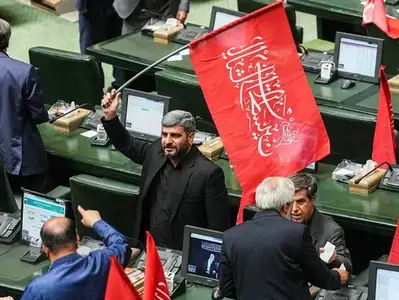
Omid Nouripour, a vice president of the German parliament, called on Berlin to take what he described as immediate and tangible action against Iran’s leadership, citing the brutal crackdown on protests.
“Germany must act,” Nouripour wrote on X. “The brutal actions of the mullah regime require an immediate, noticeable response and must not go unpunished.”
He described Iran’s Revolutionary Guards as what he called the regime’s main tool of repression and urged the German government to ban the group as a terrorist organization.
Nouripour also called for a ban on its activities in Germany, the freezing of private assets of Iranian officials and Guards-linked figures, travel bans, and the severing of diplomatic ties with Tehran.
Mourners chanted “death to Khamenei” during the funeral of Maryam and Majid Salehi Siavashani, a young couple killed in recent protests.
Videos sent to Iran International showed people shouting the slogan during the burial ceremony at Tehran’s Behesht Zahra cemetery on Jan. 10.
Iran’s nationwide internet blackout has now lasted more than 180 hours, surpassing the core length of the 2019 shutdown, internet monitoring group NetBlocks said on Friday.
The group said there had been no partial or regional restoration of connectivity so far.
“In 2019, it was only after connectivity was restored that the scale of the brutal crackdown became known,” NetBlocks said in a post on X.
Thousands of Iraqi militiamen have crossed into Iran to help Tehran suppress ongoing protests, according to a European military source and an Iraqi security source cited by CNN on Thursday.
The Iraqi security source said nearly 5,000 fighters from powerful Iraqi militias had entered Iran through two border crossings in southern Iraq, while the European source said hundreds of Shiite fighters crossed under the cover of religious pilgrimages.
The fighters were reported to be operating in several sensitive areas, including the western city of Hamedan, according to a European military assessment seen by CNN.
Iran International reported earlier this month that Iranian-backed Iraqi militias had begun recruiting and deploying fighters to assist Iranian forces in cracking down on protests.
That report said hundreds of Shiite militiamen from groups including Kataib Hezbollah, Harakat al-Nujaba, Kataib Sayyid al-Shuhada and the Badr Organization had been sent into Iran through multiple border crossings.
The fighters were transferred under the guise of pilgrimage trips and gathered at a base in Ahvaz before being dispatched to various regions, Iran International reported.