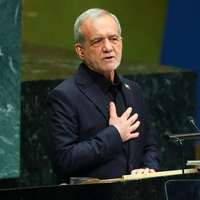
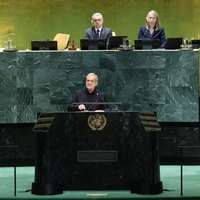
"We support the position on Iran: A regime that has lasted so many years and killed so many people does not deserve to exist. Changes are needed," Ukrainian President Volodymyr Zelenskyy said in a post on X.
President Donald Trump on Tuesday said the United States could take “very strong action” if Iran executes protesters, adding there was “a lot of help on the way” for Iranians.
“There’s a lot of help on the way and in different forms, including economic help from our standpoint,” Trump said in an interview with CBS News.
Trump said the United States had already eliminated Iran’s nuclear capacity and accused Iranian authorities of killing protesters in large numbers, though he said casualty figures remained unclear.
“Nobody’s been able to give us accurate numbers about how many people they’ve killed,” he said. “It looks like it could be a pretty substantial number.”
Pressed on the end goal, he added: “The end game is to win. I like winning.”
US Senator Lindsey Graham said he expects US help for Iranian protesters “soon,” adding the ongoing unrest as a push to replace the country’s current leadership.
“They don’t want to live in a country where a 16‑year‑old girl can be killed for not wearing the headscarf,” Graham told Iran International in an interview on Tuesday. “Help is on the way.”
“People are being killed, I think, by the thousands. Donald J. Trump is not Barack Obama. When he says help is on the way, he means it to everyone out in the streets risking your life. Your children and their children’s children will benefit from your bravery,” the Republican senator from South Carolina said.

It is the Islamic Republic as envisioned by Supreme Leader Ali Khamenei: no internet, no social media, hundreds of national and local newspapers shuttered, and mobile phones rendered largely useless.
The darkness is deliberate. It is enforced to prevent protesters from communicating and organizing—and to conceal the crimes committed to crush them when they do.
Iran International on Tuesday put the death toll from the crackdown at around 12,000, vowing in a statement that the mass killing “will not be buried in silence.”
With nearly all communication channels severed, Khamenei remains one of the few figures whose website continues to function. State television—a network of more than 30 channels—is still broadcasting the image he wants the world to see.
The same is true of a handful of state-aligned news agencies, including Fars, Tasnim, and Mehr, all controlled by the Revolutionary Guards or the Organization for Islamic Propagation.
Although Iran’s national intranet has partially resumed after several days of shutdown, even state television has struggled to maintain its broadcasts following the severing of international internet links.
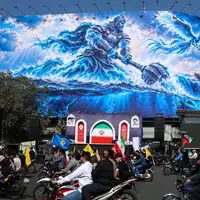
Despite those limitations, state TV aired footage promoting a tightly stage-managed pro-government rally in one of Tehran’s smallest squares, a space that can barely hold 3,000 people.
Internet experts say a small number of X users inside Iran have been selectively allowed to post content supporting government narratives. Limited Starlink access also exists, but analysts warn that the sporadic signal means foreign media remain largely blind to developments across most of the country.
As of Tuesday evening in Tehran, the government had not responded to calls from the United Nations secretary-general and European Union officials urging it to restore communication lines.
Meanwhile, social media posts describe security forces raiding homes and confiscating Starlink terminals, satellite dishes, computers, and mobile phones — part of a broader effort to prevent Iranians from accessing independent reporting or sending information abroad.
With the blackout, censorship, and signal jamming, foreign-based Persian-language media—now the primary source of information for many Iranians—may be forced to revive shortwave radio broadcasting. It would represent a step backward in media technology, but perhaps the only way to move forward in reaching a silenced population.
Shukriya Bradost, an Iran analyst based in Washington, wrote on X on Tuesday that while protesters stand “empty-handed against a regime that answers them with bullets,” no significant defections appear to have occurred within the military.
“Starlink and outside reporting no longer have the impact they once did,” she wrote, because the world already knows what is happening in Iran. If any action is to be taken, she concluded, “the time is now, not later.”

Iran's historic Lion and Sun flag has had a resurgence with latest round of widespread protests after nearly half a century of absence from the country's official identity.
Carried by some demonstrators from the earliest days of the unrest, it served as a visual rejection of the Islamic Republic’s theocratic rule.
But after exiled Prince Reza Pahlavi called on Iranians abroad to replace the Islamic Republic’s flag at embassies and consulates, the Lion and Sun moved to the center of Iran’s political narrative.
Even before that call, an Iranian protester climbed the wall of Iran's embassy in London to replace the official flag with the Lion and Sun. The footage spread rapidly online and was even shared by US President Donald Trump.
The act was repeated the following day, turning the embassy into a symbolic battleground over national identity.
Similar actions followed in Canberra, Stockholm, Oslo, Rome, Munich, Hamburg, and Ljubljana, where Iranians replaced official symbols, installed flags at entrances, or painted the Lion and Sun emblem and protest slogans on diplomatic buildings.
Videos from several cities inside Iran showed protesters carrying or displaying the Lion and Sun during demonstrations–an instant visual marker that a local protest was part of a broader national movement.
For many, the flag is less about monarchism and more about distancing themselves from the Islamic Republic. Its power lies in clarity. In a single image, it communicates rejection of the regime and identification with an alternative vision of Iran.
That efficiency has made it one of the most repeated visual motifs of the current unrest.
And that is perhaps why X also decided to change its Iran flag icon to the Lion and Sun.
The endurance of the tricolor
Iran’s green, white, and red tricolor was formalized during the Constitutional Revolution of the early 20th century, when the idea of a modern Iranian nation-state first took shape. Over time, the colors acquired widely accepted meanings: green for vitality and land, white for peace and clarity, red for courage and sacrifice.
What makes the tricolor distinctive is its continuity. It has survived monarchies, coups, revolutions, and war with minimal dispute. Across political divisions, it remained one of the few symbols broadly viewed as “Iranian” rather than “governmental.”
The Lion and Sun emblem is among Iran’s oldest political symbols. Its formal use dates back to the Safavid era and was standardized under the Qajars and later the Pahlavis as a lion holding a sword beneath a radiant sun.
In Iranian symbolism, the lion represents power, guardianship, and independence; the sun conveys enlightenment, sovereignty, and renewal. Together, they evoke a civilizational memory that predates the Islamic Republic.
This layered meaning explains why many Iranians view the emblem as representing Iran itself rather than a specific political system.
After 1979: a symbolic rupture
After the 1979 revolution, the Islamic Republic removed the Lion and Sun and replaced it with a new emblem built from stylized Islamic inscriptions.
The post-revolutionary clerical government viewed the Lion and Sun symbol as representing the "oppressive Westernising monarchy."
Over four decades of its placement on ministry façades, military uniforms, public buildings, textbooks, and state media, the emblem increasingly became seen as the “flag of the Islamic Republic” – not the “flag of Iran.”
This symbolic rupture explains why the Lion and Sun resurfaces during moments of crisis – from 2009 to 2019 to 2022, and now again. Its return in 2026 is simply its most visible resurgence.
Many leftists, republicans, and nationalists avoided it, wary of monarchist associations. This year’s protests have altered that calculus. The scale of unrest and the need for a non-regime symbol have softened ideological boundaries.
Many Iranians with no attachment to monarchy now carry the Lion and Sun as a marker of resistance, not restoration, as a symbol of “Iran without the Islamic Republic.”
In a moment of complete digital blackout, censorship and repression, symbols have again become the language of the street – durable, replicable, and difficult to silence.
Whether the lion and sun becomes a temporary emblem of a protest movement or a lasting symbol of a future political order remains one of the most consequential questions emerging from this year’s unrest.
Britain will bring forward legislation to impose further sanctions on Iran, the foreign secretary said on Tuesday in an update to parliament.
"Measures will target finance, energy, transport, software, and other significant industries which are advancing Iranian nuclear escalation," Yvette Cooper said.
Cooper added that Britain would work with the European Union and other partners to consider what additional steps may be needed in response to developments.