Officials say the payments are meant to offset the elimination of a subsidized exchange rate previously used to import essential goods, a policy shift that has already pushed prices higher.
Under the plan, the government would issue monthly coupons worth one million tomans—about $7 at the open-market rate—to every Iranian.
Some economists have questioned whether the measure can achieve its stated aim.
In an editorial published on January 5, the daily Setareh Sobh described the policy as an “economic gamble,” warning that similar efforts in the past had failed to stabilize prices or restore public confidence.
The paper noted that Iran’s currency has lost roughly 20,000 percent of its value since the 1979 revolution, when the dollar traded at seven tomans.
“This devaluation,” the daily wrote, “is the result of policies such as hostage-taking, hostility toward the West and Israel, mismanagement and the exclusion of experts from parliament and government.”
Questions of feasibility
Mahmoud Jamsaz, a leading Iranian economist, went further, arguing that the handouts risk aggravating the very pressures they are meant to relieve.
“Under current conditions,” he wrote, “the president knows very well he lacks the executive power even to pay government employees’ salaries.”
The government has acknowledged inflationary risks. Fatemeh Mohajerani, a government spokeswoman, told reporters on Sunday that the policy could raise prices of some essential goods by 20 to 30 percent.
Labor Minister Ahmad Maydari said the payments would be issued as coupons redeemable for basic commodities, rather than cash transfers, in an effort to limit price pressures.
Still, critics question whether the state has the fiscal capacity to sustain such a program, particularly as tax revenues are already under strain.
A broader breaking point
Public reaction has been largely dismissive.
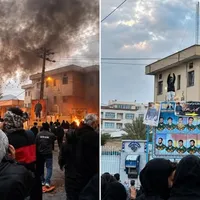
On social media, many pointed to continued protests despite the announcement, stressing that rising prices were only one factor behind demonstrations that have spread across more than 200 cities and towns.
Sociologist Taghi Azad Armaki told the Shargh newspaper that the unrest reflected “accumulated, unresolved social and political challenges,” adding that economic hardship had exposed deep divides within Iranian society.
“These gaps,” he said, “have eroded the government’s social capital and heightened concerns about the country’s future.”
Reformist commentator Abbas Abdi echoed that concern in Etemad, warning that Iranian society had reached a critical threshold. “Society has a breaking point,” he said, “and Iran is rapidly approaching it.”
Even Iran’s tightly controlled press has increasingly described the demonstrations as political in character, reflecting broader dissatisfaction with governance rather than price levels alone.
For now, the government appears to be betting that targeted relief can buy time. Whether it can ease public anger—or instead accelerate inflation while leaving deeper grievances unresolved—remains uncertain.