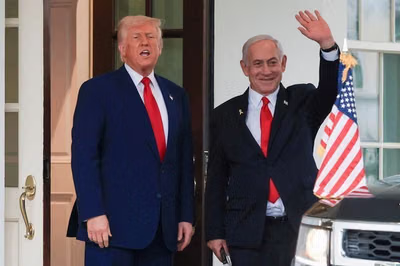
US President Donald Trump attends a press conference, as he makes an announcement about the Navy's "Golden Fleet" at Mar-a-lago in Palm Beach, Florida, US, December 22, 2025.
A new photo of US President Donald Trump posing with a “Make Iran Great Again” hat is ramping up suspense over US intentions as protests there which Trump vowed to protect are being met with deadly force.
The photo, posted on Senator Lindsey Graham’s account on X, shows the two men smiling aboard Air Force One as Trump holds the hat which he has signed.
Trump first deployed the slogan at the height of a 12-day war in June, saying that if Iran’s rulers couldn’t “make Iran great again,” regime change should be on the table.
“God bless and protect the brave people of Iran who are standing up to tyranny,” Graham wrote, referring to nationwide protests now in their ninth day.
Holly Dagres, an Iran expert at the Washington Institute, told Iran International that while the photo leaves room for interpretation it at least shows the Iran issue is on the president's radar.
“While much of the world’s focus is squarely on Venezuela, President Donald Trump’s comments about the ongoing protests and posing with the MIGA hat suggest his mind is also on Iran,” Dagres said.
“It’s hard to interpret what the president’s next steps are, but the clerical establishment won’t be resting easy," she said.
Demonstrators across Iran continue to chant slogans against the country’s supreme leader in protests which entered their ninth day.
Trump has twice warned that the United States will respond forcefully if Iranian authorities kill protesters. According to the Human Rights Activists News Agency (HRANA), at least 19 protesters and one member of the security forces have been killed so far.
Behnam Ben Taleblu, a senior fellow at the Foundation for Defense of Democracies, suggested the message could ripple beyond the White House.
“Hopefully his statement has a contagion effect in the Congress and helps the administration adhere to its own red line about standing by the Iranian people and taking down their apparatus of repression,” he told Iran International.
Others see the moment as part of a broader warning directed at Tehran. Kamran Matin, who teaches International Relations at Sussex University in Britain, described Trump’s messaging as layered and intentional.
“More broadly, the remarkable success of Trump in leading targeted and consequential operations, from the assassination of Qassem Soleimani to the bombing of Iran’s nuclear sites to the seizure of Nicolas Maduro has likely increased Trump’s appetite for using limited military force to achieve political ends in Iran now that the regime is in its weakest point,” he told Iran International.
The image has fueled anticipation online about whether Trump might pursue tougher measures toward Tehran, particularly after the US seizure of Venezuela and previous strikes on Iran’s nuclear facilities.
Greg Brew, an Iran analyst with the Eurasia Group, told Iran International the symbolism of the photo could suggest a willingness to go further.
“Trump has already secured for himself a legacy of doing what no other president would do — bombing Iran’s nuclear program. But recent protests and the success of the Maduro operation suggest he may go further,” Brew said.
An illustration showing an ancient Iranian soldier and a Revolutionary Guard member holding a weapon together, displayed during a November 7 ceremony in Tehran where a statue of pre-Islamic Persian King Shapur I was unveiled.
Tehran’s unveiling of a towering statue depicting the Roman Emperor Valerian kneeling before pre-Islamic Persian King Shapur I has renewed criticism of the Islamic Republic’s appeal to nationalist sentiment following the June war with Israel.
For over forty years, the theocracy purged ancient Persian history from schoolbooks, replacing it with post-Islamic narratives. But after the 12-day conflict with Israel, officials have turned to the distant pre-Islamic past to rally a divided society.
From murals of ancient kings and soldiers to patriotic songs added to Shi’ite mourning ceremonies performed before Supreme Leader Ali Khamenei, Tehran now embraces imagery once deemed heretical by its own revolutionary ethos.
The statue unveiled in Tehran's Revolution Square
'Kneel before Iran' campaign
Tehran’s Revolution (Enghelab) Square was the scene of an unusual spectacle on Friday as officials unveiled a massive bronze statue depicting Roman Emperor Valerian kneeling in submission before Sassanid King Shapur I, commemorating Iran’s victory at the Battle of Edessa (260 AD).
The event was held under the slogan “Kneel before Iran,” part of what authorities describe as a campaign to project “national unity and historical pride” following the June war with Israel.
Tehran Mayor Alireza Zakani, a staunch ultraconservative, said on X: “Enmity with Great Iran can only end in kneeling before this historic nation.”
Municipal official Davood Goodarzi said the installation would be accompanied by visual displays depicting “other victories of Iranians over foreign aggressors,” including the defeat of British forces by local commander Rais-Ali Delvari, Mirza Kuchak Khan’s resistance against Russian troops, and Surena’s triumph over Rome at the Battle of Carrhae in 53 BCE.
The goal, Goodarzi said, is “strengthening concepts such as national dignity, social unity, and Iranian identity.”
The statue, he said, would remain temporarily at Revolution Square before being moved to a city gateway “where it will stand as the first emblem of Iran before diplomats and foreign visitors.”
Unveiled women were allowed to attend the unveiling ceremony—an uncommon scene at events organized by Tehran’s ultra-hardline municipality.
The turn to the pre-Islamic past
The sharp reversal also recalls remarks once made by Khamenei. In a 2011 speech, he asserted that “all the great military victories of this nation came after Islam,” dismissing pre-Islamic accounts as “things that are not documented.”
In 1987, he had said that prophets triumphed over kings such as Cyrus and that “nothing remains of these monarchs in history but names remembered with derision.”
Nevertheless, pro-government social media accounts have now gone so far as to circulate posters equating Khamenei himself with Shapur, showing him standing with a staff as Benjamin Netanyahu and Donald Trump kneel before him. The caption reads: “You will kneel before Iran.”
Image circulating by hardliners on social media
'Hypocrisy'
Pro-government figures have hailed the move as a patriotic success. Conservative political reporter Hossein Saremi posted: “Today’s grand Iranian gathering showed that people and the state share one essence: Iran itself. Nothing can take our homeland away.”
Others, however, called the spectacle “hypocrisy.” Journalist Gholamhossein Pashaei wrote on X: “Every year you close Pasargadae to stop people from celebrating Cyrus Day, yet you unveil Shapur’s statue in Enghelab Square with drums and fireworks during Fatimiyya (mourning period)!”
Dissident commentator Hamid Asafi called the ceremony “a perfect snapshot of the Islamic Republic’s contradictions.”
On Telegram he wrote: “A week ago they closed Cyrus’s tomb out of fear of the crowds, and now they glorify Shapur in the same breath. The Islamic Republic fears living history but poses for selfies with its corpse.”
He added: “They know people no longer respond to rosaries and sermons. That’s why they’ve brought history back to the stage—in a controlled costume. If they can’t erase the past, they’ll try to own it.”
The irony deepened as UNESCO formally recognized Cyrus’s Charter as one of the earliest human-rights documents.
President Masoud Pezeshkian wrote on X: “Iran, the cradle of dialogue, justice, and coexistence, can still inspire peace today.”
Users swiftly replied, questioning how such pride could coexist with a government that blocks access to Cyrus’s tomb each year to those wishing to visit it on his birthday.