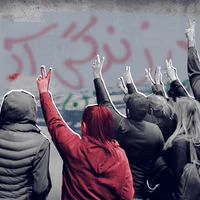
Hours after Trump posted his message on Truth Social, Ali Larijani, Secretary of Iran’s Supreme National Security Council, warned that US interference would be met with instability and the destruction of American interests across the region.
Iran’s Foreign Ministry also condemned Trump’s remarks as “interventionist,” warning that any reaction by the Islamic Republic could push “the entire region deeper into crisis and instability.”
A day later, Supreme Leader Ali Khamenei declared that Tehran would confront what he described as “riots,” while signaling limited openness to dialogue.
Exiled Prince Reza Pahlavi, whose name is being chanted by protesters as a future leader of Iran, welcomed Trump’s message. In a social media post, he thanked the US president and wrote:
“This warning you have issued to the criminal leaders of the Islamic Republic gives my people greater strength and hope—hope that, at last, a President of the United States is standing firmly by their side.”
He added: “I have the plan for stable transition for Iran and the support of my people to get it done. With your leadership of the free world, we can leave a legacy of lasting peace.”
In other messages, he urged Tehran residents to defy government efforts to prevent gatherings in the capital, calling mass street presence a vital complement to protests in smaller cities.
Amir Hossein Etemadi, an advisor to Prince Reza Pahlavi, warned Iranian officials that Trump’s message should be taken seriously, writing: “For every bullet fired at the people, they move faster toward their own death and that of their regime.”
Rejection of foreign intervention
At the same time, many reformists and government critics in Iran have strongly opposed foreign interference while urging authorities to refrain from violence.
Azar Mansouri, head of Iran’s Reformist Front, emphasized the right to protest but rejected outside interference, writing: “We stand with the protesters and do not see repression as a solution. But we explicitly and firmly condemn any foreign intervention; such interference harms non-violent protests.”
Prominent commentator Sadegh Zibakalam wrote that while he views Iran’s foreign, military, and nuclear policies as damaging to national interests, he cannot “stand alongside Trump and Netanyahu,” despite recognizing protest as a fundamental civil right.
Former vice president Mohammad-Ali Abtahi urged the government to prevent bloodshed to deny Washington any pretext.
Such statements have angered some social media users, who accuse reformist figures of aligning with the Islamic Republic against protesters.
A double-edged threat
Several analysts argue that Trump’s warning could have contradictory effects embolden some protesters and deter others.
Reformist journalist Ahmad Zeidabadi wrote that military intervention aimed at regime change is likely the last thing Trump seeks. Instead, he argued, Trump sees the protests as leverage for maximum pressure and potentially to undermine the Islamic Republic’s legitimacy.
According to Zeidabadi, such threats may push some protesters to withdraw while emboldening others.
Another commentator, Sahand Iranmehr, echoed this view, saying the message could foster “false hope” among some protesters while making others fear their movement could become “a battleground for US or Israeli geopolitical agendas.”
Journalist Bahman Amouee argued that Trump and Israeli Prime Minister Benjamin Netanyahu have effectively handed the Iranian government an excuse for harsher repression, aided by opportunists inside and outside the country.
Vali Nasr, a professor at Johns Hopkins University, summed up the concern in a post on X:
“Threatening to bomb Iran is not helping protesters… Iranians didn't revolt when Israel bombed and called on them to rise up; they are unlikely to do the same if US bombed Iran.”