France expressed concern over reports of protesters killed in Iran and urged authorities to provide full transparency, a diplomatic source at the French foreign ministry told Iran International on Sunday.
The diplomatic source said France regretted reports that several protesters had been killed during the unrest and called on the Islamic Republic to clarify the circumstances surrounding the deaths.
The source stressed the importance of freedom of expression and the right to peaceful assembly, urging Iranian authorities to respect all of Iran’s international commitments.
“We are following developments in Iran with the greatest attention,” the source said.
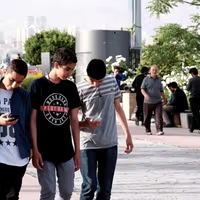
A man was seen carrying a pro-monarchy placard on Tehran’s Valiasr Street on Sunday, according to a video received by Iran International.
The footage showed the man walking along the busy central thoroughfare holding a sign reading “Javid Shah,” a slogan associated with Iran’s former monarchy.
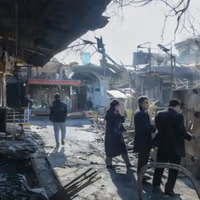
A video circulated on social media showed the moment gunfire began during a protest in Malekshahi, in Ilam province, on Saturday.
On Sunday, videos received by Iran International showed residents attending the funerals of three of those killed.
In the footage, mourners were heard chanting “death to Khamenei” during the burial ceremonies.
Israeli Prime Minister Benjamin Netanyahu said on Sunday that Iranians may be reaching a moment where they take their fate into their own hands, voicing support for protesters amid ongoing unrest in Iran.
Speaking at the start of a weekly cabinet meeting in Jerusalem, Netanyahu said Israel identifies with what he described as the Iranian people’s struggle for freedom and justice.
“The government of Israel, the State of Israel, and my own policies – we identify with the struggle of the Iranian people, with their aspirations for freedom, liberty and justice,” he said, according to a statement from his office.
“It is quite possible that we are at a moment when the Iranian people are taking their fate into their own hands,” he added.
“We reiterated our shared position of zero [uranium] enrichment on the one hand, and the need to remove the 400 kilograms of enriched material from Iran and to subject the sites to strict and genuine oversight."
A social media post by a prominent Silicon Valley investor has ignited an unusual discussion among global entrepreneurs: what it would take to invest in a future Iran after the fall of the Islamic Republic.
Josh Wolfe, co-founder of Lux Capital, a New York-based venture capital firm known for backing deep-tech companies in fields such as artificial intelligence, semiconductors, aerospace, and biotechnology, asked fellow investors on X whether they were prepared to deploy capital in a “free Iran” once political conditions change.
Addressing American investors, family offices, and asset managers, Wolfe urged them to begin thinking about how to support Iranian technologists and entrepreneurs when Iran is free and... opportunity is unleashed.”

A social media post by a prominent Silicon Valley investor has ignited an unusual discussion among global entrepreneurs: what it would take to invest in a future Iran after the fall of the Islamic Republic.
Josh Wolfe, co-founder of Lux Capital, a New York-based venture capital firm known for backing deep-tech companies in fields such as artificial intelligence, semiconductors, aerospace, and biotechnology, asked fellow investors on X whether they were prepared to deploy capital in a “free Iran” once political conditions change.
Addressing American investors, family offices, and asset managers, Wolfe urged them to begin thinking about how to support Iranian technologists and entrepreneurs when Iran is free and... opportunity is unleashed.”
The post quickly drew attention from senior figures across the technology and investment world, reflecting growing interest in frontier markets shaped by geopolitical transformation.
Among the most prominent responses came from Jeff Huber, a veteran Silicon Valley executive who previously led Google Maps and Google Ads before co-founding Triatomic Capital, an investment firm focused on infrastructure, energy transition, and advanced technologies.
Huber replied in Persian, writing simply, “Count on me,” a gesture that was widely shared among Iranian users as a sign of solidarity and intent.
Another notable response came from Michael Granoff, founder and managing partner of Maniv Mobility, an Israeli venture capital firm specializing in transportation and energy technologies.
Granoff pointed to his firm’s experience investing in the United Arab Emirates following the Abraham Accords, which normalized relations between Israel and several Arab states.
“We’d love to be the first to invest in a free Iranian startup,” Granoff wrote, explicitly linking potential investment in Iran to precedents set by rapid capital flows following political normalization elsewhere in the region.
The exchange also attracted responses from Iranian entrepreneurs in the diaspora, including business founders and professionals based in Canada, Australia, and Europe, many of whom offered to contribute expertise in healthcare, technology, and management during a future reconstruction phase.
While some users criticized the discussion as premature amid ongoing repression and protests inside Iran, the reaction from high-profile investors indicated a broader shift: the idea that Iran’s post-Islamic Republic future is no longer viewed solely through a political or security lens, but increasingly as a potential economic and technological opening.