Mohsen Rezaei, a senior official and former commander of Iran’s Islamic Revolutionary Guard Corps, warned on X that any “hostile” action would lead to the destruction of Israel, US bases and regional stability, responding to President Donald Trump’s warning to Tehran over the killing of protesters.
“The United States and Israel want to plunge the Iranian nation into insecurity like Iraq, Afghanistan and Libya. The stance of the mad US president is in line with this agenda. Any hostile action will destroy the Zionist regime, US bases and regional stability. This time, it will be different.”

A phrase used by US President Donald Trump in support of Iran’s protesters carries a specific military meaning, analysts say, going beyond political rhetoric to signal a state of readiness for action.
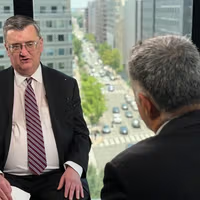
International relations scholar Kamran Matin described Trump’s wording as an explicit threat that could be interpreted as readiness for military action.
Matin told Iran International that in Trump’s latest remarks, the scope of the threat appeared to expand beyond Iran’s missile or regional activities to include the government’s violent response to domestic protests.
At the same time, he cautioned that Trump’s personal style must be taken into account, noting that the president is known for shifting positions and statements that allow for multiple interpretations.
However, Matin said that verbal threats do not always translate into action.
Despite signs of military preparedness by the United States and Israel in the region, Matin emphasized that there remains a significant gap between verbal threats, actual military readiness, and the political decision to launch a direct attack.
Read more about 'locked and loaded'


A phrase used by US President Donald Trump in support of Iran’s protesters carries a specific military meaning, analysts say, going beyond political rhetoric to signal a state of readiness for action.
In a message published on his Truth Social account, Donald Trump warned that if Iran’s rulers kill peaceful protesters, the United States would act to save the Iranian people.
"If Iran shots and violently kills peaceful protesters, which is their custom, the United States of America will come to their rescue. We are locked and loaded and ready to go."
The phrase “locked and loaded” is a classic military expression in English, meaning a weapon is armed, ammunition is in place, and it is ready to fire. Its roots lie in military training, particularly in the US armed forces, and the term has appeared in military literature since at least the eighteenth century.
Formally incorporated into weapons manuals around the time of World War II, the expression has long carried an operational and warning connotation. It is not merely a metaphor or casual figure of speech, but language traditionally used to indicate readiness for immediate action.
The expression has also become widely familiar through popular culture. In Hollywood war films, beginning notably with the 1949 film Sands of Iwo Jima starring John Wayne, “lock and load” is commonly used to signal the imminent start of combat. The phrase has since been embedded in video games such as Call of Duty and Battlefield, where it typically precedes intense fighting scenes.
Trump has used similar language in previous high-tension situations, including during confrontations involving North Korea and Syria.
Senior US officials have also employed the term in moments of crisis, signaling that the military option is not only under consideration but operationally prepared.
'US ready for military action'
International relations scholar Kamran Matin described Trump’s wording as an explicit threat that could be interpreted as readiness for military action.
Matin told Iran International that in Trump’s latest remarks, the scope of the threat appeared to expand beyond Iran’s missile or regional activities to include the government’s violent response to domestic protests.
At the same time, he cautioned that Trump’s personal style must be taken into account, noting that the president is known for shifting positions and statements that allow for multiple interpretations.
However, Matin said that verbal threats do not always translate into action.
Despite signs of military preparedness by the United States and Israel in the region, Matin emphasized that there remains a significant gap between verbal threats, actual military readiness, and the political decision to launch a direct attack.

Any action or interference against Iran would draw a harsh response, Alireza Salimi, a member of Iran’s parliamentary presidium said on Friday, reacting to comments by US President Donald Trump over the crackdown on protests.
“Trump the gambler should know that our response to any action or interference will be regret-inducing,” Salimi said, according to Iranian media.
Iranian activist and journalist Masih Alinejad called on US President Donald Trump to take concrete steps in support of protesters in Iran, thanking him for what she described as strong backing.
Trump’s words mattered, Alinejad said in a post on X, but urged immediate action. She called for expanded access to free internet by asking Elon Musk to increase Starlink coverage so authorities cannot silence protests by cutting connectivity.
Alinejad also urged Washington to expel Iranian diplomats from the United States, arguing that representatives of a government that shoots protesters should not enjoy diplomatic privileges. Alinejad further called for “maximum consequences” against Iranian officials who ordered live fire, saying those responsible must face “real, personal, and irreversible consequences.”


Iran International said it could verify the death of another protester in the town of Lordegan, identifying the victim as 22-year-old Ahmad Jalil, who was killed by direct gunfire from Iranian security forces during demonstrations on Thursday.
Jalil had previously taken part in protests during the 2022 “Woman, Life, Freedom” movement and was working as a ride-hailing driver, struggling financially, a relative told Iran International.
Sources close to the family said agents from the intelligence arm of the Islamic Revolutionary Guards Corps later summoned Jalil’s relatives to the governor’s office, threatening not to release his body unless they gave a coerced interview blaming protesters for his death.
Sources also said authorities have attempted to pressure and financially coerce families of those killed in recent protests, in an effort to suppress accountability and control public narratives around the deaths.