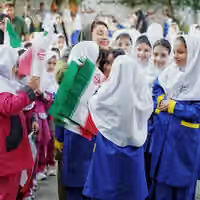
Iranians are openly rejecting the Islamic Republic, Israel’s foreign ministry said on Thursday, commenting on ongoing protests across the country.
In a post on X, the ministry’s Persian-language account said: “The people of Iran are present in the streets with a loud voice and declare that they do not want this government.”
The authorities have poured public funds “into the throats of terrorist groups Hamas, Hezbollah and the Houthis,” while pushing Iran’s economy “to the brink of collapse” in pursuit of nuclear ambitions, the account added.

Iranian President Masoud Pezeshkian said on Thursday that his government would stop distributing a heavily subsidized exchange rate, blaming the system for encouraging rent-seeking and failing to protect households despite billions of dollars in state support.
Speaking at a meeting with political and social activists in Chaharmahal and Bakhtiari province, Pezeshkian said the 28,500-toman dollar – one of several preferential exchange rates used in Iran – would no longer be allocated.
“Anyone who received the 28,500-toman dollar pocketed it, so we will not give it out anymore,” Pezeshkian said, arguing that multiple exchange rates had benefited intermediaries rather than consumers.
Iran has long used subsidized exchange rates to support imports of basic goods and curb inflation, but critics say the system has encouraged corruption and widened inequality, particularly as sanctions and high inflation have strained the economy.
Pezeshkian said the government had spent about $18 billion on subsidies, adding that the funds could be used more effectively to improve living standards.
“We have given $18 billion in subsidies, when with this amount we could plan so that everyone’s table is the same,” he said.
Late last month, Hossein Samsami, a member of parliament’s economic committee, said more than $116 billion in export earnings had not been repatriated since 2018, citing official non-oil export data.
The president added that subsidies would not be eliminated but redirected to end consumers rather than producers or intermediaries. He said foreign currency allocations for sectors such as livestock feed would be moved to the final stage of the production chain.
“We are not removing subsidies; we are giving them to the final consumer,” Pezeshkian said.
Iran operates several exchange rates, including a market rate that trades far weaker than official or subsidized levels, creating price gaps that economists say incentivize arbitrage.
The preferential exchange rate system was introduced in April 2018 under former president Hassan Rouhani, when the dollar was fixed at 42,000 rials in an effort to stabilize prices amid mounting sanctions.
Iran’s economy has been under sustained pressure from US sanctions, high inflation and currency depreciation, complicating repeated efforts by successive governments to reform subsidies and unify exchange rates.
Iranian exiled prince Reza Pahlavi called for greater unity and sustained street presence as protests continue across Iran, praising demonstrators for defying pressure and restrictions imposed by authorities.
In a message addressed to the public, Pahlavi said the Islamic Republic had tried to contain the unrest by shutting down public spaces and universities, but failed to deter protesters.
“The Islamic Republic tried to confine you to your homes by closing public places and universities,” he said. “But you stood bravely in the streets.”
Pahlavi urged protesters to use every opportunity in the coming days to expand the movement. “I ask you to take advantage of every gathering, event and occasion to grow this movement,” he said, adding that continued presence in the streets was essential to advancing demands.
Pahlavi also said he and his team would continue efforts to increase defections from within the system and to amplify protesters’ voices internationally. He described the current phase as a critical moment and sought to boost morale by expressing personal support.
“I am proud of each and every one of you,” he said. “Victory will be ours.”

Footage shared with Iran International shows protesters in Marvdasht chanting slogans including “This year is the year of blood, Seyyed Ali will be overthrown” during a demonstration on Thursday.
Additional footage from the same day shows security forces firing toward demonstrators in the city, as authorities intensified their response on the fifth day of nationwide unrest.

Canada on Wednesday rejected Iran’s decision to designate the Royal Canadian Navy as a terrorist organization, calling the move baseless and politically motivated and reaffirming its sanctions and human rights pressure on Tehran.
John Babcock, a spokesperson for Global Affairs Canada, said the designation had “no basis in fact” and was a retaliatory response to Ottawa’s decision last year to list Iran’s Islamic Revolutionary Guard Corps (IRGC) as a terrorist entity under Canadian law.
“Iran’s announcement is a baseless political reaction to Canada’s lawful decisions regarding national security and international law,” Babcock said in a statement.
Iran’s foreign ministry said the move was taken under a 2019 Iranian law adopted in response to US sanctions, arguing that Canada’s June 2024 listing of the IRGC violated international law. Tehran said it was acting under the principle of reciprocity by applying its counter-terrorism legislation to the Canadian navy.
Canada said its decision to list the IRGC under the Criminal Code followed a “rigorous, evidence-based assessment” that found reasonable grounds to believe the force had engaged in terrorist activity, either directly or through proxies.
Ottawa maintains a policy of “controlled engagement” with Tehran, limiting official contact to Iran’s nuclear program, regional security, human rights and consular issues, Babcock said.
Canada has imposed sanctions on 215 Iranian individuals and 256 entities over what it describes as threats to international peace and security, human rights violations and support for terrorism.
The human rights situation in Iran remains deeply concerning, Babcock said, adding that Canada led a United Nations General Assembly resolution on Iran’s human rights record in 2025. Canada also imposed new sanctions on four senior Iranian officials in December over their alleged involvement in gross and systematic human rights abuses.
Babcock said Ottawa was monitoring reports of protests in Iran and urged Iranian authorities to respect freedom of expression and peaceful assembly.
Canada has no resident diplomatic mission in Iran and advises Canadians to consult official travel advisories before travelling there, citing limited consular capacity.

Iran’s economy has been “mostly ruined by the ayatollah and his henchmen,” former US secretary of state Mike Pompeo said, arguing that a mix of internal mismanagement and US pressure has pushed the country toward sustained unrest.
Speaking to Fox News, Pompeo said on Wednesday that protests feel “large and a little bit different” this time because of severe economic strain, including water shortages and wasted resources. Past uprisings, he said, were crushed through killings and executions, but added that Iranians may now see “a real hope and a real opportunity” for fundamental change after decades of what he called corrupt, theocratic rule.