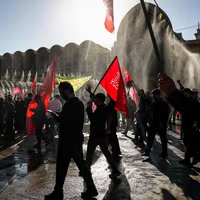
Unlike previous waves of unrest, the government has so far refrained from cutting nationwide internet access. Officials also appear keen to avoid an immediate crackdown that could further inflame public anger and broaden demonstrations.
Authorities have instead announced a series of closures under the pretext of “cold weather and energy saving.” Government offices were shut down in 26 of Iran’s 31 provinces on Wednesday, and several major universities in Tehran moved classes online until further notice under the same pretext.
Recognition of the right to protest, in words
On the third day of protests, President Masoud Pezeshkian said his government recognizes the public’s right to protest and has tasked the interior minister with holding talks with representatives of Tehran’s bazaar merchants.
Ali Ahmadnia, head of the government’s information office, also said on Wednesday that the administration had formally accepted the protests and would listen to criticism. The government, he said, “will sit down and listen to all critics and will not engage in any violent behavior—indeed, it strongly opposes it.”
The comments were met with skepticism on social media. One X user wrote: “If the government respected the people and had heard their protests, it would have resigned on the first day and stood with the public. Instead, despite all its inefficiency, it keeps making empty promises—showing it still doesn’t understand what is happening.”
Warnings from other power centers
Conciliatory language from the government was accompanied by firm warnings from other power centers.
Iran’s prosecutor general, Mohammad Movahedi-Azad, described “peaceful livelihood protests” as part of social realities but warned that “any attempt to turn economic protests into tools of insecurity, destruction of public property, or the execution of externally designed scenarios” would be met with a response from authorities.
The Islamic Revolutionary Guard Corps (IRGC) also issued a statement on Monday marking the anniversary of the 2009 protest crackdown. It warned it would confront “any sedition, unrest, cognitive warfare, or security threat,” accusing what it called the enemies of the Islamic Revolution of attempting to recreate unrest through “psychological operations and narrative warfare.”
Hossein Shariatmadari, editor of the hardline Kayhan newspaper, claimed protesters were few in number and accused them of exploiting economic grievances to create unrest. He also alleged that shopkeepers had distanced themselves from protesters because of slogans he described as “dictated by the Zionist regime.”
Partial retreat toward bazaar merchants, cash aid promises
Meeting with representatives of trade guilds, President Pezeshkian said the government and parliament had agreed to suspend certain tax requirements, including penalties, for up to one year.
The move may not be sufficient to calm unrest among merchants, whose survival depends less on tax relief than on consumers’ rapidly shrinking purchasing power amid high inflation. At the same time, such concessions risk angering salaried workers who cannot avoid paying taxes.
One user wrote on X: “That’s not even the issue. When sales are close to zero, making taxes zero changes nothing. When income doesn’t cover high rent, even cash handouts don’t help.”
The government has also sought to ease public pressure by reiterating its promise to pay a monthly cash subsidy of 7,000,000,000 rials (about $5.17) per person.
Officials present the measure as targeted support for households struggling with rising prices, but critics say the amount has been eroded by inflation and is unlikely to offset the sharp decline in purchasing power or calm growing public anger.
Limited use of force—so far
Social media reports indicate that an unspecified number of protesters have been detained in recent days, though arrests appear more limited than in comparable protests in past years.
In Tehran—where demonstrations quickly spread across markets, streets, and universities on Monday and Tuesday—there have so far been no confirmed reports of security forces firing on protesters, unlike previous unrest. However, on Wednesday, security forces opened fire in the towns of Fasa, in southern Fars province, and Kouhdasht, in Lorestan province, as protesters attempted to enter governorate buildings.
Online reports initially claimed that an 18-year-old had been killed in Fasa, but a video later surfaced showing the young man alive and saying he was unharmed.
Campus controls and university shake-ups
Protests reached several universities on Tuesday, where students chanted anti-government slogans.
Following confrontations, the heads of campus security at Alzahra, Sharif, and Iran University of Science and Technology were dismissed for “a record of misconduct and failure to properly handle recent student protests.”
Also, six of at least seven detained students in Tehran were later released.
Reformist figures welcomed the unprecedented dismissals. Azar Mansouri, head of Iran’s Reformist Front, called the move “a rational response,” saying it signaled recognition that security and stability cannot be achieved by ignoring protesters’ concerns.