Former US national security adviser Mike Flynn voiced support for protesters in Iran on Tuesday, reposting a message by exiled prince Reza Pahlavi and urging Iranians to rise up against clerical rule.
Flynn, a retired US Army lieutenant general, shared Pahlavi’s post on X and added his own message backing the demonstrations.
“Pray for the people of Iran right now who have lived under draconian fear of the Ayatollah’s brutal and tyrannical regime,” Flynn wrote. “Time to rise up and take your nation back.”
Pahlavi, the son of Iran’s last shah, wrote earlier on X: “My compatriots, you have taken the streets into your own hands. I am with you. Victory is ours because our cause is just and because we are united.”
Shopkeepers in the cities of Shiraz and Ahvaz closed their stores on Tuesday, joining strike action as protests linked to Iran’s economic crisis continued for a third day, according to videos received by Iran International.
Footage sent by citizens showed merchants in Shiraz shutting shops and halting business during normal trading hours.
Separate videos received by Iran International showed traders in Ahvaz’s main market also closing their stores and joining the strike.
Norway’s parliamentary speaker Masoud Gharahkhani said on Tuesday that he supports protests in Iran, sharing a message of solidarity as demonstrations over economic hardship continued.
In a post on social media, Gharahkhani shared an image showing Iranian security forces confronting protesters.
“Fighting a dictatorship, the real power is always in the hand of the people,” he wrote.
Gharahkhani, who was born in Iran and later emigrated to Norway, has previously spoken out on human rights issues related to the Islamic Republic.


The Kremlin said on Tuesday it sees dialogue with Iran as necessary and urged restraint after President Donald Trump warned Tehran against rebuilding its missile and nuclear programs and said he would back possible Israeli strikes.
“We believe it is necessary to develop a dialogue with Iran,” the Kremlin said, urging parties “to refrain from escalation” after President Donald Trump warned Tehran against rebuilding missile and nuclear capabilities.
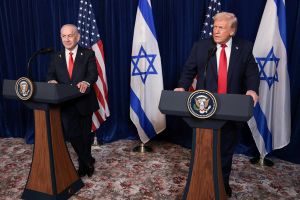
Trump, speaking Monday alongside Israel’s Prime Minister Benjamin Netanyahu in Florida, said the US would hit Iran hard if it recovers militarily from the June war and that he would back possible Israeli strikes if Iran continues missile development.
Asked about support for strikes, Trump said: “If they will continue with the missiles, yes… The nuclear… absolutely.”


"I hope Iran is not trying to build up, as I've been reading, that they're building up weapons and other things. And if they are, they're not using the sites that we obliterated, but they're using possibly different sites. We know exactly where they're going, what they're doing, and I hope they're not doing it, because we don't want to waste the fuel on B-2, it's a 37-hour trip both ways. I don't want to waste a lot of fuel," he said.
The United States held five rounds of negotiations with Iran over its nuclear program earlier this year, for which Trump set a 60-day deadline.
When no agreement was reached by the 61st day on June 13, Israel launched a surprise military offensive followed by US strikes on June 22 targeting key nuclear facilities in Isfahan, Natanz and Fordow.
The attacks killed nuclear scientists along with hundreds of military personnel and civilians. Iranian counterattacks killed 32 Israeli civilians and an off-duty soldier.
Iran denies seeking nuclear weapons and says its nuclear program is for peaceful purposes. Supreme Leader Ali Khamenei has said dealing with Trump is beneath the dignity of the Islamic Republic, while Iranian officials have rejected US demands to end uranium enrichment and curb missile capabilities.
Shopkeepers in parts of south Tehran and the capital’s Grand Bazaar closed their stores and gathered on Tuesday, according to videos received by Iran International.
Footage showed traders on Sabounian Street in the Shoush area shutting shops and forming small gatherings during business hours.
Separate videos sent to Iran International showed merchants at Saray-e Melli and along 15 Khordad Street in Tehran’s Grand Bazaar closing stores and joining strike action.
The locations are part of key wholesale and retail corridors, and closures there can disrupt supply chains to smaller markets across the city.
A senior cleric in Iran’s Qom seminary said on Tuesday that “infiltrators” and economic corruption networks were fueling public discontent, as protests over livelihoods continued across the country.
Mohammad Javad Fazel Lankarani, a seminary professor and member of the Qom Seminary Teachers’ Association, said some actors were worsening economic conditions to raise public anger.
“One cannot ignore the role of certain infiltrators and networks of economic corruption,” he said, accusing them of creating “economic disorder” and shifting its costs onto the system.
He said officials who lack the ability to run the country or confront corruption should not remain in office.
“If an official does not have the capacity to manage the country, or even a ministry, and cannot confront corruption and economic mafias, continuing in that responsibility is religiously impermissible,” he said.
Lankarani also stressed compulsory hijab, saying the spread of what he called moral decline was part of a planned project aimed at Iran’s religious identity, particularly among youth.