Guards' outlet warns market protests could invite renewed conflict with Israel
An Iranian media outlet affiliated with the IRGC Quds Force said protests by shopkeepers had been encouraged by “enemy” support, after sharing a social media post by Israel’s Persian-language account highlighting the demonstrations.
The channel said that the unrest had begun with backing from hostile actors and urged Iranian authorities to respond to public grievances, warning that failure to do so could “open the path” to renewed conflict with Israel.
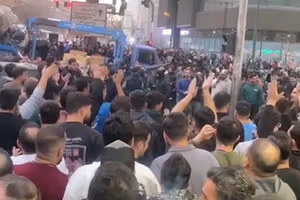
A screen grab from a video showing protests on Jomhouri Street in Central Tehran, Iran, December 28, 2025.
Shopkeepers in Tehran extended strikes into a second day on Monday, with closures reported across several key markets amid mounting economic pressure and a sharp fall in the national currency, according to information received by Iran International.
Traders in the historic Chaharsouq bazaar joined the strike, while Tehran’s gold market remained shut and shopkeepers gathered for a protest on Lalehzar Street.
Merchants at other markets, including Jafari bazaar and parts of the Shoush wholesale district, were also reported to have stopped work.
The latest closures follow protests on Sunday by mobile phone traders outside the Iran Mobile Center and the Alaeddin Mobile Shopping Center on Hafez Street in central Tehran. V
ideos sent to Iran International showed crowds chanting antigovernment slogans, with passersby later joining demonstrations near Jomhouri Street.
Reports also circulated on social media of protests at Tehran’s Charsou mall, while iron market traders were said to have closed their shops to protest the currency’s decline.
The unrest comes as Iran’s rial slid to new record lows, weakening to around 1,445,000 per dollar on Sunday, compared with about 1,370,000 the day before and roughly 1,140,000 a month earlier, according to open market rates.
Iran has been grappling with soaring prices and currency volatility. Official data show food prices have risen by more than 66% over the past year, while year-on-year inflation reached 52.6% in December.
There were no immediate reports of security force intervention on Monday.
Shopkeepers in Tehran extended strikes into a second day on Monday, with closures reported across several key markets amid mounting economic pressure, according to information received by Iran International.
Traders in the historic Chaharsouq bazaar joined the strike, while Tehran’s gold market remained shut and shopkeepers gathered for a protest on Lalehzar Street, the outlet reported.
Merchants at a few other markets were also reported to have stopped work, as signs of unrest spread across parts of the capital’s commercial districts.
Iran’s audit watchdog pushed back on President Masoud Pezeshkian’s comments about fuel costs, warning officials against providing inaccurate data and saying gasoline imports this year were far lower than figures cited publicly.
The Supreme Audit Court said in a statement that documented gasoline import costs had reached $1.8 billion by late December, adding that even under a high-end scenario, total imports for the full year would amount to around $2.7 billion, well below the president’s estimate.
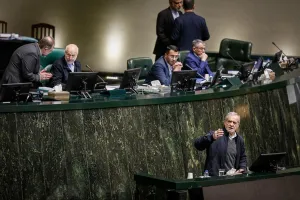
Pezeshkian had told parliament earlier this week that the government spent about $6 billion importing gasoline this year, while budgeting roughly $8 billion in subsidized foreign exchange next year for essential imports, even as many goods were effectively priced at market exchange rates.
The president cited fuel and energy subsidies as a central distortion in Iran’s economy, arguing that higher consumption channels larger amounts of state support to wealthier households. He described the current system as inequitable and unsustainable, particularly as domestic fuel demand continues to rise.
The audit body warned against the use of inaccurate or unverified financial data in policymaking, saying that decisions on energy shortages and broader economic reforms should be based on “precise, transparent and verifiable information.”
The dispute comes as Iran grapples with chronic fuel shortages, rising imports and a widening gap between domestic production capacity and consumption. Officials have said inefficient vehicles, smuggling and low prices have pushed gasoline demand well beyond refinery output, forcing imports despite Iran’s status as a major oil producer.
While the audit court challenged the scale of gasoline imports, it did not dispute broader concerns over subsidies, which economists say absorb tens of billions of dollars annually and weigh heavily on public finances.
A reformist daily, Etemad, said in an editorial on Monday that Iran’s budget debate reflects a deeper problem: a persistent gap between official plans and economic realities.
“The distance between what is written on paper and what happens in practice remains deep and worrying,” the paper wrote, adding that promises to reform spending and target resources have repeatedly translated into pressure on “transparent and productive” sectors rather than on inefficient or tax-exempt entities.
The editorial argued that quasi-state and semi-private companies continue to operate in a “safe zone,” contributing little in taxes despite controlling a significant share of economic resources. “A large portion of national resources circulates within this gray structure without an effective return to the public budget,” it said.
The paper also warned that a 25% rise in bond issuance signaled growing reliance on borrowing, shifting fiscal pressure into the future without generating sustainable growth.
The gasoline cost dispute adds to pressure on Pezeshkian’s government as lawmakers review the budget for the Iranian year beginning in March, against a backdrop of high inflation, currency weakness and public frustration over living costs.
The dispute unfolded as shopkeeper protests linked to the rial’s plunge continued in Tehran for a second day on Monday.
Iran's Zolfaghar short-range solid fuel ballistic missile on display at an exhibition of IRGC Aerospace military equipment
Iran's Islamic Revolutionary Guard Corps (IRGC) is developing biological and chemical warheads for the country's long-range ballistic missiles, informed military sources told Iran International on Sunday.
The IRGC Aerospace Force is working on the unconventional warheads for ballistic missiles as it transfers missile launchers to eastern regions of Iran, the sources said.
The sources, who requested anonymity due to the sensitivity of the matter, said these activities have accelerated in recent months and are being pursued amid rising regional tensions and Tehran’s concerns about the possibility of another direct confrontation with Israel and the United States.
Israeli Prime Minister Benjamin Netanyahu is in Florida to meet the US president on Monday, when he plans to brief Donald Trump on options for potential future strikes against Iran, amid concerns that Tehran is rebuilding ballistic missile production facilities and repairing air defenses damaged during a brief war in June.
Iran International’s sources say these programs are largely carried out under the supervision of the IRGC Aerospace Force and include optimizing ballistic missiles to carry chemical and biological agents, as well as upgrading the associated command-and-control systems.
The Revolutionary Guard, anticipating scenarios of large-scale conflict, is building capabilities that, in the view of the Islamic Republic’s decision-makers, would serve as a “complementary deterrent factor” alongside Iran’s conventional missile program, one source said.
The pursuit of chemical and biological warheads comes six months after Iran’s foreign minister described his country as “the largest victim of chemical weapons in modern history,” citing Saddam Hussein’s chemical attack on Sardasht in western Iran, which, according to OPCW documentation, killed more than 100 people in a large-scale mustard gas assault.
Asked about the contradiction, one source told Iran International, “The Iranian leadership views potential Israeli and American attacks as a threat to its very existence and intends, in the event of a conflict, to significantly raise the cost for the opposing side.”
There is a perception at the highest decision-making levels of the Islamic Republic that “the use of unconventional weapons can be justified in situations of existential threat," the source added.
Last week, Iran International reported that Western intelligence agencies had identified “unusual” activities by the IRGC Aerospace Force and had increased monitoring and surveillance of these movements.
Sources said intelligence services were tracking command-and-control signals as well as deployments and logistical movements linked to the force.
'Drastic change in Mideast deterrence balance'
Military analysts told Iran International that if these reports are confirmed, the development of chemical and biological warheads could drastically alter the region’s deterrence balance and trigger broad international reactions.
The deployment of such weapons would face widespread global condemnation and could pave the way for additional sanctions and intensified pressure on Tehran.
Tehran has consistently denied any effort to acquire unconventional weapons and has declared itself committed to its international obligations.
Over recent years, Iran has steadily increased the range, accuracy, and variety of its ballistic missiles, a program that has been one of the main sources of concern for Western countries and regional states.
Protests by Tehran shopkeepers highlight growing economic strain on small businesses in Iran, economist Ahmad Alavi said in an interview with Iran International.
Profitability has not only declined but has “become impossible” amid the rial’s steep fall, market turmoil, rising taxes, and collapsing consumer purchasing power, Alavi added.
“The decline in purchasing power is transferred directly to shopkeepers and small-scale economic activity,” Alavi said, adding that most Tehran market traders operate as small economic units with limited capital and very low risk tolerance.
He said rial's exchange-rate volatility has made planning impossible for importers, merchants, and small sellers.
“Planning, which is the basis of profitability and stability, disappears when the currency market is chaotic,” he said.
Alavi said rising direct and indirect taxes have added pressure on small business owners while weakening consumer demand further reduces sales.
He added that many shopkeepers have cut working hours and laid off employees or apprentices in order to continue operating, as inflation accelerates and purchasing power falls.
A screen grab from a video showing protests on Jomhouri Street in Central Tehran, Iran, December 28, 2025.