Lebanon urges Iran to halt interference as Israel escalation fears grow
Lebanon’s foreign minister said Arab and international parties have warned Beirut that Israel is preparing a wide military operation, while accusing Iran of playing a destabilizing role in Lebanon and the wider region.
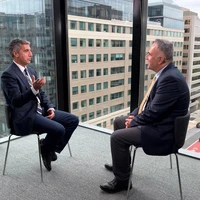
“We have received warnings from Arab and international parties that Israel is preparing for a wide military operation against Lebanon,” Foreign Minister Youssef Raji told Al Jazeera on Friday. He said Beirut was “intensifying diplomatic contacts to keep Lebanon and its facilities out of any Israeli strike.”
Raji said Hezbollah’s arsenal has failed to protect Lebanon or support Gaza, as the Lebanese state pushes to bring all weapons under national control.
“Hezbollah’s weapons have proven ineffective in supporting Gaza and defending Lebanon,” he said, adding that the government is in dialogue with the group to persuade it to hand over its arms. “But Hezbollah refuses,” he said.
Lebanon has tasked its army with extending state authority nationwide following a ceasefire with Israel that took effect in late 2024 after more than a year of cross-border fighting.
Iran ties and conditions for dialogue
Raji said Iran’s role in Lebanon and the wider region has fueled instability, while stressing that Beirut remains open to talks with Tehran under clear conditions.
“Iran’s role in Lebanon and the region has been very negative,” he said. “We have a problem with Iran, but we are open to dialogue, provided it stops interfering in our internal affairs and halts funding an illegal organization in Lebanon.”
Iran has long backed Hezbollah and has resisted international and domestic calls for the group to disarm, arguing that continued Israeli actions justify its armed presence.
Diplomatic exchange with Tehran
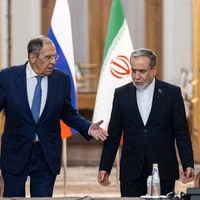
Raji’s remarks follow a diplomatic exchange with Iranian Foreign Minister Abbas Araghchi, who earlier this month invited his Lebanese counterpart to visit Tehran. Raji declined the invitation, citing unfavorable conditions, and proposed meeting in a neutral third country.
In response, Araghchi said he understood Lebanon’s position given ongoing Israeli actions and said he would accept an invitation to visit Beirut. He said Iran also seeks “a new chapter” in relations based on mutual respect and sovereignty.
A campaign supported by more than 800 Iranians at home and abroad is calling for the release of detained teenager Bita Shafiee and her mother.
The public appeal, published this week under the title Campaign to Support Bita Shafiee, warns that the teenager remains in detention while being held separately from her mother, Maryam Abbasi-Nikoo, who is also imprisoned.
“Bita Shafiee is a child in prison, separated from a mother who is herself incarcerated … Iran, as a member of the Convention on the Rights of the Child and the International Covenant on Civil and Political Rights, is obliged to uphold fundamental human rights,” the statement reads.
The signatories demanded immediate action to secure the release of both detainees and a transparent account of their legal status and health. They stressed the need for prompt access to lawyers and family members, impartial investigations into any mistreatment, and an end to delays in providing medical or psychological care.
Call for independent monitoring
The campaign says that safeguarding children’s rights “is not contingent on political beliefs” and that all citizens, regardless of family background, are entitled to legal protection, counsel and freedom from arbitrary arrest.
Security forces detained Shafiee, a former political prisoner from Shahinshahr, on November 13. Abbasi-Nikoo was arrested days earlier on November 10 by Intelligence Organization personnel of the Revolutionary Guards. She had previously been detained in July 2022 on a charge of “insulting the prophet” before being acquitted.
Intensified crackdown after June conflict
Rights groups and media outlets report a widening crackdown in recent months, particularly after the 12-day war with Israel. Reuters reported on November 13 that the scope of political repression in Iran has expanded, citing activists who said the escalation was without precedent.
The petition’s organizers highlighted what they called the need for “cross-border solidarity” to press for the safety of the teenager and her mother. International pressure from human rights groups, professional associations and educational networks “can reduce the cost of repression and enable practical support for those at risk,” they wrote.
Most signatures came from inside the country, with additional support from Iranians in Sweden, Canada, Germany and the United Kingdom.
The petition reflects growing civic mobilization over arrests that critics say increasingly target minors and family members alongside political activists.
Ukraine said on Friday it struck two Russian vessels in the Caspian Sea that had previously been sanctioned by the United States for transporting military cargoes between Iran and Russia.
Ukraine’s special forces said in a statement on Telegram that the operation was carried out with the help of what they described as a local resistance group and targeted the ships near the Russian republic of Kalmykia.
The vessels were identified as the Composer Rakhmaninoff and the Askar-Sarydzha. Ukraine said both ships had been used by Russia for military purposes and were under US sanctions over their role in moving weapons and military equipment between Iran and Russia.
Ukraine did not say how the ships were hit or provide details on the extent of any damage.
The statement said the resistance group had supplied information on the ships’ маршруtes and cargoes. Russia has not commented on the claim.
Iran and Russia have expanded military and logistical cooperation since Moscow’s full-scale invasion of Ukraine in 2022. Western governments have accused Tehran of supplying drones and other equipment to Russia, allegations Iran has denied.
Iranian-designed Shahed drones, now manufactured inside Russia under the name Geran, have played a growing role in the war. The Financial Times reported earlier this year that the drones are increasingly overwhelming Ukraine’s air defenses as Russia steps up swarm attacks.
Ukraine’s air force has said Russia often launches large numbers of Shahed-type drones alongside missile strikes to strain air defense systems. The United States has imposed multiple rounds of sanctions on Iran’s drone production and procurement networks over their alleged role in supporting Russia’s war effort.
Leaders from Russia, Iran, Turkey other regional states gathered on Friday in Turkmenistan for a rare international summit marking the country’s 30 years of official neutrality, as diplomatic engagement across the region intensifies amid wider global strains.
Iranian President Masoud Pezeshkian and Russian President Vladimir Putin held talks on the sidelines of the International Forum for Peace and Trust in the capital Ashgabat, an unusual gathering in one of the world’s most closed states.
Putin said Moscow and Tehran remain in close contact on major international issues, including Iran’s nuclear program.
“We are in close contact on all key international issues, including all matters related to the Iranian nuclear program. You know our position: we support Iran at the UN,” Putin said, adding that the foreign ministers of the two countries are “in constant contact.”
He said Russia and Iran are negotiating cooperation in the gas and electricity sectors and will work together on energy transmission projects.
“We are holding talks in the gas and power sectors, and cooperation in energy transfer will take shape,” he said.
He added that relations between the two countries are expanding steadily. “Our relations are developing day by day,” Putin said, pointing to plans to advance the North–South transport corridor linking Russia to South Asia via Iran.
Putin also cited plans to expand cooperation at Iran’s Bushehr nuclear power plant, which was built by Russia.
Broader strategic ties
The meeting comes as Tehran and Moscow deepen strategic cooperation under Western sanctions. Earlier this month, the two countries signed a new agreement covering artificial intelligence and cybersecurity, expanding collaboration in digital infrastructure, data transit and e-government.
Iran and Russia have also worked closely on space projects. Tehran has said three Iranian satellites will be launched aboard a Russian Soyuz rocket later this month, following earlier launches carried out with Russian support.
A relative of Rouzbeh Vadi said the Iranian nuclear scientist executed in August confessed only after severe torture and threats against his mother, describing a prosecution built on a single coerced statement.
Vahid Razavi, a member of Vadi’s family, told Iran International that the researcher was detained about 18 months ago following a dispute at work and was later accused of spying for Israel.
“Rouzbeh was tortured intensely, to the point that bones in his leg and two ribs were broken, and then his mother was arrested and jailed,” Razavi said. Interrogators, he added, photographed her in custody and showed the images to Vadi “to extract a forced confession.”
“They had told Rouzbeh that if he did not confess to espionage and agree to appear in a televised interview, they would torture his mother.”
Vadi, who held a doctorate in reactor engineering, had co‑authored a 2011 research paper with senior Iranian nuclear experts later killed during the June conflict with Israel, according to his Google Scholar profile.
The judiciary said he was convicted of transferring classified information about one of the scientists killed in those attacks to Mossad.
According to Razavi, interrogators warned Vadi that unless he admitted to espionage and appeared in a televised confession, “they would torture his mother.” He said Vadi accepted what he called a fabricated charge under those conditions.
Televised confession questioned
Vadi, a member of the Nuclear Science and Technology Research Institute affiliated with the Atomic Energy Organization, was executed on August 6. The judiciary said at the time he had been “recruited via cyberspace by Mossad.”
The confession, Razavi said, broadcast on state television was the sole basis for the conviction. He said authorities “moved quickly” after the 12-day conflict in June and carried out the execution without notifying the family.
Razavi also questioned state media remarks that Vadi received a black bag stuffed with cash. “In an era of digital transactions, why would a highly educated scientist accept cash in a bag?” he said.
Vadi, Razavi said, was portrayed as having copied sensitive files onto a hard drive and handed them over in a public park restroom. Such accounts, he argued, were “nonsensical” given the availability of secure digital platforms such as Signal or Telegram.
Rights organizations have long raised concerns about forced confessions obtained under torture in Iran’s judicial system.
Razavi described Vadi as intelligent, devoted to his family and focused on work, noting that he lived with his mother and had modest means. He said Vadi had no political involvement and was committed to supporting peaceful nuclear research.
Following the June war, Iranian courts have arrested, tried and executed several people on espionage charges involving Israel. In one recent case, political prisoner Javad Naeimi was executed on October 18 in Qom. These executions have drawn criticism from international human rights groups and UN rapporteurs.
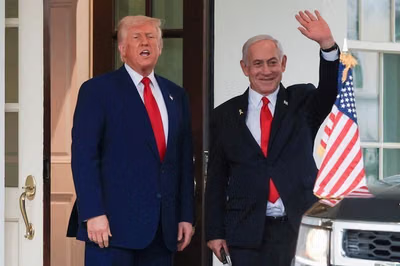
US President Donald Trump on Thursday said Iran's nuclear program is "gonzo" after air attacks he ordered in June and that it faced "obliteration" if restarted, telling Tehran they could avoid more destruction with a nuclear deal.
His speech on Iran was his most extensive in months and indicated efforts had stalled on resuming talks after a 12-day military campaign started by Israel and joined by US forces.
"The Atomic Energy Commission said it's like 'gonzo,' one person actually used the term obliterated, but Iran actually said that they probably can never go there again," he told reporters. "They can probably never start there again. If they ever started, they'd probably choose a new site."
"They can try, but it's going to take them a long time to come back. But if they do want to come back, and they want to come back without a deal, then we're going to obliterate that one, too," Trump said.
Trump’s remarks came hours after Iran’s Supreme Leader Ali Khamenei dismissed speculations about a possible fresh round of war on Iran, calling it part of “enemy propaganda”.
“Today, beyond these military confrontations — which have existed, as you have seen, and whose likelihood is constantly being talked up, with some even deliberately fanning the flames to create anxiety, though they will not succeed, God willing — we are facing a propaganda and media confrontation,” Khamenei said.
“We are confronted with a broad front in a propaganda war; we are in a spiritual war. The enemy has realized that seizing this land, this soil, this divine and spiritual territory, is not possible through pressure or military tools.”
Trump has long said the June 22 missile and bunker-buster bomb attacks on three Iranian nuclear sites took out Iran's nuclear capabilities. Still, Tehran and Washington do not appear set on resuming two months of talks they had before the war.
Iran denies seeking a nuclear weapon but the United States and Western countries want Iran to end uranium enrichment, curb its missile power and rein it aid for armed groups in the region like Hamas and Hezbollah. Tehran has rejected the conditions.
"Their nuclear capability would have been there in about two months," he said of Iran's timeline to build a nuclear weapon before the war. "I think it looked like it was—some people say two weeks. I don't know if it's two weeks, but a very short period of time."
Iran's Supreme Leader has said dealing with Trump is beneath the dignity of the Islamic Republic and that the US approach to talks amounted to dictation.
Trump insisted on Thursday that Iran could have been spared the attacks if it came to a deal through talks, and that it must.
"Forget about the nuclear. The nuclear is gone. But look at the damage they've suffered, the death that they've suffered. They could have had a deal where nobody would have died."
"They missed that opportunity. But they would like to make a deal right now," Trump said. "Yes, please."