Three Iranian villages named among world’s best by UN tourism body
Soheili Village on Qeshm Island
The United Nations World Tourism Organization on Friday named three villages in Iran among the world’s 52 best tourism villages for 2025, citing their rich cultural heritage and historical significance.
The three villages are Shafiabad in Kerman Province, Kandolus in Mazandaran Province and Soheili on Qeshm Island. Together, they represent Iran’s northern forests, central deserts and southern coasts.
Shafiabad, located on the edge of the Lut Desert, is known for its Qajar-era caravanserai and the surrounding sand dunes and “kaluts,” the wind-shaped desert formations that draw travelers and photographers from around the world.
Shafiabad Village in Kerman
Kandolus, in the green slopes of the Alborz Mountains, is famous for its traditional stone houses, handicrafts, and hiking trails through the Hyrcanian forests. With thousands of years of history, it is one of northern Iran’s oldest rural settlements and a model for cultural tourism.
Kandolus Village
Soheili, a coastal village on Qeshm Island, has become a leader in eco-tourism and community-based conservation, according to the Iranian Tourism Organization.
Villagers help protect the Hara Mangrove Forests, promote quiet and clean boating, and welcome visitors with local seafood, crafts, and star-filled night skies.
Soheili Village
UN Tourism’s “Best Tourism Villages” program honors rural destinations that protect their natural environment, celebrate local traditions, and create opportunities for local communities.
“Our Best Tourism Villages 2025 highlight communities that are working to safeguard their cultural heritage, preserve their natural resources and create economic opportunities through tourism,” UN Tourism Secretary General Zurab Pololikashvili said in a statement.
In total, 52 villages from Africa, the Americas, Asia, Europe and the Middle East received the recognition, selected from over 270 applications from 65 UN Tourism Member States.
Iran’s former ambassador to Caracas said on Friday that US President Donald Trump is exaggerating the threat of drugs from Venezuela to justify an attack on the country, while ignoring the role of Washington’s traditional ally, Colombia.
Hojatollah Soltani said Washington’s efforts blaming Venezuelan drug flows to the United States are “lies and part of psychological warfare.”
The Trump administration has conducted attacks on at least six boats off the coast of Venezuela it says were carrying drugs since last month.
"Trump’s allegations about narcotics are merely a propaganda excuse to target a country whose only 'crime' is demanding the right to self-determination and maintaining independent political sovereignty," he added.
Trump told reporters at the White House on Wednesday that he had authorized CIA covert operations in Venezuela, saying of alleged drug flows from the country that “a large portion enters by sea," adding Caracas had released “thousands of prisoners and mentally ill people” into the United States as undocumented immigrants.
Soltani said the main problem lay with Venezuela's neighbor Colombia, a traditional US ally.
“The vast majority of Latin America’s drug output occurs in Colombia, a US political and military ally hosting American bases,” he told state TV via phone on Friday. “For 40 years, Washington has run the so-called ‘Colombia Plan’ to curb production, by their own admission.”
Plan Colombia, launched in 2000, supports US-Colombia efforts against cartels, insurgents and narcotics through military assistance, crop eradication and development programs.
The Trump administration decertified Colombia as a partner in the fight against illegal drugs in September for the first time in nearly 30 years over alleged failures in its drug war, the Associated Press reported.
“International statistics show that 70% of Colombian cocaine reaches the United States via the Pacific Ocean, with no links to Venezuela by sea, land or air,” Soltani added. “Of the rest, 25% uses other routes, and just 5% transits Venezuela, where the government combats drugs with UN-backed resolve.”
Iran and Venezuela are close allies and the United States has criticized the relationship between its heavily-sanctioned adversaries.
A new and far deadlier conflict between Israel and Iran looms, former Israeli intelligence official Danny Citrinowicz told Eye for Iran, warning that Tehran has learned from past clashes and is rapidly improving its missile capabilities.
Citrinowicz, a former head of the Iran branch within Israel's military intelligence, said the United States still seeks a negotiated deal with Tehran while Israel remains focused on weakening or toppling the Islamic Republic — a fundamental imbalance he warned makes escalation “almost inevitable.”
“The starting point of the next war will be the ending point of the previous one,” he said.
Now a nonresident fellow with the Atlantic Council’s Middle East program, Citrinowicz also serves as a research fellow at the Institute for National Security Studies (INSS) in Tel Aviv.
“It will be very violent from the get-go. And I really think that there won’t be a mechanism that will allow us to close it, because unlike previously when the US forced the sides to close it, now the Iranians will not be willing to close it until they feel they have balanced the equation of deterrence with Israel."
"That is why I think the next will be much more violent and longer,” he added. "It will lead to more civilian casualties."
Citrinowicz’s warning comes as President Donald Trump continues to frame the 12-day Iran–Israel war as a decisive victory. Trump has repeatedly maintained US B-2 bomber strikes "obliterated" Iran’s key nuclear sites, forcing Tehran to accept a ceasefire and halting its nuclear ambitions.
Critics, however, say the claim is largely rhetorical and that the strikes likely delayed, not ended, Iran’s nuclear advancements, leaving the conflict’s root cause unresolved.
Satellite imagery taken in recent months shows that Iran is continuing construction at the Natanz “Pickaxe” mountain or Mount Kolang Gaz-La, consistent with activity seen before the June war.
The mountain complex south of Natanz includes another older tunnel network associated with Iran’s main enrichment site, which also shows signs of ongoing work, particularly reinforcement of tunnel entrances.
'Israel didn't win anything'
After the 12-day war between Israel and Iran, many in Israel came away with the impression that Israel had won the war. Iran was hit hard, and Israeli operations left Tehran no longer viewed as a threshold nuclear state, as US and Israeli officials say. But Citrinowicz argues that this is a dangerous misconception.
“In Israel we have the wrong perception. We are saying we won — we didn’t win anything,” he said. “We had major achievements, but from the Iranian standpoint, they really believe they had major achievements too. Both sides think they won, and that’s what makes another clash inevitable.”
Citrinowicz says Israel must not underestimate Iran’s capacity to recover. He noted that Tehran has rapidly replaced assassinated commanders, resumed missile testing “almost daily,” and is seeking Russian and Chinese air defense systems to harden its skies.
“If there’s one lesson from recent history,” he said, “it’s that the regime is stronger than many believed.”
Another confrontation, he said, is likely within weeks or months as Washington’s demands — on uranium enrichment, missile limits and even some talk of joining normalization deals with Israel — meet flat Iranian refusals.
He argued that US advisers continue to misread Iran’s ideology and decision-making, while Tehran is rapidly rebuilding and testing capabilities at Natanz and Fordow, and acting bolder at sea — all of which may prod Israel into striking again.
Israel, he added, is unlikely to enjoy the same US military umbrella it had during the last war, when Washington deployed advanced interceptors and coordinated air operations. With Trump now juggling multiple crises, Citrinowicz said, “Israel could face a far tougher fight — and far less help.”
Just over a year ago, Iran launched Operation True Promise II against Israel — part of a steady escalation in which each confrontation has become more intense.
'Growing gap' between US and Israel on Iran
In his October 13 address to the Knesset, Trump declared that Iran had been “two months away” from a bomb before the US strikes in June and that he “terminated” its nuclear program afterward. “They’re not starting anything,” he said. “They just want to survive.”
Those lines, Citrinowicz cautioned, project misplaced confidence.
“Despite the fact that both sides basically want to reach an agreement, their present stances are not allowing one to be reached,” he said.
“What President Trump said in Israel actually highlights that misunderstanding — about Iran’s behavior and ideology — that will probably lead to another confrontation. Definitely, we are reaching another round of escalation.”
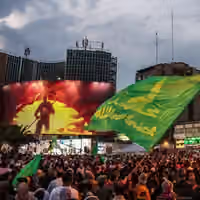
Tens of thousands of supporters of the Iran-backed armed Houthi movement converged in the Yemeni capital Sanaa on Friday to mourn the group's military chief of staff assassinated by Israel, which accused him of close ties to Iran.
The Israeli military first said it had killed Major General Mohammed al-Ghamari in an attack in August which killed the Prime Minister appointed by the Shi'ite group.
The Houthis did confirm his death until Thursday, and the date or details of his assassination were not immediately released.
"Appointed in 2016, al-Ghamari played a central role in building Houthi missile systems and weapons-production infrastructure, trained by Hezbollah and IRGC," the Israeli military said in a statement, referring to Iran's Revolutionary Guards.
"His elimination delivers a severe blow to the Houthi command structure, responsible for hundreds of attacks against Israel during the war."
At the mass funeral, Houthi politburo member Daifallah al-Shami praised the slain leader's role in confronting its enemies.
"Al-Ghamari and his comrades in the various formations of our armed forces played a great role in inflicting a humiliating defeat on America at sea, along with Britain, as well as on the criminal Zionist entity enemy over the course of two years," he said.
UK forces played a supporting role in a US military campaign against the Houthis earlier this year which appeared to make little headway in dislodging it from power.
"They proved to the whole world that God’s promise of victory to his believing servants is true and honest, even if it was in the face of the most modern arsenals of the world: aircraft carriers and strategic American bombers," al-Shami added.
Leadership central
Al-Ghamari, according to Yemen analyst Mohammed al-Basha, "was one of the most senior and influential figures within the group’s leadership."
"As the top military commander, he directed operations that targeted both civilian and military infrastructure across Yemen and neighboring countries. His leadership was central to shaping the Houthis’ strategy."
His assassination marks one of the biggest blows to the hardened fighters since Hussein Badreddin al-Houthi, their founder and brother of the current Houthi leader, was killed by Yemeni government forces in 2004.
The Houthis launched attacks on waterways straddling the war-torn Arabian Peninsula republic beginning in November 2023, in what it called a blockade of Israel in solidarity with Palestine as war raged in Gaza.
Attacks killed eight international mariners and targeted dozens of vessels with no apparent connection to Israel or Western foes.
The group has fired scores of missiles and drones to Israel since the outbreak of the Gaza war, with most intercepted by air defense systems, though there have been some lapses.
One man was killed in a drone attack on Tel Aviv which hit a residential building last year and a missile attack narrowly missed Israel's busiest airport in May.
Israel responded with multiple airstrikes in Yemen, where the Houthis control large amounts of the territory after a civil war erupted in 2014. Local health authorities say the attacks have killed scores of civilians.
Iran's foreign ministry on Friday condemned Israeli air strikes on south Lebanon, calling it a violation of a ceasefire with the weakened Hezbollah group it backs and holding the truce's guarantors the United States and France responsible.
Israeli air attacks targeted the village of Mazraat Sinay on Thursday, killing one person and wounding seven others according to local health authorities.
Videos shared on social media depicted a large orange blast and mushroom cloud rising in the night sky. The Israeli military said it aimed at "terrorist" targets.
Iranian Foreign Ministry spokesman Esmail Baqaei called the attacks "a blatant violation of Lebanon’s territorial integrity and national sovereignty."
"This situation stems from the persistent inaction and appeasement of the ceasefire guarantors, France and the United States," he added.
A shaky truce has held since a November truce ended over a year of cross-border combat between old foes Hezbollah and Israel, in which over 4,000 Lebanese people were killed according to medics.
The punishing war culminated in attacks on Hezbollah leaders' communication devices, maiming hundreds. Massive air strikes killed the group's veteran leader Hassan Nasrallah, a canny commander and the most charismatic advocate of the so-called Resistance Axis of armed groups Tehran led in the Arab world.
A chastened Hezbollah, once seen as a key deterrent for its Iranian patrons against Israeli attack, totally sat out the 12-day Iran-Israel war in which Tehran was badly bruised.
Iran's regional influence has been sapped by the nearly two years of regional conflict sparked by the attacks its Palestinian ally Hamas launched on Israel on Oct. 7, 2023.
Its continued sway hangs in the balance as a truce brokered by US President Donald Trump took hold in Gaza over the weekend.
Lebanese President Joseph Aoun accused Israel of violating the ceasefire with Hezbollah.
“The repeated Israeli aggression is part of a systematic policy aimed at destroying productive infrastructure, hindering economic recovery, and undermining national stability under false security pretexts,” he said in a statement.
Israel has demanded Hamas and Hezbollah disarm, and the Lebanese government has called for the group to give up its arsenal by the end of the year.
However, President Aoun seeks to limit Hezbollah’s weapons rather than fully disarm the group, sources close to Aoun told Iran International.
The aim is to gradually wear down and neutralize Hezbollah’s arms without the need for forced disarmament, the sources said.
As the world races to meet the UN’s 2030 Sustainable Development Goals, Iran faces a bleak environmental outlook given the scale of its problems and authorities' record of short-term policymaking.
From vanishing water reserves and dried wetlands to fragile cities, failing infrastructure and a fossil-fuel-dependent economy, decades of reactive decisions have set the country on an unmistakably unsustainable path.
Iran now stands on the brink of “water bankruptcy,” a term describing when consumption far exceeds natural replenishment.
Over-extraction from aquifers, unchecked dam-building, inter-basin transfers, and ill-planned agricultural projects have left more than 500 plains suffering groundwater collapse and land subsidence—what experts call a “silent earthquake.” In some areas, land sinks by more than 20 centimeters a year.
Hundreds of villages across central and eastern Iran now lack safe drinking water, triggering waves of climate-driven migration.
The crisis no longer threatens only agriculture and food security but the country’s social stability and national security.
No climate plan
Iran is among the world’s most climate-vulnerable nations.
Rising temperatures, shrinking snowfall, extended droughts and intensifying dust storms reveal the scale of change, yet the country still lacks a national adaptation plan.
Limited engagement with international scientific bodies, poor climate data and a reactive policy mindset have weakened its ability to respond.
While many countries invest in innovations like smart farming and early-warning systems for floods and droughts, Tehran’s measures remain short-term and unsustainable.
Cities Strained
In five decades, Iran has urbanized at one of the fastest rates globally—without the infrastructure or governance to match.
Tehran, Mashhad, Isfahan and Ahvaz now face toxic air, crumbling public services, decaying neighborhoods, and growing informal settlements.
Municipal priorities lean toward costly showcase projects instead of building resilient, livable cities.
As a result, Iran’s urban quality-of-life indicators remain far below global averages, and its cities are increasingly vulnerable to earthquakes and floods.
Self destruction
Iran’s economy remains tethered to the overuse of natural resources and fossil fuels, eroding efficiency and environmental security.
Agriculture, despite contributing little to GDP, consumes more than 90% of the nation’s water—often to grow water-intensive crops like rice and pistachios in arid zones.
Inefficient subsidies for energy and water encourage overconsumption, soil degradation and aquifer depletion. Heavy reliance on oil and gas fuels pollution and delays a shift toward a green economy.
Unlike many of its neighbors, Iran still lacks a binding strategy for renewable energy—a gap that risks locking the country into technological stagnation and environmental decline.
Governance at the core
At its core, Iran’s crisis stems less from a lack of natural resources than from weak governance and fragmented decision-making.
Years of unscientific, short-term policymaking and exclusion of civil and expert institutions from decision processes have eroded the capacity for sustainable development.
Centralized, project-based management continues to dominate where transparency, public participation and local knowledge could drive meaningful solutions.
Sustainable development is no longer optional. It is vital to Iran’s survival.
Continuing the current course—from vanishing wetlands and land subsidence to air pollution and climate migration—will erode the country’s ecological and human foundations.
Reversing course will demand a new development model—one built on sustainable water management, restored aquifers, reformed crop patterns, national climate adaptation, urban renewal and investment in clean energy.
Yet these are tall orders—and they appear far down the list of priorities for rulers consumed by political rather than ecological survival.