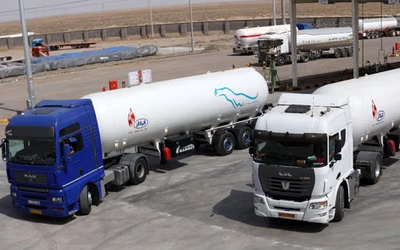
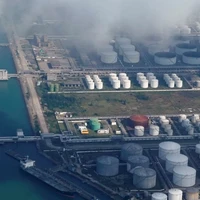
Iran-made oil tanker Aframax at a port in the Persian Gulf, March 20222
For the first time in more than seven years, Iranian-flagged oil tankers are broadcasting their location accurately and without spoofing—raising eyebrows among longtime watchers of Tehran’s sanctions-busting efforts.
The change was first noted by vessel-tracking firm TankerTrackers on Monday and has since been confirmed by several providers of AIS (Automatic Identification System) data.
Since the United States reimposed oil sanctions on Iran in 2018, Tehran’s tankers have relied on tactics to evade detection, including switching off transponders or transmitting false coordinates.
Homayoun Falakshahi, a senior analyst at commodity analytics firm Kpler, told Iran International the decision might be tied to the return of UN sanctions—either as a deterrent against seizures or as an attempt to legitimise Iran’s maritime activity.
The deterrence theory, he noted, implies Tehran is signalling that any seizure could prompt retaliation; the legitimacy theory suggests it wants to show its tankers are carrying oil, not weapons or nuclear material.
Weary of consequences?
According to Kpler, more than 80 percent of tankers carrying Iranian crude transmitted AIS data within the past 48 hours, although the so-called ghost fleet operating under other flags may still be off radar.
Miad Maleki, a former US Treasury official and now adviser at the Foundation for Defense of Democracies (FDD), suggested Iran may have decided to tread more carefully.
“Under UN International Maritime Organization (IMO) rules, AIS spoofing and manipulation are violations that can trigger serious consequences if enforced,” he told Iran International.
“Iran may perceive that the UN is likely to take stronger enforcement action against violations of these IMO requirements.”
Iran has long used ageing, often uninsured ships operating under various flags for ship-to-ship transfers before cargoes reach Chinese ports with their origin obscured.
The renewed UN sanctions give other countries stronger legal grounds to inspect or seize Iranian ships, especially those without insurance.
View from Tehran
Hamzeh Safavi, a political analyst and son of Yahya Rahim Safavi - an advisor to Iranian Supreme Leader Ali Khamenei - said last week that Washington has warned that ships disabling their AIS could face sanctions.
As a result, he asserted, Chinese ports and insurers are now insisting vessels keep their tracking systems on.
Maleki, however, questioned that interpretation.
“Sanctions are based on engagement in the transport or sale of Iranian petroleum or petrochemical products, not on a tanker’s behaviour,” he said.
Kpler reported recently that US pressure on vessels handling Iranian crude has intensified—with the share of tankers sanctioned by the Treasury rising from 38 to 60 percent in a year.
Too costly?
Another likely reason for Tehran’s shift is the soaring cost of sanctions evasion.
Cargo-tracking firm Vortexa estimates about 82 percent of Iranian oil cargoes are transferred at least twice before reaching their destination, and it now takes an average of 10 weeks to reach China, instead of 3 weeks under normal conditions.
The daily charter rate for a very large crude carrier (VLCC) is around $100,000, while vessels in the “ghost fleet” charge several times more. The extended voyages can erase up to 15 percent of a cargo’s value, Vortexa added.
Falakshahi said Tehran has recently increased its oil discounts to Chinese refiners by about 30 percent.
Iranian crude is now sold to China at US$8–10 per barrel below comparable Middle Eastern grades, while Tehran bears extra costs for rebranding, forged documents and intermediaries to mask the source.
Tehran may have concluded that elaborate sanctions-evasion tactics are eroding too much of its oil revenue.
It is also possible that Iranian authorities now believe China will continue purchasing Iranian oil, allowing them to deliver shipments more openly.
For now, though, all explanations remain conjecture. The real test will come in the days and weeks ahead—if the broadcasts continue and prove not to be a one-off.
Iranian-flagged vessels are now transmitting properly over AIS without spoofing. Screengrab from MartineTraffic.org