Russian Rosatom delegation meets Iran atomic chief in Tehran
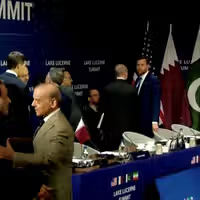
Rosatom Deputy CEO for International Relations Nikolai Spassky meets Iranian Vice President and Atomic Energy Organization chief Mohammad Eslami in Tehran.
A Russian delegation led by Rosatom Deputy Head Nikolai Spassky met with Iranian Nuclear Chief Mohammad Eslami in Tehran to discuss nuclear cooperation, Iranian state media reported on Wednesday.
The meeting followed Eslami’s trip to Moscow last week, where Iran and Russia signed agreements on small reactors and a $25 billion project for four large nuclear power units in Hormozgan province.
The talks also covered small modular reactors and 1,250 megawatt power units, the report said.
The two sides reviewed current projects and stressed the need to speed up joint work, Iranian officials said. They also agreed Rosatom Director Alexey Likhachev would visit Iran soon to inspect progress on units two and three of the Bushehr nuclear plant.
The discussions came as a new strategic partnership treaty between Iran and Russia entered into force after approval by Russia’s lower house of parliament. The agreement covers wide cooperation in areas including nuclear energy.
The nuclear meetings followed reports this week that Iran has a €6 billion agreement with Russia for 48 Su-35 fighter jets, with deliveries expected between 2026 and 2028. Iranian lawmakers have said Moscow has already sent MiG-29 aircraft and that more advanced systems such as Su-35s and S-400 air defenses will follow.
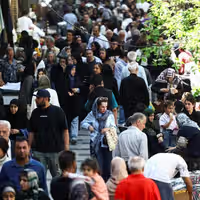
Medicine shortages and rising prices in Iran are fueling widespread anxiety according to testimonials received by Iran International, as the reimposition of UN sanctions last month deepens economic pain for ordinary citizens.
Iranian respondents to a bulletin requesting input on their experiences seeking medicine submitted audio, video and text messages detailing daily struggles.
Several messages said the prices of both basic and specialized medicines have multiplied in recent weeks, forcing many to visit multiple pharmacies to find affordable essential drugs.
Some reported that even common cold and allergy medications are in short supply, adding that there appeared to be a near-immediate change after the sanctions' return.
While Iranian officials have sought to downplay the impact, the complaints from the public suggest otherwise.
Prices triple, quality falls
Some said drug prices have tripled or quadrupled while quality has declined. One consumer said the price of a five-tablet pack of antihistamines rose from 250,000 rials (about $2.16) to 1.2 million rials (about $10.37) in a month.
Others described searching multiple pharmacies only to find a lone remaining box of medicine sold at inflated prices.
“Previously, the medications we needed were available, and with approval from the Hemophilia Center and the Food and Drug Organization, we could obtain them from pharmacies. But now these drugs have become scarce, and we have to pay 20 million rials ($173) for each one,” one audio message said.
Iran’s minimum wage for 2025 is 104 million rials per month, equivalent to about $94.
Some messages indicated that people have had to ration medicines, skip meals, or make other sacrifices to afford treatment.
“My medicines were already expensive before the war and before sanctions, but now they are rationed. I have to skip meals because after every meal I need a pill, and I can’t afford more," A diabetic respondent said.
Another respondent said he had reduced his family’s food intake to pay for his wife’s medication. A homemaker reported spending over 60 million rials (about $518) on gastrointestinal drugs despite not earning an income.
Blame and frustration
Many Iranians blamed government policies for the crisis.
“The medicines were already scarce and expensive, but after the UN sanctions they became worse. Officials are not suffering; it’s the middle class and workers,” one respondent said.
Officials in Iran routinely attribute shortages to foreign pressure, while critics and dissidents cite mismanagement and corruption.
Iran's former foreign minister Mohammad Javad Zarif at a seminar on international affairs, Tehran, Iran, October 8, 2025
Former Iranian chief negotiator Mohammad Javad Zarif said on Wednesday that a deal with Donald Trump is possible if it preserves Iran’s dignity and the US president’s ego.
“If we can design a dignified deal that protects Iran’s interests and satisfies Trump’s sense of self-importance, that could mark the end of the hostilities—and such a thing is possible,” Zarif told foreign-policy experts and reporters at a Tehran seminar on Wednesday.
The former foreign minister, who negotiated the 2015 nuclear agreement, suggested both Tehran and Washington sought to avoid a full-scale conflict in the June war with Israel, and defused it through back-channel communication.
“In the end, one side called at four in the morning and said, ‘We’re not going to strike,’ and the other replied, ‘We won’t strike either,’” Zarif recalled. “Wars end through dialogue, but it’s better if that dialogue happens when we still have leverage.”
His comments appear to counter hardliners’ calls to abandon diplomacy following US attacks on Iran’s nuclear sites and the Europeans’ snapback of UN sanctions last month.
Israel, not the US, wants Iran 'collapse'
Zarif argued that while Israel and the United States share interests, their strategic goals differ.
“America’s policy is not to bring about Iran’s collapse, but Israel —even during the Pahlavi era—believed that Iran was too big and must be broken apart,” he said.
The veteran diplomat said the continuation of the conflict could have led to Iran's collapse, in rare wording for a prominent former official.
“Continuing would either expand the war or lead to Iran’s collapse,” he said. “Both outcomes would have trapped America further in the region, which contradicts its policy.”
'People more important than missiles'
Zarif is President Masoud Pezeshkian’s closest aide and the moderates’ most prominent voice on foreign policy. Still, he holds no official position after he resigned as vice-president in March and is loathed by Iran's ascendant hardliners.
Yet he, like many others, avoided mentioning the role of Supreme Leader Ali Khamenei, who on the eve of Pezeshkian’s trip to New York ruled out any talks with the Trump administration.
He only alluded to Khamenei’s control when saying he was not authorized to negotiate beyond the nuclear issue during his tenure.
“Trying to solve the nuclear problem purely through the nuclear file is no longer possible. Back then it was, and that opportunity was wasted,” Zarif added, calling for “a broader framework” for other discussions, without elaborating.
Those “other discussions” may refer to Iran’s missile program—an issue Tehran has repeatedly said is off the table in any future talks.
“Missiles are important,” he said, “but people are more important. It’s the people who have kept Iran alive through the centuries.”
Iranian authorities have opened judicial cases in recent weeks against Instagram users for liking posts critical of the Islamic Republic, pro bono legal group Dadban said on Wednesday.
Several citizens have been charged with offenses including “insulting the leader of the Islamic Republic” and “propaganda against the state” for liking posts shared by opposition figures or independent media outlets on Instagram, the group said.
Most cases have been filed in smaller towns, though some have also been reported in the northeastern city of Mashhad.
While no verdicts have been issued yet, prosecutors have in some instances set heavy bail amounts for the defendants, according to Dadban.
Iran continues to enforce tight control over digital communication despite easing some bans late in 2024. Major platforms such as Facebook, X, Telegram and YouTube remain blocked or heavily filtered. Access to Instagram and WhatsApp has been periodically restricted, especially during protests.
Tehran also deploys throttling, or selective blocking of app features, and strict regulation of VPNs used to bypass censorship.
In December 2024, Iranian authorities lifted a ban on WhatsApp and Google Play, a move seen as a limited concession to broader social media use.
Still, officials concurrently advanced legislation to regulate cyberspace more tightly and promote domestic replacements for foreign apps.
Critics warn that these constraints further limit free expression and undermine online commerce, especially for small businesses relying on social platforms.
Iran's President Pezeshkian submitted an urgent bill to parliament in July that would impose harsher penalties on social media users and content creators who publish what authorities describe as false or misleading information.
Later the same month, the government withdrew the internet bill amid mounting public pressure and accusations that it sought to criminalize dissent under the guise of combating false information.
Over 2,000 people were arrested during and after the 12-day war with Israel accused of spreading false information online.
U.S. President Donald Trump visits a temporary migrant detention center informally known as "Alligator Alcatraz" in Ochopee, Florida, U.S., July 1, 2025. REUTERS/Evelyn Hockstein/File Photo
The reported detention of two Iranian green card holders marks “a profound erosion of due process,” international human rights lawyer Gissou Nia told Iran International, saying it represents a growing threat to lawful residents.
“Lawful permanent residence was always considered secure — almost unassailable,” Nia said. “To see people who have lived and worked here for years suddenly detained or deported with little to no process is alarming. ICE appears to be acting unlawfully in many of these cases, without proper judicial oversight."
US media reported this week that two Iranian green card holders were arrested in recent months by US Immigration and Customs Enforcement (ICE) in cases apparently involving minor crimes.
The administration of US President Donald Trump has stepped up efforts to detain and deport some green card holders citing past crimes or political activity at odds with its values. Most of the cases are being contested in courts.
Under US immigration law, green-card holders can only be deported in limited circumstances, such as when they commit certain crimes, falsify immigration documents, or remain outside the country for extended periods.
Nia said what is happening now goes far exceeds those bounds.
“Deporting Iranians who fled repression — or sending them to third countries like Sudan, Rwanda or Somalia — violates both international law and America’s own treaty obligations,” she said.
“This normalization of lawlessness should concern every American.”
In Los Angeles, NBC News reported that Sharareh Moghaddam, a small-business owner who had already passed her citizenship exam, was detained after attending what she thought was a routine immigration appointment. Her husband, Hooshang Aghdassi, said she had entered the country legally and had no record of wrongdoing.
“She had green card and passed exam for citizenship and was waiting for the ceremony,” Aghdassi told NBC. “She is not a bank robber or thief or criminal.”
ICE rejected that account, telling NBC Los Angeles in a written statement that reports claiming Moghaddam had no criminal history were “completely FALSE.” The agency described her as “an Iranian native and citizen with a documented criminal history dating back to 2015,” citing two theft convictions between 2015 and 2019, and concluded that she was “subject to removal under US immigration law.”
Newseek reported last month Reza Zavvar, a 52-year-old green card holder in Maryland who has lived in the United States for four decades, was detained for seventy-seven days by ICE in a case related to a marijuana charge in the nineties.
Zavvar, who first came to the country as a child, described his treatment as “unnecessary, inhumane, corrupt.”
“Saying that you can stay here as long as you don’t get in trouble, that you stay clean and just stay here, work, pay taxes — and that’s what I was doing,” Zavvar told the news outlet.
Iranians sent back from US without consent, lawyer says
This comes after The New York Times reported that the operation followed “months of negotiations” between Washington and Iranian officials, and that the deportees were flown aboard US-chartered aircraft that left from a military airport in Louisiana, stopped in Puerto Rico to collect more passengers, and continued to Doha before their transfer to Iran.
Immigration attorney Ali Herischi, of Herischi & Associates in Maryland, told Iran International that two of his clients were among those deported against their will. “Their belongings — including their files, evidence and cell phones — have been handed to Iranian authorities. That’s very dangerous,” Herischi said.
He added that some detainees were given a stark choice: “ICE would say, ‘either you consent to deportation to Iran, or we send you to Somalia or Sudan.’ It was, ‘pick your poison.’ In the case of my clients, they didn’t even get that. They just said, ‘you’re done, let’s go.’”
Another Iranian national, Erfan Qaneifard, a political activist and writer, has been held for six months at the Prairieland Detention Center in Texas.
His lawyer, Masoud Peyma, told Iran International that ICE contacted Iran’s Interests Section in Washington seeking travel papers to deport him. “The risk is real. If he is sent back, his life will be in danger,” Peyma said. “There is no reason for him to remain in detention after six months.”
For Nia, these cases expose a broader collapse of process and accountability within the immigration system.
“It’s the normalization of a lack of process — the idea that even a green card, or eventually citizenship, could become conditional on political speech,” she said. “That’s authoritarianism creeping into the system.”
Civil-rights groups echoed those concerns, warning that forced returns could endanger vulnerable Iranians.
“Asylum seekers now face the possibility of being returned to a country where they have a well-founded fear of persecution,” the Iranian American Legal Defense Fund, Pars Equality Center, and the Public Affairs Alliance of Iranian Americans said in a joint statement.
“This runs against core American values as a nation based on hope, freedom, and liberty that has long welcomed people facing oppression who, in turn, have contributed mightily to America," the statement read.
ICE and the Department of Homeland Security did not immediately respond to Iran International requests for comment on these cases.
A composite image of the six Baha’i citizens in Iran whose prison sentences were upheld.
An Iranian appeals court has upheld prison sentences and social restrictions for six Baha’i citizens in Alborz province on alleged charges of spreading propaganda against the state, Iran International has learned.
The court sentenced the six — Nasser Rajab, Mahindokht Sa’adatmand Menashadi, Naghmeh Mirza Agha, Samar Masoudi, Mahshid Safidi Miyandoab, and Mona Zakaei — to five months in prison, a two-year travel ban, and a ban on social activities.
They were previously handed 10-month prison terms and the same restrictions by a lower court.
In seperate case, an Iranian court sentenced Keyvan Dehghani, a Baha’i citizen from the central city of Isfahan, to six years in prison, two years of exile, and a fine of 1.2 billion rials (about $1,040), according to information received by Iran International.
Authorities also confiscated mobile phones, laptops, and cash, and destroyed the family’s photo albums and personal photographs during a raid on his home.
Keyvan Dehghani
Baha'is constitute the largest religious minority in Iran and have faced systematic harassment and persecution since the Islamic Revolution of 1979.
The Islamic Republic does not recognize the Baha’i faith as an official religion, unlike Christianity, Judaism or Zoroastrianism.
The Iranian Baha’i community has faced nearly 1,500 years in prison sentences over the past five years, according to a report by HRANA in August this year.