• العربية
  • فارسی
Brand
  • Iran Insight
  • Politics
  • Economy
  • Analysis
  • Special Report
  • Opinion
  • Podcast
  • Iran Insight
  • Politics
  • Economy
  • Analysis
  • Special Report
  • Opinion
  • Podcast
  • Theme
  • Language
    • العربية
    • فارسی
  • Iran Insight
  • Politics
  • Economy
  • Analysis
  • Special Report
  • Opinion
  • Podcast
All rights reserved for Volant Media UK Limited
volant media logo

Germany says EU sanctions allow limited private money transfers with Iran

Oct 7, 2025, 13:34 GMT+1
The German national flag flies in Berlin, Germany.

Germany’s foreign ministry told Iran International that the European Union’s reimposed sanctions on Iran include financial restrictions but still allow limited personal money transfers.

“The measures contain restrictions in the financial sector, but provide exceptions, thresholds or authorizations to enable certain transactions, for example money transfers with Iranian persons in limited amounts as well as certain private transactions,” the ministry said in a written response to a query on Tuesday.

It added that EU sanctions regulations are directly applicable in Germany and that Berlin has not introduced additional national restrictions. “Possible further measures taken by banks or other private actors on their own responsibility are not necessarily based on sanctions law,” the ministry said.

The EU sanctions were restored last month after Britain, France and Germany triggered the United Nations “snapback” mechanism over what they called Iran’s repeated breaches of the 2015 nuclear deal. Six previous Security Council resolutions on Iran’s nuclear and missile activities were reinstated, along with autonomous EU measures.

Last week, German Foreign Minister Johann Wadephul said the return of sanctions was unavoidable because of Tehran’s actions, adding that “Iran must never come into possession of a nuclear weapon.”

Iran has rejected the sanctions as illegal and said it will not recognize any attempt to revive measures that expired under Resolution 2231.

Most Viewed

Ideology may be fading in Iran, but not in Kashmir's ‘Mini Iran'
1
INSIGHT

Ideology may be fading in Iran, but not in Kashmir's ‘Mini Iran'

2
INSIGHT

Hardliners push Hormuz ‘red line’ as US blockade tests Iran’s leverage

3
VOICES FROM IRAN

Hope and anger in Iran as fragile ceasefire persists

4

US sanctions oil network tied to Iranian tycoon Shamkhani

5

Iran International says it won’t be silenced after London arson attack

Banner
Banner

Spotlight

  • Hardliners push Hormuz ‘red line’ as US blockade tests Iran’s leverage
    INSIGHT

    Hardliners push Hormuz ‘red line’ as US blockade tests Iran’s leverage

  • Ideology may be fading in Iran, but not in Kashmir's ‘Mini Iran'
    INSIGHT

    Ideology may be fading in Iran, but not in Kashmir's ‘Mini Iran'

  • War damage amounts to $3,000 per Iranian, with blockade set to add to losses
    INSIGHT

    War damage amounts to $3,000 per Iranian, with blockade set to add to losses

  • Why the $100 billion Hormuz toll revenue is a myth
    ANALYSIS

    Why the $100 billion Hormuz toll revenue is a myth

  • US blockade targets Iran oil boom amid regional disruption
    ANALYSIS

    US blockade targets Iran oil boom amid regional disruption

  • Iran's digital economy battered by prolonged blackout
    INSIGHT

    Iran's digital economy battered by prolonged blackout

•
•
•

More Stories

Iran announces upcoming joint naval drill in Caspian Sea

Oct 7, 2025, 13:29 GMT+1

Iran said on Tuesday it would soon stage a joint naval exercise in the Caspian Sea with the other four littoral states, saying the sea was off-limits to outside powers.

“The Caspian Sea belongs only to its five coastal states – Iran, Russia, Kazakhstan, Turkmenistan and Azerbaijan – and they will resolve related issues themselves,” navy commander Shahram Irani said at a gathering of naval chiefs in St. Petersburg.

Irani said the littoral states had developed “very good relations” in security, economic and environmental fields and had the capability to ensure stability without foreign involvement. “There is no place in the Caspian Sea for extra-regional powers,” he said.

He said a recent joint exercise in Iran’s Bandar Anzali and along the southern Caspian coast had strengthened cooperation, and that another drill would be held soon.

Iran navy chief Rear Admiral Shahram Irani meets commanders of Caspian littoral states in St. Petersburg, Russia. (undated)
100%
Iran navy chief Rear Admiral Shahram Irani meets commanders of Caspian littoral states in St. Petersburg, Russia.

Iran maintains two distinct naval forces. The army navy, commanded by Irani, operates in the Gulf of Oman, the Indian Ocean, and the Caspian Sea, while the Revolutionary Guard navy controls the Persian Gulf and Strait of Hormuz.

In August, Iran’s army navy fired a range of anti-ship cruise missiles in large-scale exercises in the Gulf of Oman and northern Indian Ocean, following a separate Iran-Russia drill in the Caspian a month earlier. Officials said the systems were radar-evading and high-precision, and warned that any new conflict with Israel would bring a stronger response from Tehran.

The Caspian Sea, bordered only by the five littoral states, has long been treated by Tehran and Moscow as off-limits to foreign militaries.

Iconic lake in western Iran dries up amid worsening water shortages

Oct 7, 2025, 13:13 GMT+1

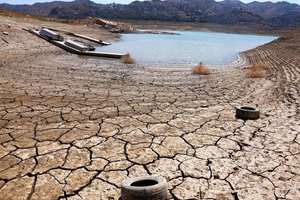
The Sarab Niloufar spring, one of western Iran’s most iconic natural landmarks, has dried up, local environmental officials said, warning that years of groundwater depletion, unregulated farming and drought have destroyed the 25-meter-deep lake once covered in lotus flowers.

Located near the city of Kermanshah, Sarab Niloufar -- famous for its blue lotus flowers and migratory birds -- has turned into cracked earth after years of over-extraction of groundwater, repeated droughts, and unregulated farming, Tasnim reported on Tuesday.

Provincial authorities blamed excessive water use for crop irrigation, illegal wells, and reduced rainfall for the collapse of the lake’s ecosystem.

Soraya Ghorbani, deputy head of Kermanshah’s Department of Environment, said this week that more than half of the factors driving the crisis stem from “repeated planting of water-intensive crops and poor management of groundwater resources.”

She warned that even heavy rainfall would no longer be enough to restore the body of water due to severe shortage of its groundwater.

A view from Sarab Niloufar lake in Kermanshah province in a recent photo
100%
A view from Sarab Niloufar lake in Kermanshah province in a recent photo

Experts say the drying of Sarab Niloufar mirrors a national trend of environmental decline.

A new satellite-based study shows that Iran is undergoing severe land subsidence across 106 regions covering about 31,400 square kilometers -- an area roughly the size of Belgium -- mainly due to excessive groundwater extraction for agriculture.

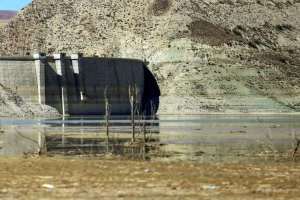
Iran’s water reservoirs have reached their lowest levels in decades -- with only 35% of dam capacity remaining, according to government data -- while 19 major dams are nearing depletion and three have already run dry.

  • Dozens of Caspian seals found dead on Iran’s northern coast

    Dozens of Caspian seals found dead on Iran’s northern coast

  • Northern Iran’s wetlands face collapse as migratory birds disappear

    Northern Iran’s wetlands face collapse as migratory birds disappear

  • Tehran dam runs dry, Lake Urmia collapse displaces residents

    Tehran dam runs dry, Lake Urmia collapse displaces residents

Across the north, wetlands in Golestan Province have also shrunk dramatically after years of drought and dam construction, leaving vast tracts of land barren and driving away hundreds of thousands of migratory birds.

Environmentalists warn that the loss of these wetlands could turn fertile regions into new dust storm hotspots, worsening air quality and threatening nearby farms.

In western Iran, the crisis has both ecological and social dimensions. Once a key habitat and tourist attraction, Sarab Niloufar supported local livelihoods and served as a natural water reservoir.

Officials say its disappearance shows how climate change, mismanagement, and overuse are converging to push Iran’s fragile water systems toward collapse.

“Without immediate national action on sustainable agriculture, groundwater control and interprovincial water sharing, more wetlands will follow the same fate,” Ghorbani said.

Netanyahu says Iran seeks to put US in missile range

Oct 7, 2025, 11:58 GMT+1

Israeli Prime Minister Benjamin Netanyahu said Iran is developing long-range ballistic missiles capable of reaching the United States, warning that Tehran’s expanding weapons program poses a global security threat.

“Iran can blackmail any American city,” Netanyahu warned in an interview with Ben Shapiro, alleging that Tehran is developing intercontinental ballistic missiles with a range of 8,000 kilometers.

“People don’t believe it. Iran is developing intercontinental missiles with a range of 8,000 kilometres, add another 3,000, and they can get to the East Coast of the US.”

He said the missiles could “put New York City, Boston, Washington or Miami under their atomic guns.”

“That’s a really big danger, you don’t want to be under the nuclear gun of these people, who are not necessarily rational and chant ‘death to America,’” he added.

Netanyahu said Israel is “doing great work keeping that away,” crediting cooperation with Washington for bolstering regional defense.

He said Israel and the United States are co-developing “the most advanced offensive weapons on the planet,” and claimed Israeli intelligence had prevented attacks by ISIS, including plots against US targets.

Turning to Gaza, he said Israel is “close to the end of the war, but not there yet,” adding that “we smashed the Iranian axis with most of their proxies.”

Netanyahu said Israel’s campaign would only conclude once Hamas rule in Gaza ends and the remaining hostages are freed.

Iran says Afghan attempts to cross border illegally have doubled

Oct 7, 2025, 11:40 GMT+1

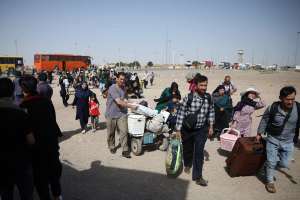
Attempts by Afghan citizens to cross illegally into Iran have doubled over the past six months compared with the same period last year, a senior Iranian border commander said, as Tehran accelerates deportations and tightens control along its frontier with Afghanistan.

Majid Shoja, border guard commander for Iran’s Khorasan Razavi province, said this week that more than 1.5 million Afghan nationals had returned to their country since the start of the Persian year in March -- triple the number from last year.

About 500,000 of them left legally after their residence permits expired, mostly through the official crossings of Dogharoun and Taybad, he said.

Shoja added that around 40,000 illegal crossings were prevented in the first half of the year, double the figure from the same period in 2024.

Iran, he said, is expanding its eastern border sealing project, including the construction of a 300-kilometer border wall, of which 100 kilometers have been completed, and the installation of thermal cameras, acoustic sensors, and 360-degree watchtowers.

These systems, he said, can detect movement up to 45 kilometers away and reduce reliance on manpower.

The commander described the use of advanced surveillance and what he called border diplomacy with Afghanistan and Turkmenistan as key to enhancing security and managing migration.

He also reported a 12% rise in cross-border vehicle traffic and the growing importance of the Taybad free-trade zone and the Khaf–Herat railway link for legal commerce.

  • Iran border guards kill six Afghan migrants in Sistan-Baluchestan - Haalvsh

    Iran border guards kill six Afghan migrants in Sistan-Baluchestan - Haalvsh

  • Iran expels 1.8 million Afghans, eyes 800,000 more

    Iran expels 1.8 million Afghans, eyes 800,000 more

Broader crackdown on Afghan migrants

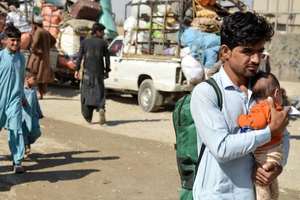
The tighter border measures come amid a nationwide crackdown on undocumented Afghans. In late August, an Interior Ministry official said Iran had expelled 1.8 million migrants over the past year -- most of them Afghans -- and planned to deport at least 800,000 more under a new removal plan.

Rights groups have reported several deadly incidents involving Afghan migrants. On September 8, border guards in Sistan-Baluchestan province opened fire on about 120 Afghans attempting to cross, killing six and wounding five, according to the Baluch rights group Haalvsh.

  • Khamenei-linked daily says Afghan expulsions failed to curb bread prices

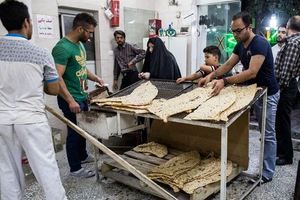
    Khamenei-linked daily says Afghan expulsions failed to curb bread prices

  • With post-war deportations, Afghans in Iran bear brunt of official failures

    With post-war deportations, Afghans in Iran bear brunt of official failures

Human rights monitors, including HRANA, condemned the use of heavy weapons and described the incident as a violation of international law.

The United Nations has warned that mass deportations could trigger a humanitarian crisis in Afghanistan, where the Taliban government is struggling to absorb the influx.

Tehran says its policies are aimed at enforcing immigration law and protecting its borders, insisting that Afghan migrants are treated in accordance with domestic and international norms.


Iran says US conditions for talks not formally presented

Oct 7, 2025, 09:55 GMT+1

Iran said on Tuesday it had not received any formal conditions from the United States for negotiations, after a US newspaper report said Washington had set four requirements.

“According to the foreign minister, such conditions have not been formally presented to Iran, and until that happens they cannot be seriously reviewed,” government spokeswoman Fatemeh Mohajerani told reporters in Tehran.

The Washington Post reported last week that the Trump administration wants Tehran to agree to direct and meaningful talks, end uranium enrichment, impose curbs on its missile program, and stop funding regional armed groups as the basis for any renewed diplomacy.

US officials cited in the report said the reimposition of United Nations snapback sanctions last month was meant to create the environment for a diplomatic solution.

The measures, triggered by Britain, France and Germany, restored pre-2015 sanctions covering arms transfers, financial restrictions, and missile-related activities.

  • US puts stiff peace conditions on Iran - Washington Post

    US puts stiff peace conditions on Iran - Washington Post

Iran has dismissed the new sanctions as “illegal and politically motivated,” saying they violate its right to peaceful nuclear development.

The sanctions followed a June conflict in which Israeli and US strikes targeted Iranian military and nuclear sites, killing hundreds of personnel and civilians. The 12-day war ended with a US-brokered ceasefire on June 24.

Tehran has consistently denied pursuing nuclear weapons, insisting its program is civilian in nature.

Iranian President Masoud Pezeshkian told the UN General Assembly last month that Iran remains open to dialogue but that “the wall of distrust with Washington is quite thick and quite tall.”

  • Calls for Larijani to lead nuclear talks may signal push for rethink

    Calls for Larijani to lead nuclear talks may signal push for rethink

Earlier, Iran’s Security Chief Ali Larijani said US efforts to dictate Tehran’s military and foreign policy predetermine any negotiation outcome, calling them incompatible with Iran’s sovereignty.

The two countries held indirect talks earlier this year aimed at reducing tensions over Iran’s nuclear activities, but progress stalled after the June escalation.

Analysts say the US conditions -- particularly ending enrichment and curbing missile development -- mirror past sticking points that have derailed previous rounds of diplomacy.