''If you impose sanctions, if you threaten us, if you take any action (against Iran), our people will become stronger, more resilient,” deputy coordinator of the Revolutionary Guards’ Quds Force said on Thursday.
“The people of Tehran and all segments of the Islamic Republic will stand against the enemies with all their strength and will ultimately defeat them,” he added, speaking at ceremony in Tehran marking the anniversary of the deaths of Hassan Nasrallah, the slain Secretary General of Hezbollah, and his deputy.
Washington is seeking stiff concessions from Iran for any peace deal, the Washington Post reported on Thursday citing a US official, including curbs to its missile program and support for armed allies in the region.

Iranian officials are downplaying talk of another war with Israel and the United States but US carrier and tanker movements have sparked anxiety as weary citizens weigh readiness for a possible re-run of a punishing summer war.
Mohammad-Jafar Ghaempanah, the President’s executive deputy, told reporters after a cabinet meeting on Wednesday that Iran is “fully prepared” for any new war, though he judged it unlikely Iran's foes would “repeat the mistake”.
Ali Saeedi, head of the Supreme Leader’s Ideological-Political Office, told state media he “could not give a clear answer” on whether war will come.
“The armed forces must be fully prepared, but people should continue their lives and should not be inflamed. At present, we do not observe signs of an enemy attack.”
Flight tracking data over the weekend showed a rapid deployment of aerial refueling craft to the Al Udeid airbase in Qatar, the largest American military installation in the region.
The last large-scale movement of such assets coincided with surprise US and Israeli attacks on Iran in a brief June war. That conflict sent tens of thousands of Iranian civilians heeding Israeli warnings to flee major urban areas. Hundreds were killed.
Open-source satellite imagery and flight tracking date shows the USS Nimitz aircraft carrier and its attendant aircraft operating in the Persian Gulf and docked at Dubai's Jebel Ali port as of last month. Such port calls are largely routine.
Behnam Saeedi, secretary of parliament’s National Security Committee, rejected a link between snapback of UN sanctions and war: “Whether a war restarts or not, in the current circumstances, it has nothing to do with the snapback.”
Still, he described the situation as “not a ceasefire but a suspension of combat operations.”
Military posture: beefing up deterrence
Nour News, a news outlet close to Iran's mercurial ex-security boss Ali Shamkhani, on Tuesday framed new US deployments as a “political message” of support to regional allies and a warning to Iran that the military option is still on the table.
Chief of the General Staff Major-General Amir Mousavi declared the Army and the Revolutionary Guards maintain “extraordinary readiness for a possible future clash.”
Brigadier General Mohammad-Jafar Asadi of the Khatam al-Anbiya headquarters promised Iran would “increase the range of its missiles as far as necessary,” while maintaining that Tehran “will not initiate a war but will give a decisive response to any aggression.”
Competing calculations: low or high risk?
Journalist Hossein Yazdi assessed the probability of renewed large-scale strikes as low. He argued Iran’s nuclear sites, already hit, have not been rebuilt; Israel has extracted its revenge; and the US would likely block further escalation.
“The military phase is over,” he wrote on X, suggesting Israel is now using psychological pressure to sap Iran’s economy.
But others warn that the prospect of strikes are high.
“If you think that the deployment of this volume of armaments, refueling aircraft, fighter jets, and so on by America is random, accidental, or merely for the sake of creating fear and intimidation, congratulations," writer Mohammad-Reza Mohajer posted on X. "You are extremely optimistic, and no other event can destroy this optimism in you."
Political analyst Ali Nasri called endless speculation corrosive: “Keeping society continually struggling to ‘predict’ or ‘await’ a military attack is itself a tool of psychological warfare and collective torture of the Iranian people."
"It aims to further damage the economy and disrupt life. If there is a war, we will respond proportionately," he added on X. "For now, our challenge as citizens is to continue ordinary life.”
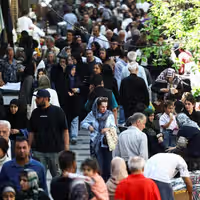
Street-level voices: fear, anger, fatigue
Signals of potential conflict are already being priced in Iran's moribund markets.
The rial and gold have reacted, with the dollar rate again breaking records against the prone rial and gold hitting new highs. On social media, frustration dominates.
One user lamented: “Instead of enjoying the weekend, everyone I meet talks about war and the dollar and the misery the clerics have given us!”
Another wrote: “Dollar, sanctions and the possibility of war — I really have no strength left to continue.”
Iran’s central bank governor blamed what he described as psychological warfare by the country’s adversaries for the rial’s decline, saying the current exchange rate against major currencies reflects fear rather than economic fundamentals.
“The current exchange rate is a rate of fear and the result of the enemy’s psychological warfare,” Mohammad Reza Farzin said.
“The enemy is trying to create fear, panic, and instability in the country’s economy through false news and the creation of fake foreign exchange channels on social media, most of which are operated on servers outside the country,” he added.
Iran’s currency, the rial, traded at more than 118,000 to the US dollar on Tehran’s open market on Thursday morning, up from around 116,400 a day earlier.
Paris believes the reinstatement of UN sanctions does not prevent dialogue with Tehran and that the path to negotiations remains open, Al Arabiya quoted French Foreign Minister Jean-Noël Barrot as saying in an interview on Thursday.

Washington is seeking stiff concessions from Iran for any peace deal, the Washington Post reported on Thursday citing a US official, including curbs to its missile program and support for armed allies in the region.
The United States wants Tehran to commit to direct talks with the United States, ending uranium enrichment, curbing its missile program and ending funding for its armed affiliated in the Middle East, the newspaper cited the official as saying.
European-triggered international sanctions were reimposed on Tehran over the weekend as a standoff over Iran's nuclear activities lingers despite Israeli and US attacks in June which US President Donald Trump says "obliterated" Iran's program.
According to the US official cited by the Post, the so-called snapback sanctions will “create the environment” for “a diplomatic solution."
Tehran denies seeking a bomb and has called the new sanctions an illegal attempt to violate its sovereignty and end enrichment activities permitted by international law.
On Wednesday, Iran's security chief Ali Larijani said US attempts to dictate its military capabilities, foreign policy and nuclear rights were unacceptable and anticipated the outcome of any talks before they had even began.
The Trump administration and Tehran held two months of talks earlier this year to reach an agreement on Iran's disputed nuclear program.
But the day after Trump's 60-day deadline passed, Israel launched a surprise attack on Iran on June 13, striking military and nuclear facilities as well as senior commanders and officials.
Hundreds of military personnel and civilians were killed. Iran retaliated with ballistic missiles and drones which killed 31 Israeli civilians and an off-duty soldier.
On June 22, the US joined the campaign, hitting three major nuclear sites in Isfahan, Fordow, and Natanz, which President Trump said destroyed Iran’s capacity to build a nuclear bomb.
A ceasefire was brokered by the United States on June 24, ending the 12-day war.
Arab caution
Tensions remain high in the region, especially after a failed Israeli attempt to assassinate senior Hamas officials based in Qatar last month.
A senior Arab government official close to the Trump administration cited by the Post cautioned against a continuing cycle of violence.
“The region today cannot go through the same Iranian-Israeli war or the other wars of the last two years. The cost is too high,” the daily quoted the official as saying, adding “de-escalation” and "diplomacy has to be the way forward".
Since the ceasefire, the United Kingdom, France, and Germany in August have pushed Iran to enter direct negotiations with the US and fully cooperate with the International Atomic Energy Agency (IAEA). Iran, however, had suspended cooperation in response to the attacks.
The three European powers warned that if Iran refused, they would trigger the return of UN sanctions under a UN resolution codifying a now mostly lapsed 2015 nuclear deal. Those sanctions are now in force.
The new sanctions further strained Iran’s already fragile economy. Oil exports, the country’s main source of revenue, have faced renewed restrictions, threatening foreign currency earnings.
The Iranian rial has continued to lose value against the dollar, pushing inflation higher and worsening the cost of living crisis. International banking channels remain largely closed to Iran, hampering trade and investment.