Iranian Foreign Minister Abbas Araghchi in a letter to his foreign counterparts urged governments not to recognize or comply with the reimposition of UN sanctions on Iran, calling the measures illegal.
Araghchi called on governments "to reject any claims related to the revival of terminated resolutions, avoid incorporating such illegal measures into their national policies and laws, and encourage other countries to uphold multilateralism and resist the misuse of international institutions,” according to the Iranian foreign ministry.
He said that Iran has “always demonstrated its readiness for diplomacy and constructive engagement,” adding that the Islamic Republic will “continue to firmly defend its sovereign rights and legitimate interests.”

President Masoud Pezeshkian’s reference at the UN to Iranian children killed by Israeli strikes triggered a backlash at home, where many asked why he did not also acknowledge the dozens of children slain by Iranian security forces during the 2022 uprising.
The contrast revived one of the movement’s most searing slogans: “Death to the child-killing government.”
The stories of these children underscore the scale and cruelty of the crackdown, where even toddlers were killed and grieving families were threatened into silence.

The boy who became a symbol
Nine-year-old Kian Pourfalak from Izeh in southwest Iran became a national symbol. He was killed when security forces opened fire on his family’s car on 16 November 2022. His parents—wounded but survived—insist they were deliberately targeted.
A bright, imaginative child, Kian loved rainbows and robotics, constantly inventing projects and experiments. One of his proudest creations was a boat built from lollipop sticks that floated successfully on water.
After his death, images of his rainbow drawings and handmade boat spread widely, becoming symbols of innocence and promise destroyed by the crackdown.
Kian’s parents have faced repeated intimidation and summons by intelligence officials for speaking publicly about his killing
The Youngest Victim
The youngest victim recorded was just two years old. Known only by her family name, Mirshekar, she was reportedly shot dead while playing outside her home in Zahedan, in southeastern Sistan and Baluchestan Province, on 30 September 2022.
That day—remembered as “Zahedan’s Bloody Friday”—was among the deadliest of the uprising.
Security forces and snipers opened fire on protesting crowds after Friday prayers in the city’s Sunni-majority area, killing over 100 people and injuring many more with live ammunition, pellets, and tear gas.
More than a dozen children were among the dead.

The Child Laborer
Also killed on Bloody Friday was Mohammad-Eghbal Nayeb-Zehi, a 16-year-old Baluchi boy.
From a poor family without official identity papers, he had worked in construction since the age of nine to help support his parents and siblings.
That Friday, he walked many kilometers from his village to Zahedan to attend prayers. Carrying just enough money for a sandwich afterward, he was gunned down.
His modest dream was to one day buy a smartphone and open an Instagram account—a simple ambition that captured both his hopes and the fragility of his life.

Lost Before First Class
Hasti Narouei, a seven-year-old about to begin her first year of school, never made it.
On 30 September, her grandmother took her along to Friday prayers. There, she was reportedly struck on the head by a tear gas canister.
Hasti suffocated and died before she ever had the chance to sit in a classroom.

Gunned down on the way to school
In a village near Saravan, also in Sistan and Baluchestan, Mona Naghib was walking to class with her older sister Maryam when security forces opened fire while chasing two teenage protesters.
A bullet struck Mona. Maryam tried to carry her home, but she died before any medical help could arrive. The family has faced threats from intelligence officials who ordered them to remain silent, according to rights groups.

Killed for chanting
Helen Ahmadi, a seven-year-old girl from Bukan in West Azerbaijan Province, was shot on 12 October 2022 while walking home from school with other children, allegedly for chanting slogans.
Activists say security forces later pressured her family to claim her death was caused by a car accident, highlighting the ongoing intimidation faced by families of children killed in the crackdown.
Iran will enter a war with the United States if Israel launches a new attack on the Islamic Republic, the former chief commander of Iran's Revolutionary Guard said on Sunday.
Major General Mohsen Rezaei also said Tehran will not accept negotiations with Western powers that give Israel time to prepare or strengthen its position.
“Negotiations aimed at giving Israel time or strengthen it are unacceptable,” Rezaei told the state TV as he was once again seen wearing his military uniform.
“If that happens, the moment Israel starts a war, we will also enter a war with the United States,” Rezaei, a member of Iran’s Expediency Council, added.
“Negotiations must not be accepted in any form, at any price, or without conditions,” he said.
“If we enter negotiations, military force must in no way be used against Iran. Otherwise, we will retaliate; not only against Israel, but also against American targets in the region.”

French Foreign Minister Jean-Noël Barrot said the reimposition of UN sanctions on Iran does not close the door to diplomacy with Tehran.
“The door of diplomacy remains open. We want to continue the dialogue that should allow us to move forward,” Barrot told French news channel LCI.
“It is in Iran’s interest to pursue dialogue.”
He added that sanctions and talks would proceed in parallel.
“So, sanctions are being reapplied today, but dialogue continues so that all security guarantees may be provided by Iran and our security interests may be truly ensured,” he said.

The reimposition of UN sanctions on Iran, atop the US sanctions President Masoud Pezeshkian had pledged to lift during his election campaign, has disillusioned many of his moderate supporters and prompted hardliners to call for his resignation.
Pezeshkian, who left New York on Saturday empty-handed after failing to secure a deal with European powers, said the United States demanded Iran surrender its stock of highly enriched uranium in exchange for only 90 days of relief from UN sanctions.
“If we are to choose between the unreasonable demands of the Americans and the snapback, our choice is the snapback,” Pezeshkian said, hours before the return of UN sanctions.
Kamran Matin, professor of international relations at the University of Sussex, told Iran International that Iran’s leaders knew negotiations would not succeed because halting enrichment and surrendering the highly enriched uranium stockpiles would have meant “total surrender”—something that would have endangered the Islamic Republic’ cohesion.
US-based commentator Ali Afshari argued that the responsibility went beyond Pezeshkian, stressing that presidents do not determine Iran’s strategic policies.
“Those who peddled illusions in the 2024 presidential ‘quasi-election’ cannot hold only Masoud Pezeshkian responsible for the return of UN sanctions and the war,” he wrote on X, adding that reformists had misled voters by urging participation.
Hardliners claim vindication
The snapback of UN sanctions has emboldened Pezeshkian’s conservative rivals who staunchly opposed the 2015 nuclear deal.
After the UN vote, his hardline election rival Saeed Jalili wrote on X: “In 2015 they said JCPOA would completely lift sanctions but almost nothing (happened). Ten years of a nation’s life was wasted because of this political behavior.”
Ultra-hardline lawmaker Amirhossein Sabeti, a close ally of Jalili, echoed his remarks: the JCPOA “was a colonial and one-sided agreement that wasted ten years of the nation’s life, restricted Iran’s nuclear infrastructure, and ultimately, by proving the wisdom of the revolutionary camp that opposed it from the beginning, exposed the illusions of the pro-West faction.”
On social media, ultra-hardline users demanded prosecutions. One wrote: “The end of the disgraceful JCPOA—the greatest shame in the history of Iran’s politics—congratulations to patriotic compatriots and those who care for Iran, and condolences to reformists, centrists, moderates, and all traitors to the homeland. It is time that those responsible for this disgraceful agreement be put on trial for this unforgivable betrayal.”
Some voices in the reformist camp lamented the collapse. Azar Mansouri, head of the Reform Front, accused conservatives of political score-settling.
“They fought it for years and now celebrate its death. But returning to the pre-JCPOA era means sanctions, isolation, and more pressure on the people. What is there to celebrate?”
Disillusionment with Pezeshkian
Frustration has increasingly turned toward the president. One user recalled his campaign pledge: “Pezeshkian had promised that if he failed to achieve his goals, including lifting sanctions, he would resign. Why didn’t he rely on popular mobilization to achieve his aims? Why doesn’t he resign now?”
Others mocked his unkept promises. “From the beginning, pinning hopes on Pezeshkian to lift sanctions was wishful thinking,” one activist wrote. “Someone who couldn’t deliver on his promise of lifting internet filtering after a year cannot be expected to deliver on lifting sanctions… He had also promised to resign if his pledges were not fulfilled.”
Journalist Mohammad Aghazadeh faulted reformists for urging turnout: “They frightened us by saying if Jalili won, the JCPOA would collapse, and war would break out. Pezeshkian was elected, but sanctions returned, and war came too—and will come again.”
Activist Hossein Razzagh, who boycotted the election, wrote: “The only thing Pezeshkian is not committed to is the votes of those he lured to the ballot box with promises of lifting the shadow of war. The only thing he is committed to is the Leader!”
Journalist Ahmad Zeidabadi urged Pezeshkian to level with voters: “Most of the decisive factors lie beyond his control. But he must frankly explain to the people what his plan is… In fact, he entered the second round of the presidential election with the aim of saving us from Saeed Jalili’s program. Now he is compelled to play Mr. Jalili’s role himself!”
Political activist Motahereh Gounei summed up the wider sense of betrayal: “You celebrated that Jalili didn’t come and Pezeshkian did! The country was ruined, its resources and infrastructure destroyed, we got both war and negotiations!"
"Sanctions returned, the dollar reached 110,000 tomans, and now I, a young Iranian, am awaiting a prison sentence simply for writing about Khamenei’s incompetence in governance and policymaking," the activist said.
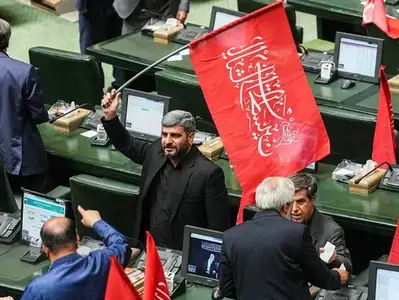
Iranian parliament speaker Mohammad Bagher Ghalibaf dismissed concerns that reinstatement of UN sanctions on Tehran could lead to war, saying Israel has refrained from further attacks because it fears another defeat.
“If the Israelis have not attacked our country again until now, it is because they have felt that another attack would lead to a defeat worse than the previous war,” Ghalibaf said.
He also rejected the European troika’s activation of the UN snapback mechanism as illegal.
“Iran does not consider itself bound by these illegal resolutions, including the suspension of enrichment, and we believe that our right to enrichment remains recognized under international law,” he wrote on X.
Ghalibaf said UN sanctions are weaker than US measures and face “serious legal obstacles” at the UN, warning of a “serious and reciprocal” response to any action against Iran.
He accused Western countries of using negotiations “as a deceptive way to intensify pressure and disarm Iran’s missile program.”