Iran’s First Vice President Mohammad Reza Aref said the government has finalized its plans to respond to the reimposition of UN sanctions.
“The government’s plans to confront the unjust sanctions have been reviewed and finalized, and in this regard, it is necessary to make decisions appropriate to the country’s conditions,” Aref said at an economic and administrative policy meeting attended by senior officials, including Ali Larijani, secretary of the Supreme National Security Council.
He added that for several months, the government has been holding meetings with the president to assess various regional and international scenarios and has prepared itself for any situation.
Iranian President Masoud Pezeshkian ruled out entering new negotiations with Western powers, speaking at the first cabinet meeting after his return from New York and the UN Security Council’s decision to reimpose sanctions on Tehran.
“We will never agree to negotiations that entangle us in new issues and problems,” Pezeshkian said.
He added that Iran’s strategy is to deepen constructive ties with neighboring and friendly countries to counter external pressure. “Through the broad and constructive interactions and relations formed with neighbors and friendly, like-minded countries, ill-wishers will never achieve their goals or delusions,” he said.
Pezeshkian added that Iran is prepared to face any situation, with people’s livelihoods at the center of the government’s attention.
Israeli Prime Minister Benjamin Netanyahu said Israel knows the location of 450 kilograms of highly enriched uranium in Iran and has shared the information with the United States.
“We certainly know where it is. We have a pretty good idea where it is, and we share that information with each other,” Netanyahu said in an interview with Fox News when asked whether Israel knows where the uranium is and has plans to neutralize it.
He said that Israel knew in advance of the June strikes that the stockpile would not be destroyed.

“We knew that in advance. In fact, our whole plan before and after the United States decided to join us took into account that we wouldn't get these 450 kilograms of enriched uranium,” Netanyahu said.
“We knew that. What we were targeting is the capacity to make more of that enriched uranium and also the attempt to weaponize it.”
He added that reinstatement of UN sanctions on Iran was a positive step toward increasing pressure to stop Tehran from resuming its nuclear program.
“I'm glad… We have to keep up the diplomatic and economic pressure on Iran to make it clear that we will not tolerate a resumption of their efforts to build nuclear bombs to destroy my country and yours (the United States),” he said.
Iranian exiled prince Reza Pahlavi welcomed the UN Security Council’s decision to reimpose snapback sanctions on Iran, calling it a long-overdue acknowledgment that the Islamic Republic is “incapable of reform or rehabilitation.”
“These sanctions and their consequences are the responsibility of Ali Khamenei and his criminal regime who over 46 years have dragged Iran from prosperity to isolation,” Pahlavi said on X.
“While sanctions alone will not stop the regime’s aggression, they deprive it of vital resources used for repression at home and terror abroad,” he added.
Pahlavi urged governments to take further steps, saying: “Designate the IRGC as a terrorist organization, isolate the world’s foremost state sponsor of terrorism economically and diplomatically, and provide maximum support to the Iranian people in their fight for freedom.”

Finnish Foreign Minister Elina Valtonen called Iranian state television’s decision to blur her legs during a broadcast of her UN meeting with Iran’s foreign minister a “sad” reflection of women’s treatment in the country.
“My Swedish colleague sent me the video on Friday. My first reaction was that it was amusing. But I immediately added, 'sad too’,” Valtonen told Helsingin Sanomat, Finland’s largest daily newspaper.
She added that she does not change her clothing based on who she is meeting and avoids events that require covering the face or hair.
Valtonen said she raises women’s rights in every meeting with Iranian officials, including this week’s talks.
Iranian state television blurred Valtonen’s legs in a news broadcast of her meeting with Iran’s Foreign Minister Abbas Araghchi on Tuesday on the sidelines of the UN General Assembly in New York.
Sweden’s Foreign Minister Maria Malmer Stenergard’s legs were also blurred in the same broadcast. The footage was widely shared on social media, including by Iranian women's rights activist and journalist Masih Alinejad.
Finland’s National Coalition Party, which Valtonen represents, also reacted on Instagram, calling the incident “a sad example of the trampling of women’s rights.”
"This is a reminder of how women around the world are still controlled and erased from visibility. Every woman has the absolute right to be seen, heard, and live freely," the party wrote on a post on Instagram.
"The National Coalition Party stands firmly for women’s rights — both in Finland and globally," it added.
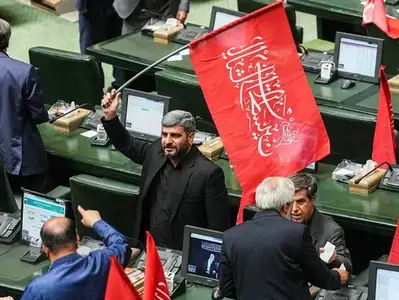
Hardline Iranian lawmaker Mehdi Koochakzadeh said parliament speaker Mohammad Bagher Ghalibaf blocked a proposal to discuss Tehran's withdrawal from the Nuclear Non-Proliferation Treaty during a closed session on Sunday.
Lawmakers had earlier said the decision to exit NPT must be first made by the Supreme National Security Council.