Swiss president offers to host renewed nuclear talks with Iran
Bern is ready to host renewed negotiations between the Islamic Republic and European states should talks resume, Switzerland’s president told Iran's President Masoud Pezeshkian in New York.
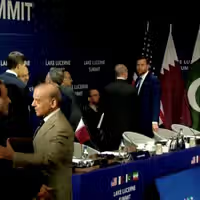
Pezeshkian met the leaders of Bolivia, Finland, and Switzerland on Wednesday on the sidelines of the UN General Assembly.
“If the nuclear talks are revived, Switzerland can provide the venue,” the Swiss president Karin Maria Keller-Sutter said.
The meetings came as new US restrictions confined the Iranian delegation’s movements in New York more tightly than in past years. Iran’s ambassador to the UN has since written to Secretary-General Antonio Guterres to protest the measures.
Iran’s Ambassador to the United Nations, Amir-Saeid Iravani, addresses members of the U.N. Security Council after a vote on a resolution that would permanently lift UN sanctions on Iran, at UN headquarters in New York City, US, September 19, 2025.
Russia and China have asked the UN Security Council to vote on a draft resolution on Friday that would delay the reinstatement of international sanctions on Iran by six months, Reuters reported citing diplomats.
Iran and European powers held last-ditch talks in New York on Tuesday to try to prevent the revival of UN sanctions on Tehran, though diplomats on both sides cautioned that chances of success remain slim.
Last week, a UN Security Council resolution on whether to permanently lift UN sanctions on Iran was voted down.
All UN sanctions on Iran will be reimposed at 8PM Eastern time on Friday (0000 GMT Saturday) after the E3 — Germany, France and Britain — triggered a 30-day process accusing Tehran of violating the 2015 nuclear deal aimed at preventing it from developing nuclear weapons.
The E3 have offered to delay deadline by six months if Tehran agrees to resume talks with Washington and cooperate with UN nuclear watchdog.
French President Emmanuel Macron said he pressed his Iranian counterpart Masoud Pezeshkian on the E3’s three non-negotiable demands during their meeting on the sidelines of the UN General Assembly on Wednesday.
The demands, he said, include full access for International Atomic Energy Agency inspectors in Iran, transparency on enriched uranium stockpiles and the immediate resumption of negotiations.
Pezeshkian said a "definitive solution" was possible after talks with the French president. But on Thursday, he warned that Iran is fully prepared to face any scenario and would adjust its policies if UN sanctions are reinstated.
UN spokesperson Stéphane Dujarric told Iran International on Thursday that the window for diplomacy was still open.
"I think it is important that the Islamic Republic as well as the Europeans and the US seize the moments, the few days or hours that are left to try to work for a diplomatic solution to the Iranian nuclear issue," he said.
Earlier this week, Iran’s Supreme Leader Ali Khamenei, who holds ultimate authority on Iranian policy, ruled out talks with the United States, saying they would lead to a “dead end.”
Ali Larijani, Secretary of Iran's Supreme National Security Council
Iran’s top security official Ali Larijani said on Thursday US demands that Tehran curb its missile program were a non-starter and that looming UN sanctions ought not to pinch Iran as much as current US measures.
Speaking in a televised interview, Larijani, head of Iran’s Supreme National Security Council, said Washington has demanded Iran halt all uranium enrichment and curb its missile program.
“The Americans insist we must negotiate, specifically about Iran’s missiles,” Larijani said. “They came and said you shouldn’t have any enrichment at all … They said no missiles, sometimes below 300 kilometers (185 miles), now below 500 kilometers (310 miles)—meaning they want to strip us of key defensive and offensive capabilities.”
For years, Iran has voluntarily capped its missile range at 2,000 kilometers, which it says is sufficient to reach its main regional adversary, Israel.
France, Britain and Germany triggered the resumption of UN sanctions against Iran last month through the “snapback” mechanism of a 2015 nuclear deal, accusing Tehran of not conforming to nuclear obligations outlined in the agreement.
The measures are scheduled to take effect September 28. Larijani dismissed their impact, arguing that US sanctions remain far harsher.
“Some politicians in Iran ask why we don’t resolve this sooner. We’re trying to resolve it; we don’t want unnecessary pressure on the country. But is there any politician in Iran who would agree to cut our missile range below 500 kilometers?” he asked.
Supreme Leader Ali Khamenei on Tuesday rejected talks with Washington, calling US President Donald Trump’s demand that Iran end domestic uranium enrichment an “insult” that had earned him a “slap in the face” from the Iranian people.
President Masoud Pezeshkian, addressing the UN General Assembly in New York on Wednesday, denounced Israeli raids on Iran’s nuclear facilities in June as illegal and condemned European powers for reimposing UN sanctions.
Bad terms
Larijani said that Iran is open to dialogue but unwilling to accept terms he called “illogical.”
“The issue is they want us to negotiate. Negotiate, fine—has anyone said don’t negotiate? But if the endgame is already decided, no sensible person will accept it. We’ve tried all paths, but if they insist on these illogical demands, we must stand firm.”
Israel launched a surprise military campaign on June 13, striking military and nuclear sites in Iran. Air raids killed nuclear scientists along with hundreds of military personnel and civilians. Tehran retaliated with drone and missile attacks that killed 31 Israeli civilians and one off-duty soldier.
The United States entered the conflict on June 22, bombing major nuclear facilities including Fordow, Natanz, and Isfahan, before brokering a ceasefire on June 24.
Washington said the strikes set back Iran’s nuclear program by years, though the International Atomic Energy Agency has yet to verify the damage due to lack of access.
Supporters, relatives, Mayor of Paris Anne Hidalgo and officials hold a banner in support of Cecile Kohler and Jacques Paris, two French citizens held in Iran, during a rally to mark their three-year detention and to demand their release, Paris, France, May 7, 2025
France withdrew its case against Iran at the International Court of Justice (ICJ) over the detention of two French citizens arrested in May 2022 on espionage charges, the court announced on Thursday without elaborating.
The decision, announced by the court on Thursday, came a day after French President Emmanuel Macron met Iranian President Masoud Pezeshkian on the sidelines of the UN General Assembly in New York.
It was not clear why the case was withdrawn or whether it augured progress toward a deal.
The ICJ case, filed in May, accused Iran of violating consular rights of Cécile Kohler and Jacques Paris under the Vienna Convention and subjecting the detainees to torture-like conditions in Tehran’s Evin prison.
France labeled the arrests as "hostage diplomacy," with Kohler and Paris, a teacher and her partner, accused of spying for Israel’s Mossad.
They were detained in May 2022, and Iranian state TV aired a confession from the pair in October of that year.
Human rights groups have accused Iran for systematically extracting confession by force. Tehran denies political motives behind the detentions.
Iran seeks the release of Iranian national Mahdieh Esfandiari, who has been held in Fresnes prison near Paris since March on charges of glorifying terrorism.
During their meeting on Wednesday, Macron said he pressed Pezeshkian for the release of Kohler, Paris and a third French national Lennart Monterlos, as well as compliance with Western demands for greater transparency on its nuclear program.
Pezeshkian, posting on X, expressed optimism about resolving tensions.
The last prisoner swap between Iran and a European country came when Italy freed an Iranian national wanted by the United States for allegedly supplying Tehran with drone technology in exchange for an accredited Italian journalist arrested in Iran.
Russia and China have asked the UN Security Council to vote on a draft resolution on Friday that would delay the reinstatement of international sanctions on Iran by six months, Reuters reported citing diplomats.
Iran and European powers held last-ditch talks in New York on Tuesday to try to prevent the revival of UN sanctions on Tehran, though diplomats on both sides cautioned that chances of success remain slim.
Last week, a UN Security Council resolution on whether to permanently lift UN sanctions on Iran was voted down.
All UN sanctions on Iran will be reimposed at 8 p.m. EDT Friday (0000 GMT Saturday) after the UK, France and Germany triggered a 30-day process accusing Tehran of violating the 2015 nuclear deal aimed at preventing it from developing nuclear weapons.
The death of a female Iranian political prisoner in hospital following a series of seizures has sparked outrage from Iran's two Nobel laureates and right groups who have labeled her death a state-sponsored murder.
Somayeh Rashidi died after several days in hospital following her transfer from Qarchak Prison near Tehran, Iran’s judiciary-affiliated Mizan news agency reported on Thursday.
Rashidi, born in 1983, was detained in April for allegedly writing anti-government graffiti slogans in Tehran’s Javadieh district. Initially held in Evin Prison, she was transferred to Qarchak after an Israeli strike on the facility in June.
Nobel Peace laureates Narges Mohammadi condemned her death in custody, describing it as part of a pattern of abuse in detention.
“This devastating loss of Somayeh Rashidi is not an accident but the result of a systematic policy of neglect and cruelty inside Iranian prisons,” Mohammadi said in a post on X.
'Evident torture'
Rights groups and activists including Nobel laureate Shirin Ebadi had previously raised alarm about Rashidi’s deteriorating condition, highlighting her urgent need for medical attention.
“Neglecting her health, ignoring her repeated seizures in prison, is clear evidence of torture and deliberate negligence,” Ebadi posted on Instagram.
“Somayeh Rashidi’s state-sponsored murder must be a wake-up call—a slap in the face to human rights defenders, freedom fighters, and equality advocates who still choose silence or compromise, and to an opposition caught in internal disputes.”
Iran International reported earlier this month that Rashidi’s condition had severely declined, with doctors holding little hope for her recovery.
An informed source, speaking anonymously to Iran International for safety, said that under Iran’s criminal laws Rashidi’s death constitutes intentional murder.
“The prison’s health deputy, warden, Qarchak court, Tehran prison director, case investigator and prison supervisor all played a role. They could have ordered an immediate transfer or declared the prison unfit to hold her,” the source said.
“When a prisoner is evaluated and has a known condition, authorities can refuse detention due to lack of capacity. Admitting they knew and still detained her means deliberate neglect leading to intentional murder.”
Death for graffiti
Iranian rapper Toomaj Salehi, who faced a death sentence and torture in prison but was ultimately released, called Rashidi’s death a deliberate act to suppress dissent.
“Such deliberate disregard for political prisoners is an example of silent, systematic suppression and elimination of dissenters. Why should anyone be arrested for graffiti?” Salehi posted on X.
Former political prisoner and women’s rights defender Hasti Amiri said Rashidi’s case showed deliberate neglect.
“She had a medical history and her family could not afford bail, yet authorities denied release and delayed her transfer. This is intentional murder under Article 290 of the Penal Code meaning intentional murder,” she wrote on X.
Motahereh Gooneyi, another former political prisoner, recalled collapsing half-conscious during a hunger strike after being transferred to Qarchak following Israeli strikes on Evin and said the life of political prisoners in Iran is “worthless,” adding the hashtag #SomayehRashidi in Persian on X.
According to information received by Iran International, a group of female political prisoners in Qarchak Prison, staged a sit-in in the prison yard to protest Rashidi's death, chanting anti-government slogans.
The sources said the prisoners chanted that her death was a “silent state murder” and accused the judiciary, prison authorities and other government officials of complicity in her death.
Qarchak deaths mount
Human rights groups including the Norway-based Iran Human Rights (IHR) have publicly called for the closure of Qarchak, describing it as “one of the darkest symbols of systematic human rights violations in the Islamic Republic.”
Rashidi death comes less than a week after another prisoner, Maryam Shahraki, died in Qarchak last Friday.
According to Norway-based rights group Hengaw Organization, three women have already died in this facility this year due to lack of adequate medical care — Jamileh Azizi on September 19, Shahraki on September 13, and Farzaneh Bijanipour on January 11.