Talks with Iran remain feasible, said the United Nations, with Secretary-General António Guterres’s spokesman framing diplomacy as the only dependable path.
“There is still an opportunity for diplomacy with Iran,” said UN spokesman Stéphane Dujarric in an interview with Iran International.
By addressing Iran and the conflict together, the UN underlined its commitment to diplomatic avenues even as political divisions complicate prospects for negotiation.

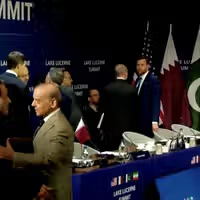
Bern is ready to host renewed negotiations between the Islamic Republic and European states should talks resume, Switzerland’s president told Iran's President Masoud Pezeshkian in New York.
Pezeshkian met the leaders of Bolivia, Finland, and Switzerland on Wednesday on the sidelines of the UN General Assembly.
“If the nuclear talks are revived, Switzerland can provide the venue,” the Swiss president Karin Maria Keller-Sutter said.
The meetings came as new US restrictions confined the Iranian delegation’s movements in New York more tightly than in past years. Iran’s ambassador to the UN has since written to Secretary-General Antonio Guterres to protest the measures.

Russia and China have asked the UN Security Council to vote on a draft resolution on Friday that would delay the reinstatement of international sanctions on Iran by six months, Reuters reported citing diplomats.
Iran and European powers held last-ditch talks in New York on Tuesday to try to prevent the revival of UN sanctions on Tehran, though diplomats on both sides cautioned that chances of success remain slim.
Last week, a UN Security Council resolution on whether to permanently lift UN sanctions on Iran was voted down.
All UN sanctions on Iran will be reimposed at 8PM Eastern time on Friday (0000 GMT Saturday) after the E3 — Germany, France and Britain — triggered a 30-day process accusing Tehran of violating the 2015 nuclear deal aimed at preventing it from developing nuclear weapons.
The E3 have offered to delay deadline by six months if Tehran agrees to resume talks with Washington and cooperate with UN nuclear watchdog.
French President Emmanuel Macron said he pressed his Iranian counterpart Masoud Pezeshkian on the E3’s three non-negotiable demands during their meeting on the sidelines of the UN General Assembly on Wednesday.
The demands, he said, include full access for International Atomic Energy Agency inspectors in Iran, transparency on enriched uranium stockpiles and the immediate resumption of negotiations.
Pezeshkian said a "definitive solution" was possible after talks with the French president. But on Thursday, he warned that Iran is fully prepared to face any scenario and would adjust its policies if UN sanctions are reinstated.
UN spokesperson Stéphane Dujarric told Iran International on Thursday that the window for diplomacy was still open.
"I think it is important that the Islamic Republic as well as the Europeans and the US seize the moments, the few days or hours that are left to try to work for a diplomatic solution to the Iranian nuclear issue," he said.
Earlier this week, Iran’s Supreme Leader Ali Khamenei, who holds ultimate authority on Iranian policy, ruled out talks with the United States, saying they would lead to a “dead end.”
"We're obviously concerned about anything that might happen that would reignite an open conflict that would further destabilize the region,” United Nations spokesperson Stéphane Dujarric told Iran International.
"There is still room for diplomacy and I think it is important that the Islamic Republic as well as the Europeans and the US seize the moments, the few days or hours that are left to try to work for a diplomatic solution to the Iranian nuclear issue," he added.

Iran’s top security official Ali Larijani said on Thursday US demands that Tehran curb its missile program were a non-starter and that looming UN sanctions ought not to pinch Iran as much as current US measures.
Speaking in a televised interview, Larijani, head of Iran’s Supreme National Security Council, said Washington has demanded Iran halt all uranium enrichment and curb its missile program.
“The Americans insist we must negotiate, specifically about Iran’s missiles,” Larijani said. “They came and said you shouldn’t have any enrichment at all … They said no missiles, sometimes below 300 kilometers (185 miles), now below 500 kilometers (310 miles)—meaning they want to strip us of key defensive and offensive capabilities.”
For years, Iran has voluntarily capped its missile range at 2,000 kilometers, which it says is sufficient to reach its main regional adversary, Israel.
France, Britain and Germany triggered the resumption of UN sanctions against Iran last month through the “snapback” mechanism of a 2015 nuclear deal, accusing Tehran of not conforming to nuclear obligations outlined in the agreement.
The measures are scheduled to take effect September 28. Larijani dismissed their impact, arguing that US sanctions remain far harsher.
“Some politicians in Iran ask why we don’t resolve this sooner. We’re trying to resolve it; we don’t want unnecessary pressure on the country. But is there any politician in Iran who would agree to cut our missile range below 500 kilometers?” he asked.
Supreme Leader Ali Khamenei on Tuesday rejected talks with Washington, calling US President Donald Trump’s demand that Iran end domestic uranium enrichment an “insult” that had earned him a “slap in the face” from the Iranian people.
President Masoud Pezeshkian, addressing the UN General Assembly in New York on Wednesday, denounced Israeli raids on Iran’s nuclear facilities in June as illegal and condemned European powers for reimposing UN sanctions.
Bad terms
Larijani said that Iran is open to dialogue but unwilling to accept terms he called “illogical.”
“The issue is they want us to negotiate. Negotiate, fine—has anyone said don’t negotiate? But if the endgame is already decided, no sensible person will accept it. We’ve tried all paths, but if they insist on these illogical demands, we must stand firm.”
Israel launched a surprise military campaign on June 13, striking military and nuclear sites in Iran. Air raids killed nuclear scientists along with hundreds of military personnel and civilians. Tehran retaliated with drone and missile attacks that killed 31 Israeli civilians and one off-duty soldier.
The United States entered the conflict on June 22, bombing major nuclear facilities including Fordow, Natanz, and Isfahan, before brokering a ceasefire on June 24.
Washington said the strikes set back Iran’s nuclear program by years, though the International Atomic Energy Agency has yet to verify the damage due to lack of access.