“The clock is ticking,” EU foreign policy chief Kaja Kallas told Al Jazeera in an interview at the United Nations on Wednesday.
Kallas and envoys from France, Britain and Germany met with Iran's delegation to the annual UN General Assembly after the three countries triggered the so-called snapback of international sanctions on Iran over its nuclear program last month.
The sanctions are due to return on Sunday barring any diplomatic breakthrough.
“There are just a few hours left,” she added. “We have sat down and really tried to find diplomatic solutions. There are still a few hours left, and hopefully we get there.”

Iran’s Supreme Court has upheld the death sentence of a poet from northern Iran whose works focused on social justice and civil rights, his lawyer said on Wednesday.
“The death sentence of Peyman Farahavar, which had been issued by Branch 1 of the Revolutionary Court of Rasht, was reviewed in Branch 39 of the Supreme Court following an appeal. The appeal was rejected and the death sentence of my client was upheld,” defense lawyer Ramin Safarnia wrote on X.
“A request for a retrial will be submitted to the Supreme Court, and we hope that through legal means, this prisoner’s death sentence will be overturned,” he added.
Farahavar, from Gilan province in northern Iran, was arrested by security forces in 2024.
He was sentenced to death on April 30, this year on alleged charges of baghi (armed rebellion) and moharebeh (waging war against God).
The US-based rights group Human Rights Activists News Agency, citing an informed source close to the family, said the charges were based on his poems and protest activities related to social justice and civil rights.
Iran has executed at least 1,000 people so far this year, according to Norway-based Iran Human Rights (IHR).
At least 30 people have been executed this year on security-related charges such as baghi (armed rebellion) and moharebeh (waging war against God), according to IHR.

Senior Iranian officials highlighted what they called intelligence successes and the urgency of backing armed groups against their arch-foe Israel on Wednesday, a day after Supreme Leader Ali Khamenei delivered a defiant speech.
Esmael Khatib, Iran’s intelligence minister, announced that Iranian operatives had penetrated Israeli intelligence circles and stolen significant data, without citing any evidence.
“Westerners and regime officials admit Iran’s influence within the Zionist regime. The arrest of their citizens and members has been publicized, and acknowledging Iran’s penetration and power is a great blessing … documents stolen from this regime and valuable intelligence obtained are additional blessings,” Khatib was cited as saying by Tasnim News.
Following Israel’s 12-day strike in June, Iran cracked down on networks it claimed were linked to Israel, arresting about 700 alleged Mossad collaborators and executing 6 people for espionage. Israel also charged several of its citizens with spying for Iran.
Khatib praised Iran’s domestic response during the conflict, saying it showcased national unity.
“Many may have made mistakes in their political lives, but their presence, solidarity, and empathy with the people during this 12-day war is another impactful factor that should be encouraged by officials,” he said.
Khamenei, Iran's ultimate decision-maker, delivered a rare televised speech on Tuesday in which he ruled out talks with the United States and emphasized a hard line against what he described as Israeli and American threats.
Concessions to Washington, he said, would mean "Iran’s hands should be so tied that if it were attacked, it could not even respond to the US bases.” Lebanese armed group Hezbollah, Khamenei added, is a "treasure" and should not be counted out.
Support for proxy groups
Parliament Speaker Mohammad Bagher Ghalibaf emphasized Tehran’s commitment to supporting allied groups such as Hamas, Islamic Jihad and Hezbollah, saying they defend Iran’s security interests.
“Our support for these groups defends Iran’s national security and interests. After Operation True Promise 3, the enemy knows that if we don’t stand against the Zionist regime in the Golan, it will advance to Julula in Iraqi Kurdistan, 30 kilometers from Iran’s border,” Ghalibaf was quoted as saying by Revolutionary Guards-linked Tasnim.
“Operation True Promise 3” was Iran’s retaliatory campaign against Israel during the 12-day war, involving multiple waves of ballistic missiles and drone strikes on Israeli targets.
Israeli attacks in the surprise campaign killed nuclear scientists along with hundreds civilians and military personnel. Iranian counterattacks killed 31 Israeli civilians and an off-duty soldier.
Ghalibaf also pointed to challenges in Syria and Iraq, saying Iran remains focused on those fronts.
“Defending the Islamic world, regional security, and human rights requires us to defend ourselves in the Golan, which is why we support resistance groups,” he said.
Addressing Hamas’s October 7 attack on Israel, Ghalibaf stressed that the operation was planned solely by Hamas.
“There was no mistake in Hamas’s October 7 strategy. The legitimacy and righteousness of the resistance remain intact. The decision was entirely Hamas’s, and neither the Islamic Republic of Iran nor Hezbollah in Lebanon were aware of the operation’s details,” he said.
Israel is currently continuing its military campaign in Gaza and has demanded the release of all hostages as a condition for halting the offensive.
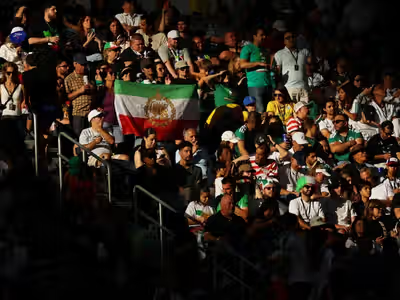


Supporters of the exiled opposition group the National Council of Resistance of Iran rallied outside the UN Headquarters in New York on Wednesday to protest the speech of President Masoud Pezeshkian before the General Assembly.
There appeared to be scores or hundreds of attendees standing behind a banner reading "No to Khamenei's President".
The Mujahideen-e-Khalq (MEK) group, which is banned in Iran, is the largest component of the NCRI whose leaders are based in Paris.
A leftist-Islamist group, the MEK carried out attacks against the shah's government and US targets in the 1970s but fell out with other factions during the 1979 revolution which toppled the monarchy and has been at war with Tehran ever since.

Iranian President Masoud Pezeshkian denounced Israeli raids on Iran’s nuclear facilities in June as illegal and blasted European powers for triggering the return of UN sanctions in a speech to the United Nations General Assembly on Wednesday.
“The world ... was witness to these surreptitious raids, infringement upon the sovereignty of nations, violation of the territorial integrity of states ... all of this under the full support of the most heavily armed regime in the face of the earth,” Pezeshkian said, referring to Israel and the United States.
“Who is the disturber of the stability of the region and the world? Who is the actual threat against international peace and security? (Iran) was subjected to a savage aggression and flagrant contravention of the most elementary law,” he added according to a simultaneous translations, referring to a US-Israeli war in June.
The President, a relative moderate, stopped short of presenting what Tehran's response might be to its foes or the looming sanctions. Ali Khamenei is the ultimate decision-maker over Iran's domestic and foreign affairs.
Pezeshkian called Prime Minister Benjamin Netanyahu a “criminal,” accusing Israel of committing “genocide” in Gaza.
Israel’s delegation boycotted Pezeshkian’s speech, walking out of the UN hall during his address. It has rejected the findings of a United Nations Commission of Inquiry last week that Israel has committed genocide, calling them false and politicized.
E3 move a 'gross violation'
Turning to European powers, Pezeshkian accused Germany, Britain and France of acting in “bad faith” by triggering the so-called snapback of international sanctions on Iran last month which are due to take effect in days.
“Three European states – having failed through a decade of bad faith and thereafter by supporting military aggression to bring the proud people of Iran to their knees – at the behest of the United States of America sought by means of pressure, coercion, imposition and manifest abuse to reinstate against the Iran Security Council resolutions that had already been terminated,” he said.
“In doing so, they set aside good faith. They circumvented legal obligations,” he added, calling the move a “gross violation.”
No to atomic bomb
Pezeshkian said that Iran had never pursued nuclear weapons. Israel and the United States had asserted in June, without providing any public evidence, that Tehran had decided to race toward a bomb.
“I hereby declare once more that Iran has never sought and will never seek to build a nuclear bomb,” he said.
"We do not seek nuclear weapons, this is our belief... those who disturb the peace and stability in the region is Israel," he added.
Israel launched a surprise military campaign on June 13, striking military and nuclear facilities in Iran. Air attacks killed nuclear scientists along with hundreds of military personnel and civilians. Iran retaliated with drone and missile attacks which killed 31 Israeli civilians and one off-duty soldier.
The United States joined the conflict on June 22, conducting strikes on major nuclear sites including Fordow, Natanz and Isfahan, before brokering a ceasefire on June 24.
Washington said the attacks set back Tehran’s nuclear program by years, though the International Atomic Energy Agency has not yet been able to fully assess the impact of the strikes due to lack of access.