Iran’s government has drawn up “the most pessimistic scenarios” to prepare for the activation of the United Nations snapback sanctions mechanism, government spokeswoman Fatemeh Mohajerani said on Wednesday.
“The government is optimistic, but we have designed the most pessimistic scenarios for this issue,” Mohajerani told reporters.
She added that while Tehran would not forgo diplomatic opportunities, “if they want to act with bullying, that is not dialogue.”
Ali Akbar Velayati, senior adviser to Iran’s Supreme Leader, condemned Britain, France and Germany for triggering UN snapback sanctions, calling it proofof Western “inability” against Iran’s advances and saying the step would further isolate Europe, according to an interview with al-Mayadeen.
Velayati also compared US President Donald Trump’s conduct to Adolf Hitler’s early aggression, and fiercely criticized Israel, denouncing what he called crimes in Gaza and an “assault on Qatar.”
He said Iran favors peaceful diplomacy but will respond “with strength and national dignity” and argued the snapback mechanism has “no practical effect” on Tehran.
An Iranian lawmaker said on Wednesday that the reimposition of UN sanctions under the snapback mechanism would not close the door on the country’s economy.
Mojtaba Zolnouri, a parliamentarian from Tehran, said Iran would respond to the measures with reciprocal actions.
“With the activation of the snapback mechanism, the world will not shut down on our economy,” he said. “On the other hand, Iran will not remain passive and will take countermeasures.”
Iran has begun rebuilding missile production facilities damaged in June’s 12-day war with Israel, but experts say a crucial element for solid-fuel production remains missing: planetary mixers, according to an Associated Press report analyzing satellite imagery.
Satellite images reviewed by AP show construction at missile sites in Parchin and Shahroud, where buildings housing mixers appear under repair.

Iran has begun rebuilding missile production facilities damaged in June’s 12-day war with Israel, but experts say a crucial element for solid-fuel production remains missing: planetary mixers, according to an Associated Press report analyzing satellite imagery.
Satellite images reviewed by AP show construction at missile sites in Parchin and Shahroud, where buildings housing mixers appear under repair.
“If they’re able to reacquire some key things like planetary mixers, then that infrastructure is still there and ready to get rolling again,” said Sam Lair of the James Martin Center for Nonproliferation Studies.
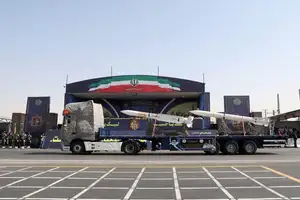
Solid-fuel missiles are central to Iran’s deterrence strategy after Israeli strikes decimated much of its air defense.


Iran operates solid-fuel missile production facilities at Khojir and Parchin, both near Tehran, as well as at Shahroud, about 350 kilometers (215 miles) northeast of the capital. All three sites were struck by Israel in October 2024, during earlier hostilities between the two countries.
Experts say the June strikes appeared designed to destroy buildings housing mixers, the machines essential for evenly combining missile fuel.
Iran had been producing more than 200 solid-fuel missiles a month before the war, according to AP.


Iran fired more than 570 ballistic missiles during the conflict, depleting an estimated third of its arsenal, according to the Jewish Institute for National Security of America.
Western officials believe Tehran could try to source mixers and propellant chemicals from China, which has previously supplied materials for Iran’s missile program. Beijing said it supports Iran’s sovereignty but voiced “deep concern” over rising regional tensions.
Iran’s Defense Minister Aziz Nasirzadeh said last month the country was now focused on producing “military equipment with higher precision and greater operational capabilities.”
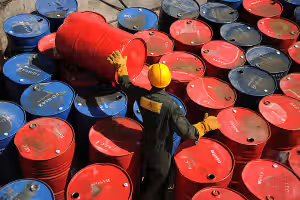
The looming revival of UN sanctions on Iran is unlikely to halt Tehran’s vital crude exports but could hand Chinese refiners a lucrative advantage, giving them greater access to discounted Iranian oil, Reuters reported on Wednesday.