Trump criticizes media for casting doubt on success of US strikes on Iran
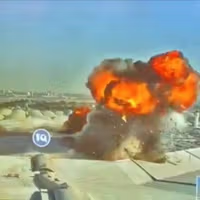
US President Donald Trump on Tuesday night criticized CNN and New York Times for “teaming up” to cast shadow of doubt on the success of US military strikes on Iran.
“Fake news CNN together with failing New York Times have teamed up in an attempt to demean one of the most successful military strikes in history. The nuclear sites in Iran are completely destroyed,” Trump posted on his Truth Social platform.
"Both the Times and CNN are getting slammed by the public.”
CNN, The New York Times and several other outlets cited an early assessment by the Defense Intelligence Agency that said the US air strikes on three nuclear sites in Esfahan, Natanz and Fordow failed to destroy them completely.
Earlier US Secretary of Defense Pete Hegseth also criticized CNN's reporting, saying, “Based on everything we have seen and I’ve seen it all, our bombing campaign obliterated Iran’s ability to create nuclear weapons.”
"Our massive bombs hit exactly the right spot at each target and worked perfectly. The impact of those bombs is buried under a mountain of rubble in Iran.”
He added, “So anyone who says the bombs were not devastating is just trying to undermine the president and the successful mission.”
The Islamic Republic executed three men accused of smuggling equipment for the assassination of Iranian officials, the judiciary's news agency Mizan reported on Wednesday.
Edris Aali, Azad Shojaei, and Rasoul Ahmad Rasoul were executed at Urmia Prison on the official charges of "spreading corruption on earth and moharebeh (enmity against God) through collaboration with hostile foreign governments in the Zionist regime's interest," the report said.
"They hid the assassination tools in a shipment of alcohol, which ultimately led to the killing of a notable figure," Mizan added.
Earlier reports said the three men were kolbars (cross-border porters) accused of smuggling equipment and weapons used in the 2020 assassination of Mohsen Fakhrizadeh, a key figure in Iran’s nuclear program.
“The US attacks on three nuclear facilities were so effective that, for certain, Iran cannot develop any nuclear weapons,” US Special Envoy Steve Witkoff said on Tuesday.
“Esfahan destroyed, Natanz eviscerated, and Fordow obliterated," he told Fox News.
Citing a variety of damage assessments he has seen, Witkoff said three components of Iran’s ability to make a nuclear weapon are destroyed.
“The Esfahan facility for conversion was above ground and was hit by a bunker-buster bomb. This means that even if Iran enriches uranium to 90 percent, it still cannot make any weapon.”
“At Natanz, there are two enrichment facilities, one underground and one above ground. The underground one was eviscerated, and the above-ground one, already hit by Israel, was struck again by us with another bomb just to ensure it is totally destroyed,” he added.
Witkoff said that Fordow was the last enrichment operation in Iran, and “we dropped 12 bunker-buster bombs there. There is no doubt it was obliterated.”
He said that once the US and Israel’s objective of completely dismantling Iran’s enrichment capabilities was met, President Trump reached out to both sides and secured a ceasefire settlement.
Iranian intelligence forces have arrested over 700 suspected Israeli agents over the past 12 days, targeting an active espionage network following Israel's military campaign on Iran, the IRGC-affiliated Fars News reported on Tuesday evening.
“Agents are accused of operating micro aerial vehicles (MAV) and suicide drones, making homemade bombs, photographing sensitive military sites, and sending intelligence to Israeli forces," the report said.
Based on the report, “over 10,000 MAVs were seized in Tehran alone” and “most arrests occurred in Kermanshah, Isfahan, Khuzestan, Fars, and Lorestan and Tehran.”
A screengrab of the Israeli ambassador to the United States' interview with Iran International on June 24, 2025
Regime change in Iran cannot be imposed from the outside, but the recent Israeli air strikes laid the groundwork for Iranian people to take the lead in ousting the Islamic Republic, Israel's ambassador to the United States told Iran International on Tuesday.
"You can't establish democracy top down. It doesn't work," Yechiel Leiter said in a Washington DC town hall hosted by Iran International, when asked if Israel expected a regime change after its recent air strikes on Iran.
"We have created the backdrop. We've created the props on the stage, and hopefully they're enough for there to be capitalized upon and for change to be brought about," the Israeli ambassador told the town hall moderator Fardad Farahzad.
Prime Minister Benjamin Netanyahu earlier told Iran International that the Israeli military campaign against Iran was giving its people a chance to topple the Islamic Republic, adding that the ruling system's days were numbered.
"A light has been lit—carry it to freedom,” Netanyahu said on June 16. “This is the time. Your hour of freedom is near—it’s happening now.”
Leiter said on Tuesday that Netanyahu spoke "with a tremendous passion and hope that the world will change and that the Iranian regime will change."
"That's a wish, but that can't be a military goal," he said. "Democracy is, in of itself, an expression of the people's will. So how can you ignore the people's will by forcing it?"
Israeli ambassador to the US Yechiel (Michael) Leiter (left) and Iran International's Fardad Farahzad who moderated the townhall on June 24, 2025
'World must join Israel'
The Israeli ambassador criticized other countries especially the Europeans for leaving the Jewish State alone in countering the Islamic Republic, saying it would be much easier for Iranian people to topple the Islamic Republic should other countries help Israel.
"Why is it that the Chancellor of Germany says 'Israel is doing the dirty work for all of us'? We're a tiny little country. Where's Germany? Where's England? England has a huge stake, huge history in your neck of the woods," Leiter said.
"They can feel an affinity for somebody who threatens an ally, like Israel. And it's not just Israel. Who created the sleeper cells in Europe? Why is there fear now in the United States, of sleeper cells? They have interfered with international waterways, with globalization, with maritime trade," he added.
Iran sent a communiqué to Trump in the days before the US air strikes on its nuclear facilities threatening to activate sleeper-cell terror inside America if it were attacked, NBC News reported on Sunday citing sources.
Eleven Iranian nationals, including a suspected former army sniper and an individual with admitted ties to Hezbollah, were arrested by US Immigration and Customs Enforcement (ICE) over the weekend in what officials say is a broader crackdown on individuals with ties to Iran and potential national security risks.
An audience member asks the Israeli ambassador a question during the townhall held on June 24, 2025.
The Israeli ambassador addressed the German chancellor and said, "You're absolutely right. We're doing the dirty work for the world, but it's about time that you helped us. And if they did, it would be a lot easier for the people of Iran."
"You have a minority government with its boot on the necks of, of good people, of innocent people, of tens of millions of people."
Surprises every day with Trump in office
The Israeli envoy said he was not surprised by Trump’s ceasefire proposal, as Israel’s military objectives in the war with Iran had been largely achieved by Tuesday morning when the ceasefire took effect.
He said working as a diplomat in Washington DC under President Trump feels like riding a roller coaster—with no idea when the next sharp turn is coming.
"You're on a roller coaster, and the only difference between Washington during the Trump administration and a roller coaster is that with the roller coaster, you know where the twists and turns are coming," he said.
"Here in Washington at the present time, you just don't know when the roller coaster is going to go sideways and you've got to hold on."
Trump on Monday night announced the unexpected ceasefire in the 12-day war between Iran and Israel via a post on his Truth Social platform, further fueling a sense of unpredictability surrounding US policy decisions.
The recent airstrikes by the United States and Israel will not lead Iran to abandon its nuclear technology, Iran’s Foreign Minister Abbas Araghchi said on Tuesday when asked if Tehran would continue to enrich uranium.
“We have made tremendous efforts to achieve this technology, and our scientists have made enormous sacrifices, even losing their lives for this goal,” Araghchi said in an interview with the London-based New Arab website.
“Our people have endured sanctions for this, and a war was imposed on our nation over this issue. No one in Iran will abandon this technology.”
When asked if Iran would reconsider its stance toward the International Atomic Energy Agency (IAEA), he responded, “I imagine that our outlook on the nuclear program and the non-proliferation regime will undergo changes, though I cannot yet determine their direction.”