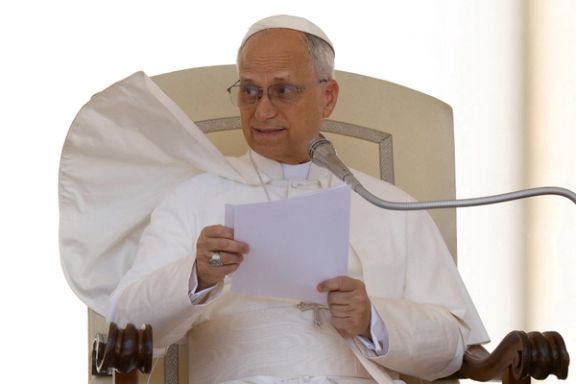
Pope Leo on Wednesday appealed to Iran and Israel not to pursue vengeance after 12 days of war, using his weekly general audience to call for dialogue to resolve the conflict.

US Secretary of State Marco Rubio told Politico on Wednesday that Iran is "much further away from a nuclear weapon" after US strikes on Iran's three main nuclear sites over the weekend.
"The bottom line is, they are much further away from a nuclear weapon today than they were before the president took this bold action," Rubio told Politico.
"Significant, very significant, substantial damage was done to a variety of different components, and we’re just learning more about it,” he added.

Iran’s parliament has passed a bill suspending cooperation with the International Atomic Energy Agency, including inspections, parliamentary spokesman Alireza Salimi said on Wednesday.
Under the legislation, IAEA inspectors will be barred from entering the country unless national nuclear security is guaranteed, and any future access will require approval from Iran’s Supreme National Security Council, Salimi said.
He added that the bill, approved in both its general and specific terms, imposes penalties on any individuals who allow agency personnel into the country without proper authorization.
The new measure applies to both safeguards-related and broader cooperation with the agency, he said. The country's Supreme National Security Council now needs to give final approval to the move.
The United States must compensate Iran for damage caused by recent military strikes on its facilities, Deputy Foreign Minister Saeed Khatibzadeh said on Tuesday in remarks to Al Mayadeen.
Khatibzadeh said Tehran will file a formal complaint with the United Nations, and warned that Washington must be held responsible for what he called unlawful aggression against Iran’s nuclear and scientific infrastructure.
He claimed that it was the US that first sent messages seeking to halt the conflict, not Iran.
“The US must pay for the damage inflicted on Iranian facilities,” he said, adding that Iran will pursue the matter through diplomatic and legal channels.

Iran’s missile response to US and Israeli strikes led directly to the current ceasefire, Foreign Minister Abbas Araghchi said in an interview published Wednesday by Al-Araby Al-Jadeed.
“They thought US involvement would lead to Iran’s surrender,” Araghchi said. “But our strong missile response using Kheibar Shekan missiles forced them to back down and propose a ceasefire through diplomatic channels.”
Iran presents ceasefire as moral victory
The ceasefire ended 12 days of fighting between Iran and Israel and remains in place. Araghchi said Iran accepted the deal to maintain moral high ground and to build the foundation for a new regional policy based on Islamic and regional values.
“We must see whether the aggressor is truly able to uphold the ceasefire, or if—as before—it is simply using it to manage domestic challenges,” he said.
Araghchi also defended Iran’s missile strike on the US Al Udeid base in Qatar, calling it a lawful act of self-defense in response to attacks on Iran’s nuclear facilities. He stressed that the strike was not a threat to Qatar’s sovereignty.
According to Araghchi, the US sent messages before and after the attack to avoid escalation. Iran responded by telling intermediaries, including European officials, that talks with Washington would not resume while aggression continued.
Tehran vows to continue nuclear work despite attacks
Despite attacks on nuclear sites, Araghchi said Iran would not abandon its program, which he described as transparent and under IAEA oversight.
“Diplomacy during war is still diplomacy,” Araghchi added, citing Geneva talks and coordination with regional partners as key in isolating Israel and building broader support for Iran’s position.
Iran has told the United Nations Security Council that its missile strike on the US Al Udeid Air Base in Qatar was a legitimate act of self-defense and posed no threat to the Qatari government or people, according to a letter from its ambassador released Wednesday.
In the letter, Iran’s Ambassador and Permanent Representative to the UN, Amir Saeid Iravani, said the June 23 strike was carried out in response to US attacks on Iranian nuclear sites and was consistent with Article 51 of the UN Charter, which allows for self-defense.
The letter cited US responsibility for strikes on Iran’s nuclear facilities in Fordow, Natanz, and Isfahan on June 22, which President Trump publicly acknowledged. Iravani said the Iranian response was “defensive, legitimate, and proportionate,” and emphasized that the targeted US base was located far from civilian areas to avoid collateral damage.
Iran also stressed that the action did not endanger Qatar, calling the country a “friend and brother” and reaffirming its commitment to strong bilateral relations.