The Israeli military issued a new evacuation warning to the residents of an area in Tehran's District 7, saying it will be operating in this area.
"Dear citizens, for your safety and well-being, we kindly ask you to immediately evacuate the designated area on the map and avoid approaching it in the coming hours. Your presence in this area puts your life at risk," it said.


The United Nations warned on Monday that Israeli and Iranian actions may violate international law, with civilians—especially in Iran—suffering mass casualties, displacement, and widespread destruction.
The ongoing war began on June 13 with waves of Israeli airstrikes across Iran.
“Hundreds of civilians, including women and children, have been killed in the Israeli airstrikes and millions have fled major cities for fear of further attacks,” the UN Fact-Finding Mission on Iran and the UN Special Rapporteur on Iran said in an online statement, describing the Iranian population as “traumatized.”
Israel says it is targeting military objectives. However, UN experts say some of Israel’s actions appear to violate the principle of distinction under international humanitarian law, including the strike on Iran’s state broadcaster (IRIB), and the targeted killing of scientists.
At least 950 people have been killed and 3,450 injured in Israeli strikes across Iran, according to the Human Rights Activists News Agency (HRANA). The dead include 380 civilians, 253 military personnel, and 317 individuals of unknown status. Israeli attacks have hit 25 provinces, damaging homes, hospitals, and critical infrastructure.
Lack of 'effective' advance warning
The UN Human Rights Council’s Fact-Finding Mission and the Special Rapporteur on Iran have also raised concerns. Among those reported killed were residents of an apartment complex, three aid workers from the Iranian Red Crescent, and patients at a hospital in Kermanshah, according to the report. Other sites struck include a clinic for children with autism.
The UN said a lack of effective advance warning may have prevented civilians from reaching safety, raising concerns over compliance with the principles of proportionality, distinction, and precaution.
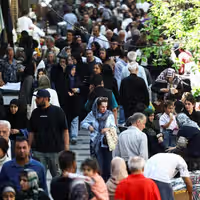
Airstrikes and evacuation orders have triggered mass displacement in Iran, with millions leaving Tehran. Limited access to shelters, fuel shortages, and disruption of essential services have increased civilian vulnerability.
Iranian counterstrikes have caused casualties and damage in Israel, with at least 24 killed and 1,217 injured, according to authorities. One missile struck a hospital in southern Israel, injuring staff and patients and forcing evacuations. Other strikes hit residential areas, prompting sirens across the country.
While many projectiles were intercepted, some got through, causing fires, power outages, and structural damage.
Internet blackout
On June 18, Iran’s Ministry of Communications imposed widespread internet restrictions, further complicating efforts by civilians to coordinate evacuations or contact family. The UN says this digital blackout has made it more difficult to assess the full scale of the humanitarian impact.
UN experts have also noted reports of arbitrary arrests of journalists, activists, social media users, and Afghan nationals accused of espionage. At least two people have reportedly been executed, and Iranian authorities have announced expedited trials, raising concerns overdue process.
Target: Evin Prison
One of the sites hit in Tehran on Monday was Evin Prison, which houses political prisoners and human rights activists, among other inmates. Iran’s judiciary said the strike damaged parts of the facility. State television broadcast footage of emergency responders carrying casualties and searching through rubble.
Israel’s defense minister said the military struck “regime targets and agencies of government repression,” including Evin.
Amnesty International condemned the attack, calling it a potential war crime, and urged Iranian authorities to release those arbitrarily detained and relocate others away from sites at risk of future strikes. The group also warned against the use of force by prison officials in response to unrest among detainees.
The UN called on Iranian authorities to relocate prisoners held near potential strike sites and urged all parties to respect international humanitarian law.
“The escalating hostilities pose grave risks to civilians across the region,” the Fact-Finding Mission and Special Rapporteur said, “with ordinary families and communities bearing the brunt of a conflict that threatens their safety, livelihoods, and daily lives.”

The US president's goal is to end the Israel-Iran war and he is going to make it clear to Israeli Prime Minister Benjamin Netanyahu, Axios reported citing a White House official.
"We want a deal and don't want any more war," the official was quoted as saying.
"Iran has officially responded to our Obliteration of their Nuclear Facilities with a very weak response, which we expected, and have very effectively countered," US President Donald Trump said in a post on Truth Social.
"There have been 14 missiles fired — 13 were knocked down, and 1 was “set free,” because it was headed in a nonthreatening direction. I am pleased to report that NO Americans were harmed, and hardly any damage was done."

Trump said "they’ve gotten it all out of their “system,” and there will, hopefully, be no further HATE."
"I want to thank Iran for giving us early notice, which made it possible for no lives to be lost, and nobody to be injured. Perhaps Iran can now proceed to Peace and Harmony in the Region, and I will enthusiastically encourage Israel to do the same!"
"Congratulations world, it's time for peace," Trump said in another Truth Social post.


At least sixteen people including staff members at Tehran’s Evin Prison were killed on Monday after Israeli strikes hit the jail's buildings as well as other arms of the Islamic Republic’s security apparatus, according to sources familiar with the matter.
Among the dead were Vahid Heidarpour and Rouhollah Tavassoli, who oversaw wards 4, 7 and 8 at various times and were known for managing inmates accused in financial and political cases, sources said.
“They had a reputation for exploiting detainees linked to powerful networks,” a source familiar with the prison told Iran International.
The pair died in the prison’s administrative block, where they were present during the strike alongside the deputy health chief and several guards.
Some inmates were also injured by shattered glass and blast waves, though authorities have not confirmed any prisoner fatalities.
“I saw 16 prison employees in body bags being loaded into ambulances,” a witness inside the facility said. “They plan to move political detainees to Fashafuyeh or to Saheli prison in Qom. The death toll is high. No debris has been cleared yet. Many soldiers were also killed, and female staff are among the dead.”
Twenty buses transported Evin Prison inmates to Fashafuyeh prison on Monday, eyewitnesses told Iran International.
Detainees from Ward 209, who include recent protest arrestees, were moved out after the strike.
Prisoners from Ward 4 were relocated by bus to Fashafuyeh without their belongings, according to a second source who confirmed reports of gunfire inside the prison following the Israeli strike.
The families were being held back from the scene, which was taken over by Basij and plainclothes agents, the source added.
Damage was concentrated in the visitors’ hall, the infirmary, and the intelligence wing of the prison, where electricity is now limited to emergency supply and water has been cut off.
Call for prisoners' release
Families of political prisoners have repeatedly called for their release following the onset of Israeli airstrikes.
Reza Valizadeh, an American-Iranian journalist held at Evin, said in a message on June 16 that political prisoners had petitioned for conditional release, which is permitted under wartime laws passed in 1986.
The rules exclude so-called dangerous criminals but allow temporary release for others whose lives may be at risk during emergencies.
The Monday strikes, carried out under the direct orders of Israeli Prime Minister Benjamin Netanyahu and Defense Minister Israel Katz, focused on “regime targets and government repression bodies,” according to the Israeli Ministry of Defense.
Command centers of the Tharallah base, the Seyyed al-Shohada Corps, and the intelligence directorate of Iran’s police force were also struck in what Israeli officials called the most extensive operation of its kind.
"We did not assault anyone, and we absolutely do not accept being assaulted by anyone, nor will we submit to any aggression. This is the logic of the Iranian nation. #Herald_of_Victory," read a new post on Supreme Leader Ali Khamenei's X account, referring to Iran's attack on US forces in Qatar.