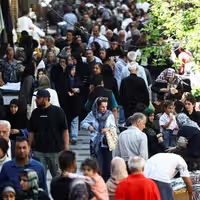
Israel issues second Tehran evacuation warning an hour after first


The Israeli military issued a new evacuation warning to the residents of an area in Tehran's District 6 early Tuesday local time, just over an hour after a similar warning for District 7.
"Dear citizens, for your safety and well-being, we kindly ask you to immediately evacuate the designated area on the map and avoid approaching it in the coming hours," the warning, published in Persian on X read.
"Your presence in this area puts your life at risk."

I’ve spent time in Evin, Iran’s most notorious prison, the one Israel bombed on Monday. Half a dozen of my closest friends have been there too. Do we want it flattened, turned into a park? Yes. Are we pleased it was bombed? No.
I still carry its smell of damp concrete and stale fear. I dream of bulldozers flattening the walls and children playing where the interrogation rooms once were. But bombs are not bulldozers, and a missile strike is not a promise of renewal.
I picture a June afternoon. The heat in Tehran is already unbearable when the siren splits the air.
Inside Evin’s women’s ward, glass gives way with a sharp, accusing crack. Shards slice arms and cheeks before anyone even understands what happened. Outside, the scene is worse: mothers, fathers, siblings—mine among them—stand at that kiosk manned by a teenage conscript teenager who despises his post as much as we despise the regime.
In a single flash, they all disappear.
This is every visiting day at Evin: desperate faces pressing for scraps of news, hoping for a glimpse, a rumor, a promise. Now the asphalt is scorched, the kiosk mangled.
How, exactly, does bombing a prison free a nation?
Ruins attract new bosses, not playgrounds. That is not the future we fought for when we risked everything to challenge the regime.
These are strange times—to say the least.
Friends and family members are turning against one another. Geography is becoming a dividing line.
Concerned, broadly well-meaning Iranians watching from London or LA are far more likely to cheer. They don’t hear the explosions rattling our walls. They don’t see the plumes or the pale, crumpled faces—our neighbors, our parents, our children—shaking in silence.
I try not to block those who infuriate me with their aloofness, their crass humor. They’re a product of the Islamic Republic too—desensitized by a daily flood of suffering from Kyiv to Gaza, stripped of empathy by proximity to too much pain.
I try not to block them because we need each other, as many as we can, if we’re to survive this and not fall into the abyss.
I am exhausted, furious, with this regime as anyone. I despise the system that robbed me of my life with empty slogans, the man who telegraphs defiance from a bunker under my city.
But this is not deliverance.
Once we were never asked whether we wanted uranium enrichment in exchange for our aspirations. Now no one asks whether we want Netanyahu’s jets overhead or police compounds in downtown Tehran pulverized.
I shed no tears for slain IRGC generals—courtrooms would have been better—but I do mourn our own powerlessness, trapped between rulers who do not care and outsiders who use our suffering as a talking point.
Spare us the righteous speeches please. Pursue your interests if you must, but don’t pretend the collateral is a gift to the Iranian people.
A true leader would have stepped aside long ago to spare us this spiral. Instead, Khamenei hides underground while we—prisoners in and outside Evin—keep counting the costs.
I am typing this having passed by a crater’s dust on my way home. I’m not sure who will read this. But it’s the only thing I can do between mourning the lives blasted away and fearing the new bars that will rise where the old ones fell.
US President Donald Trump announces 'complete and total ceasefire' between Iran and Israel.
"CONGRATULATIONS TO EVERYONE!," his post reads. "It has been fully agreed by and between Israel and Iran that there will be a Complete and Total CEASEFIRE (in approximately 6 hours from now, when Israel and Iran have wound down and completed their in progress, final missions!), for 12 hours, at which point the War will be considered, ENDED!"
It continues with details and timing of the implementation of the agreement.
"On the assumption that everything works as it should, which it will, I would like to congratulate both Countries, Israel and Iran, on having the Stamina, Courage, and Intelligence to end, what should be called, “THE 12 DAY WAR.”
"This is a War that could have gone on for years, and destroyed the entire Middle East, but it didn’t, and never will! God bless Israel, God bless Iran, God bless the Middle East, God bless the United States of America, and GOD BLESS THE WORLD!"
Israeli intelligence operatives warned several senior Iranian Revolutionary Guards generals that they had only a few hours to abandon Supreme Leader Ali Khamenei and flee with their families — or be killed — according to three sources familiar with the operation who spoke to the Washington Post.
The June 13 call, made just hours after Israeli strikes began killing key Iranian personnel, was part of a covert intimidation campaign targeting more than 20 officials, the report said.
“You’re on our list right now,” an Israeli caller told one general, adding that Israel was “closer to you than your own neck vein.”
“I advise you now: you have 12 hours to escape with your wife or child,” said a voice in the recording, ordering the IRGC commander to record a video renouncing the Islamic Republic.
The Israeli military issued a new evacuation warning to the residents of an area in Tehran's District 7, saying it will be operating in this area.
"Dear citizens, for your safety and well-being, we kindly ask you to immediately evacuate the designated area on the map and avoid approaching it in the coming hours. Your presence in this area puts your life at risk," it said.


The United Nations warned on Monday that Israeli and Iranian actions may violate international law, with civilians—especially in Iran—suffering mass casualties, displacement, and widespread destruction.
The ongoing war began on June 13 with waves of Israeli airstrikes across Iran.
“Hundreds of civilians, including women and children, have been killed in the Israeli airstrikes and millions have fled major cities for fear of further attacks,” the UN Fact-Finding Mission on Iran and the UN Special Rapporteur on Iran said in an online statement, describing the Iranian population as “traumatized.”
Israel says it is targeting military objectives. However, UN experts say some of Israel’s actions appear to violate the principle of distinction under international humanitarian law, including the strike on Iran’s state broadcaster (IRIB), and the targeted killing of scientists.
At least 950 people have been killed and 3,450 injured in Israeli strikes across Iran, according to the Human Rights Activists News Agency (HRANA). The dead include 380 civilians, 253 military personnel, and 317 individuals of unknown status. Israeli attacks have hit 25 provinces, damaging homes, hospitals, and critical infrastructure.
Lack of 'effective' advance warning
The UN Human Rights Council’s Fact-Finding Mission and the Special Rapporteur on Iran have also raised concerns. Among those reported killed were residents of an apartment complex, three aid workers from the Iranian Red Crescent, and patients at a hospital in Kermanshah, according to the report. Other sites struck include a clinic for children with autism.
The UN said a lack of effective advance warning may have prevented civilians from reaching safety, raising concerns over compliance with the principles of proportionality, distinction, and precaution.
Airstrikes and evacuation orders have triggered mass displacement in Iran, with millions leaving Tehran. Limited access to shelters, fuel shortages, and disruption of essential services have increased civilian vulnerability.
Iranian counterstrikes have caused casualties and damage in Israel, with at least 24 killed and 1,217 injured, according to authorities. One missile struck a hospital in southern Israel, injuring staff and patients and forcing evacuations. Other strikes hit residential areas, prompting sirens across the country.
While many projectiles were intercepted, some got through, causing fires, power outages, and structural damage.
Internet blackout
On June 18, Iran’s Ministry of Communications imposed widespread internet restrictions, further complicating efforts by civilians to coordinate evacuations or contact family. The UN says this digital blackout has made it more difficult to assess the full scale of the humanitarian impact.
UN experts have also noted reports of arbitrary arrests of journalists, activists, social media users, and Afghan nationals accused of espionage. At least two people have reportedly been executed, and Iranian authorities have announced expedited trials, raising concerns overdue process.
Target: Evin Prison
One of the sites hit in Tehran on Monday was Evin Prison, which houses political prisoners and human rights activists, among other inmates. Iran’s judiciary said the strike damaged parts of the facility. State television broadcast footage of emergency responders carrying casualties and searching through rubble.
Israel’s defense minister said the military struck “regime targets and agencies of government repression,” including Evin.
Amnesty International condemned the attack, calling it a potential war crime, and urged Iranian authorities to release those arbitrarily detained and relocate others away from sites at risk of future strikes. The group also warned against the use of force by prison officials in response to unrest among detainees.
The UN called on Iranian authorities to relocate prisoners held near potential strike sites and urged all parties to respect international humanitarian law.
“The escalating hostilities pose grave risks to civilians across the region,” the Fact-Finding Mission and Special Rapporteur said, “with ordinary families and communities bearing the brunt of a conflict that threatens their safety, livelihoods, and daily lives.”