Cruz hits out at UN for rapping US strikes
Hawkish Texas Republican Senator Ted Cruz lashed out at the United Nations for criticizing a US strike on Iran on Sunday, saying it had sided with Tehran.
Hawkish Texas Republican Senator Ted Cruz lashed out at the United Nations for criticizing a US strike on Iran on Sunday, saying it had sided with Tehran.




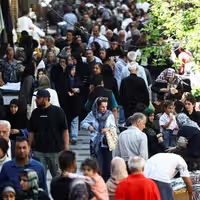




Iran’s political factions are in open conflict after the US strike on the Fordo nuclear site—hardliners are demanding military retaliation, while moderates and reformists warn of catastrophic consequences.
State television, dominated by ultra-hardliners, signaled escalation just hours after the attack.
“The Islamic Republic is no longer bound by red lines and considers all US military bases in the region legitimate targets,” ane anchor declared,
On platforms aligned with the regime, the rhetoric was even more aggressive.
“It is now our turn to act without delay,” wrote Hossein Shariatmadari, supreme leader Ali Khamenei’s representative at Kayhan newspaper.
“As a first step, we must launch a missile strike on the US naval fleet in Bahrain and simultaneously close the Strait of Hormuz to American, British, German, and French ships.”
'Beware the consequences'
But many moderate voices warned that such a drastic move would only place Iran in a more perilous position.
“Closing the Strait of Hormuz would drag neighboring countries—and even players like China and India—into direct confrontation with Iran,” journalist Ehsan Bodaghi posted on X. “Does our country have the capacity to endure that scale of conflict and hostility?”
Perhaps the most prominent figure to urge calm and foresight was former president Mohammad Khatami.
“All decisions, positions, and diplomatic or defensive actions must be taken with wisdom and long-term thinking, free from emotional reactions or a pure desire for revenge,” he was quoted as saying by reformist outlet Jamaran.
Economist and former official Reza Kashef echoed the call with a Gandhi quote: “True power lies in self-restraint and patience, not in hasty reactions.”
Ordinary Iranians silenced
A nationwide internet shutdown has sharply reduced the volume of public online discussion.
While insiders—hardliners, in particular—often retain privileged access, ordinary Iranians—and even moderate insiders—have been effectively silenced. The imbalance has further amplified hardline voices in the post-Fordo narrative.
“The main issue is that the US has officially entered a war with Iran, and Iran's deterrence will be lost if it does not respond strongly,” ultra-hardline MP Amir-Hossein Sabeti posted on X.
Abdollah Ganji, former editor of IRGC-linked daily Javan, was more specific—and dramatic.
Tehran’s actions should be withdrawing from the Nuclear Non-Proliferation Treaty, expelling UN inspectors and the silence. “This silence,” he posted on X, “will become the sound of a very powerful bomb explosion, and they will come to you with concessions.”
Activist Hatef Salehi posted a map of US bases in neighboring countries with the caption: “Which one should we strike first?”
Another reason such voices appear to have dominated in the past day or two is the risk built into advocating restraint.
Publicly questioning the wisdom of retaliation can be construed as contradicting Khamenei’s stance—and in the current wartime atmosphere, that carries serious consequences.
Still, some tried to tread the minefield.
“Most patriots don’t want to dampen the nation’s spirit during times of aggression,” prominent tech leader Nima Namdari posted on X. “But the realities of war … and our understanding of those in power make it impossible not to worry about the decision-making process.”
“So what’s the solution, really,” he asked, “should we just remain silent?”
"Monumental Damage was done to all Nuclear sites in Iran, as shown by satellite images. Obliteration is an accurate term!" US President Trump said.
"The white structure shown is deeply imbedded into the rock, with even its roof well below ground level, and completely shielded from flame. The biggest damage took place far below ground level," he added, not appearing to cite any image.
"Bullseye!!!"
Iran into Monday had so far held off retaliating against the United States for its surprise attack by submarine missiles and heavy bombers the previous day, as Supreme Leader Ali Khamenei saved his threats for Israel.
"The punishment continues," a post on the 86-year old leader's X account wrote.
"The Zionist enemy has made a grave mistake, committed a major crime; it must be punished—and it is being punished. It is being punished right now. #AllahuAkbar".
No mention was made of the United States in his remarks, the first since US President Donald Trump proudly declared his forces had bombed three nuclear sites.
His post came as Israeli military authorities said only a single missile was fired at it by Iran in an attack overnight, in a possible sign of depleted power.
The day after the attack, the hawkish president upped the ante yet again, suggesting regime change would be welcome if Tehran could not "Make Iran Great Again".
"It’s not politically correct to use the term, 'Regime Change,' but if the current Iranian Regime is unable to MAKE IRAN GREAT AGAIN, why wouldn’t there be a Regime change??? MIGA!!!" Trump wrote.
Protests
Protests were held on Sunday in far-flung cities against the US attack on Iran's nuclear sites, including in Los Angeles, Karachi and outside a NATO meeting at The Hague.
Russia's United Nations ambassador Vassily Nebenzia hit out a what he called a rerun of the US Iraq War, based on weapons of mass destruction which were never found.
"Again we're being asked to believe the US's fairy tales, to once again inflict suffering on millions of people living in the Middle East," Nebenzia said.
US President Donald signaled he would accept little opposition as he tore into a lawmaker critic from his own Republican party on social media.
Kentucky congressman Thomas Massie had called out Trump, saying on X:"This is not America First folks.
What war wrought
Israel's attacks on Iran have so far killed 950 people and injured 3,450, human rights group HRANA reported on Sunday.
Meanwhile no clear picture had yet emerged on the impact of US attacks and whether it achieved its goal of ending Iran's nuclear ambitions.
The UN nuclear watchdog said Sunday that entrances to underground tunnels at Iran’s Isfahan nuclear complex were damaged in the strikes.
“We have established that entrances to underground tunnels at the site were impacted,” the International Atomic Energy Agency (IAEA) said in a statement.
The IAEA chief Rafael Grossi told CNN it was too early to assess the underground damage to Iran's Fordow site.
Iranian defiance
Iran's foreign minister arrived in Moscow for talks with Russian President Vladimir Putin after appearing to vow Iranian retaliation in Turkey.
"The US crossed a very big red line by attacking Iran’s nuclear facilities," Abbas Araghchi said. Speaking in Istanbul, Araghchi said the US bore full responsibility.
“The attack on peaceful nuclear installations marks a dangerous precedent and will not go unanswered."
Relative moderate President Masoud Pezeshkian also promised a rejoinder.
“The US has attacked us. What would you do if you were in our position? Naturally, they must receive a response to their aggression,” Pezeshkian said.
Veteran security insider Ali Shamkhani said the strikes would not sink Iran's nuclear enterprise.
“Even if nuclear sites are destroyed, the game isn’t over... enriched materials, indigenous knowledge, and political will remain,” Shamkhani said on X.
“The initiative is now with the side that plays smart, avoids blind strikes. Surprises will continue!”
Australian Foreign Minister Penny Wong said on Sunday that the country supports the US attack on Iranian nuclear facilities while calling for calm and diplomacy.
“We support action that the US has taken to prevent Iran from obtaining a nuclear weapon,” Wong told a local television interviewer.
Iranian Supreme Leader Ali Khamenei vowed in harsh terms to keep up its "punishment" of Israel in an X post on Satuday, his first comments since US bombings on Iranian nuclear sites.
"#RightNow," a post on Khamenei's account wrote: "The punishment continues"
"The Zionist enemy has made a grave mistake, committed a major crime; it must be punished—and it is being punished. It is being punished right now. #AllahuAkbar".
Khamenei made no mention of attacking US targets.