State television, dominated by ultra-hardliners, signaled escalation just hours after the attack.
“The Islamic Republic is no longer bound by red lines and considers all US military bases in the region legitimate targets,” ane anchor declared,
On platforms aligned with the regime, the rhetoric was even more aggressive.
“It is now our turn to act without delay,” wrote Hossein Shariatmadari, supreme leader Ali Khamenei’s representative at Kayhan newspaper.
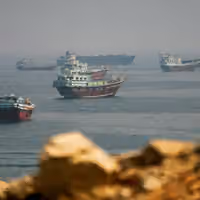
“As a first step, we must launch a missile strike on the US naval fleet in Bahrain and simultaneously close the Strait of Hormuz to American, British, German, and French ships.”
'Beware the consequences'
But many moderate voices warned that such a drastic move would only place Iran in a more perilous position.
“Closing the Strait of Hormuz would drag neighboring countries—and even players like China and India—into direct confrontation with Iran,” journalist Ehsan Bodaghi posted on X. “Does our country have the capacity to endure that scale of conflict and hostility?”
Perhaps the most prominent figure to urge calm and foresight was former president Mohammad Khatami.
“All decisions, positions, and diplomatic or defensive actions must be taken with wisdom and long-term thinking, free from emotional reactions or a pure desire for revenge,” he was quoted as saying by reformist outlet Jamaran.
Economist and former official Reza Kashef echoed the call with a Gandhi quote: “True power lies in self-restraint and patience, not in hasty reactions.”
Ordinary Iranians silenced
A nationwide internet shutdown has sharply reduced the volume of public online discussion.
While insiders—hardliners, in particular—often retain privileged access, ordinary Iranians—and even moderate insiders—have been effectively silenced. The imbalance has further amplified hardline voices in the post-Fordo narrative.
“The main issue is that the US has officially entered a war with Iran, and Iran's deterrence will be lost if it does not respond strongly,” ultra-hardline MP Amir-Hossein Sabeti posted on X.
Abdollah Ganji, former editor of IRGC-linked daily Javan, was more specific—and dramatic.
Tehran’s actions should be withdrawing from the Nuclear Non-Proliferation Treaty, expelling UN inspectors and the silence. “This silence,” he posted on X, “will become the sound of a very powerful bomb explosion, and they will come to you with concessions.”
Activist Hatef Salehi posted a map of US bases in neighboring countries with the caption: “Which one should we strike first?”
Another reason such voices appear to have dominated in the past day or two is the risk built into advocating restraint.
Publicly questioning the wisdom of retaliation can be construed as contradicting Khamenei’s stance—and in the current wartime atmosphere, that carries serious consequences.
Still, some tried to tread the minefield.
“Most patriots don’t want to dampen the nation’s spirit during times of aggression,” prominent tech leader Nima Namdari posted on X. “But the realities of war … and our understanding of those in power make it impossible not to worry about the decision-making process.”
“So what’s the solution, really,” he asked, “should we just remain silent?”