The Israeli military's home front command said on Thursday that an Iranian missile attack on central Israel had deployed cluster bombs, in the first time such a weapon was used in the conflict, but that no one was killed or injured in the attack.
Distributing a picture of the alleged munition, the military warned people not to approach or touch the ordnance if seen.
Iran could race toward a bomb after a US strike on its Fordow nuclear facility or assassination of its Supreme Leader, the New York Times reported citing senior US intelligence officials.
Still, the newspaper cited the officials as saying US intelligence agencies continue to assess that Iran has not decided to build a nuclear bomb.

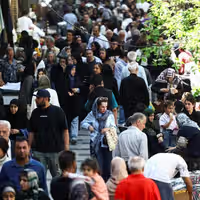
A growing number of Iranians are reporting near-total internet outages across the country as the government appears to have imposed a widespread digital blackout amid the ongoing war.
In messages sent to Iran International, Iranians from across the country described severe connectivity outages affecting both mobile networks and home internet services which left them in the dark about the historic attack on the country.
The shutdown, which some residents say has lasted more than 24 hours, is the most severe connectivity crisis since the November 2019 protests, according to monitoring group NetBlocks.
The disruption has left millions struggling with basic daily tasks, from financial transactions to communicating with loved ones abroad.
“I am a driver for Snapp (a popular ride-hailing app), and with GPS and navigation systems down, I can’t work anymore,” said one message.
“This is how I made a living. Now, in these conditions of war and economic hardship, how am I supposed to support my family?”
Users across the country described scenes of isolation and desperation, with one resident characterizing the situation as “being held hostage.”
“We feel like hostages," the contributor wrote. "The only reason I could even send you this message was through VPNs."
Multiple Iranians confirmed that the internet is entirely down in their areas, preventing the sending of videos or voice messages.
“Even basic messaging barely works," One user from Tehran said. "I managed to connect to the global internet by accident using Psiphon on Windows. Please inform others that this method might still work.”
As international lines remain disrupted, many Iranians living abroad are unable to reach their families.
“I am a student living outside Iran and haven’t been able to contact my family,” another person said.
'Please, Elon'
Others appealed directly to global figures. “Please, we are asking the Iranian people and international media to call on Elon Musk to provide satellite internet to the people of Iran, like he did for Ukraine during the war,” wrote a user in central Tehran.
Home internet services appear to be limited to internal Iranian websites and apps, such as Rubika, and even then operate at extremely low speeds.
In Arak, central Iran, residents reported complete disconnection and uneasiness.
“Even text messages sometimes don’t send. There are still long queues at bakeries and gas stations, even though the city is quiet and most shops are closed.”
Messages also highlighted emotional distress caused by the isolation.
“We are psychologically exhausted. Only Netanyahu finishing this [conflict] can save us,” one person wrote.
Losing touch
Another said, “It’s been over 48 hours since I last heard from my family in Qom. Every call just rings endlessly.”
One message by read, "Since yesterday afternoon, I have not only been unable to contact my loved ones living in Tehran and nearby cities, but I’ve also lost all means of communication with my mother and immediate family, who live in a northern city. I can’t reach them by landline or mobile."
"Today, I tried calling more than a hundred times at different hours. At one point, my call unexpectedly connected to other numbers in Iran — though they couldn’t hear me."
Others warned of the broader economic impact. “All banks are closed. Nationalized internet systems are down. No one can even update their debit cards,” said one message.
Those operating online businesses have reported losses. “I am a trader, and for the past week, my group of nearly 800,000 members has made no income.”
Meanwhile, some Iranians abroad shared partial workarounds. “My mother just managed to call me directly from Iran. Please let families know that direct calling might still work occasionally. It will help relieve some of the anxiety,” a user in Sweden reported.
The nationwide blackout has stoked fears of increased censorship and state control of digital communication.
“The ongoing blackout incident is the most severe tracked since the November 2019 protests and impacts the public's ability to stay connected at a time when communications are vital,” NetBlocks said.
Tasnim news agency, affiliated with the Revolutionary Guards, published an article on Thursday calling for a total internet blackout for people. The outlet described the blackout as a necessity “to disrupt enemy cyberattacks and drone operations.”
US President Donald Trump is determined that Iran's Fordow underground nuclear facility be disabled, CBS cited sources as saying, and will do it by force if Iran does not shut it down.
Trump has been briefed on the risks and benefits of military action again Fordow, the CBS report said citing the sources, but has considered the possibility that Iran might be convinced to dismantle the site on its own.
"He believes there's not much choice," CBS quoted a source as saying. "Finishing the job means destroying Fordow."
Trump is willing to attack the site if US military action is the only way for it to be disabled, CBS cited the sources as adding, though no firm decision has been made.
The president was shown intelligence reports indicating the speed at which Iran might acquire a nuclear weapon and he has discussed the details of how bunker-busting bombs could be used, CBS reported.
CIA Director John Ratcliffe views Iran as close to a nuclear weapon, the report said, citing a source as saying the top US spy had likened Iran's nuclear drive as like football players who fought their way to the one-yard line and seek a touchdown.

Israel hopes the United States will knock out Iran's underground nuclear site Fordow with its superior firepower but may try alone within days while military gains and global opinion allow, two Israeli security sources told Iran International.
The two sources still viewed joint action alongside the United States as the most likely scenario, within 48-72 hours at most.
An attack could be underway as early Friday night, the sources added, but Israel is also weighing going it alone to avoid losing the military advantage it has gained this week.
“In order for us to force Iran into concessions it would otherwise not make, and to bring it back to the negotiating table, this is the only way; we need the US to take action," an Israeli intelligence source told Iran International on condition of anonymity.
"We need Trump to do this within the next two to three days," one source added. "Trump is extremely unpredictable right now though, so anything could happen.”
Buried deep underground, the Fordow nuclear enrichment facility has remained untouched so far in the ongoing Israeli military campaign which appeared to take Iran by surprise in the early hours of last Friday morning.
Window closing
The window of opportunity to knock out the site was closing, the second Israeli security source said, and Israel had been planning for an attack for months.
“Until now the IDF (Israeli military) has opened up the flight path to Iran and the skies are open but that will be for a limited time, it can’t go on indefinitely,” he told Iran International on condition of anonymity.
“Therefore, if America decides to get involved, it has to be a decision made as fast as possible otherwise the opportunity will be missed.”
As the war begins to impact the global economy, including the soaring price of oil, the source said world powers could quickly lose patience with the conflict.
“There are economic issues at stake, so for example if oil prices spike, then these countries could be involved due to their own economic interests. So in general, America has to take this opportunity within 48-72 hours.”
The reach and strength of Israel's bombers are more limited compared to their American peers, making an attack on Fordow by Israeli forces alone more complex.
“Israel doesn’t have the heavy B-52 capabilities to drop a 14-ton bomb to penetrate the heart of the Iranian atomic sites that have to be destroyed,” the security source said.
Israel’s F-15s travel nearly 2,000 kilometers with far smaller payloads of around 400 kilograms, the source added. "Do the math. America could do that mission within a few days, but for us, it would be a much longer, more complex operation."

Destroying the Fordow enrichment facility requires a US military asset never been used in war, according to a report in the Wall Street Journal.
Known as the Massive Ordnance Penetrator, the GBU-57 is designed to tear through 200 feet of mountain rock before exploding. The United States has around 20, the newspaper reported, delivered via B-2 stealth bombers.
In the White House on Wednesday, Trump maintained studied ambiguity. “I may do it. I may not do it. I mean, nobody knows what I’m going to do,” he told reporters.
Iain Overton, the Executive Director of Action on Armed Violence, told Iran International that despite the heavy blows taken, Tehran could opt to fight on.
“Iran may lack parity in conventional military terms, but it possesses a distributed deterrent capability: armed proxies across the region, cyber warfare expertise, and a long-honed ideological machinery that frames death not as loss but as victory," he said.
"If the Ayatollah’s regime interprets US involvement as existential, it will not capitulate. It will escalate.”