Israeli Defense Minister Israel Katz on Tuesday issued a warning to Iran’s Supreme Leader Ali Khamenei, suggesting he could suffer a fate similar to former Iraqi dictator Saddam Hussein.
"I warn the Iranian dictator from continuing to commit war crimes and fire missiles at Israeli citizens. He should remember what happened to the dictator in the country neighboring Iran who took this path against the State of Israel,” Katz said in a video from Israel's security headquarters.
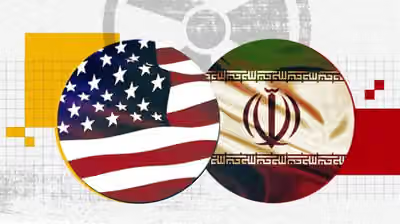

US President Donald Trump on Tuesday said he had not initiated any communication with Iran for potential peace negotiations, dismissing such claims as "highly fabricated" and "fake news."
In a post on his social media platform, Truth Social, Trump wrote: “I have not reached out to Iran for ‘Peace Talks’ in any way, shape, or form. This is just more HIGHLY FABRICATED, FAKE NEWS!”
“If they want to talk, they know how to reach me,” Trump added. “They should have taken the deal that was on the table – Would have saved a lot of lives!”
Iran’s Cyber Security Command has banned government officials and their security teams from using any devices connected to public communication or telecommunications networks, Fars news agency reported on Tuesday.
The directive follows growing concerns over the use of mobile phone tracking for targeted assassinations inside Iran. It may also aimed at preventing incidents similar to last year's pager attack by Israel against Hezbollah members.
The IRGC-affiliated Fars News Agency said on Monday that Israel has used such technology to kill individuals, including nuclear scientists, during recent strikes.
Fars warned that even turning off mobile phones at sensitive locations may not prevent location tracking and recommended the use of secure, anti-tracking devices.
Separately, Tehran lawmaker Hamid Rasaei wrote on X that all officials and their associates must hand in their phones to reduce the risk of being tracked.
“The use of connected devices by officials and their security personnel is now prohibited,” Fars quoted the Cyber Security Command as saying, without specifying which government departments were affected or whether exceptions would apply.
Iran’s Foreign Ministry spokesperson Esmail Baghaei on Tuesday criticized the Group of Seven (G7) for what he described as a failure to address what he called Israel’s unlawful and blatant aggression against Iran.
In a statement posted on social media platform X, Baghaei accused the G7 of overlooking attacks that Tehran says have resulted in civilian casualties and damage to public infrastructure.
The G7 leaders, in their joint statement on Monday, reaffirmed their support for Israel’s right to self-defense. “We affirm that Israel has a right to defend itself… Iran is the principal source of regional instability and terror,” the statement read.
The bloc reiterated that “Iran can never have a nuclear weapon” and called for a resolution to the Iranian crisis that contributes to a broader de-escalation, including a ceasefire in Gaza.
Baghaei urged permanent members of the United Nations Security Council, particularly those within the G7, to uphold their legal and moral responsibilities under the UN Charter.
“Israel has launched an unprovoked war of aggression against Iran,” Baghaei said, alleging violations of Article 2(4) of the Charter and international norms protecting peaceful nuclear facilities.
He warned that continued inaction by the Security Council could undermine the credibility of the UN and called for an immediate halt to hostilities and accountability for violations of international law.
Iran’s Islamic Revolutionary Guard Corps (IRGC) said on Tuesday it had struck Israel’s Military Intelligence Directorate and a Mossad operation center, according to state media reports.
The hacker group Predatory Sparrow claimed responsibility on Tuesday for a cyberattack targeting Bank Sepah, one of Iran’s oldest financial institutions with ties to the Islamic Revolutionary Guard Corps (IRGC) and the Army.