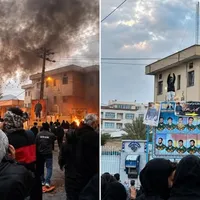


An exodus of fearful Tehran residents quit the capital in droves as Israel ramped up air strikes and Iran sent another missile barrage into Israel as combat between the two Mideast foes entered a fourth day.
Israeli attacks targeted Iran’s foreign ministry, interior ministry and ministry of intelligence along with military targets across the capital Tehran and nationwide. Tehran’s historic bazaar was shut down as merchants evacuated.
US President Trump said it was time for a deal to end the hostilities but suggested letting Israel and Iran keep scrapping.
"Well I hope there's going to be a deal. I think it's time for a deal and we'll see what happens but sometimes they have to fight it out but we're going to see what happens. I think there's a good chance there will be a deal," he told reporters on Sunday.
Israeli attacks since Friday had killed 224 people and wounded 1,277, spokesman for Iran’s health ministry Hossein Kermanpour said on social media.
Four people were killed in the latest Iranian missile attacks on Israel's central region, medic service Magen David Adom said early on Monday local time. Live feeds showed several apparent missile impacts on the northern port city of Haifa as well.
Tehran exodus
Traffic volume also surged at major exit points from Tehran, including the Tehran-North highway, Tehran-Qom route, and Haraz road, police said on Sunday, amid escalating war between Iran and Israel.
Israel has approved a new strike plan designed to prompt a mass civilian exodus from Tehran by targeting sites linked to the Iranian government, the Jewish state's Channel 14 reported Sunday night.
Explosions were also reported near key locations including Niavaran, Kashavarz Boulevard, the vicinity of Azadi Stadium, and the Air Force area (Nirou-Havaei) in eastern Tehran.
More attacks struck around Fatemi Square -- where the Interior Ministry is located --Valiasr Square, and downtown intersections near Alaeddin shopping mall in Jomhouri street.
Iranians from neighborhoods such as Jannatabad, Shush, Saadatabad, Punak, Ekbatan, and Chitgarhave sent Iran International video confirming missile strikes and anti-aircraft fire throughout the capital.
Around the airport area and Mehrabad, drone activity and defensive fire were also reported.
Strikes all across Iran
Beyond Tehran, the nearby city of Karaj faced drone assaults, particularly around the Azimieh area, with residents reporting heavy smoke and continuous anti-aircraft defense activity from the nearby mountains.
In the northwest, officials in Tabriz confirmed drone incursions and defensive responses but denied any explosions.
An Israeli military spokesperson also said on Sunday that they also attacked Isfahan nuclear facility.
Warning of regional escalation
Meanwhile a veteran commander mooted regional conflict and a possible eventual resort to nuclear weapons.
"Iran may be forced to take actions that could destabilize the entire region," Mohsen Rezaei, the IRGC general who commanded Iranian forces during the Iran-Iraq war, told the state TV.
Rezaei, once again seen wearing his military uniform, warned that Iran might have to cross its own red lines.
"For now, we have no plans to move towards nuclear weapons," Rezaei said.
Communications disrupted
Internet services have been disrupted in many Iranian cities, with users reporting severe difficulties accessing social media platforms like Instagram and messaging apps such as WhatsApp.
Videos shared on social media showed simultaneous fires at the Shohran oil depot and the Shahr-e Rey refinery near Tehran, with flames continuing for hours after the initial strikes overnight.
‘We have yet to strike all targets,’ Israeli military says
An Israeli military official said that a long list of Iranian targets remains untouched. Since June 13, the Israeli military has conducted approximately 170 airstrikes, striking over 720 sites across Iran.
Israel also issued a warning on Sunday, urging Tehran residents near weapons production centers to evacuate.
As the strikes continue, sounds of explosions and anti-aircraft gunfire remain frequent across Tehran and other cities.
The European Union opened the G7 in Canada on Sunday by chiding Iran as a destabilizing force in the Middle East and urging diplomacy while backing what it called Israel’s right to defend itself.
“Iran is the principal source of instability in the Middle East,” said Ursula von der Leyen, President of the European Commission.
Von der Leyen warned that Iran’s destabilizing actions aren’t confined to the Middle East.
“The same type of Iranian-designed drones and ballistic missiles are indiscriminately hitting civilians in Ukraine and now in Israel,” she said. “They must be addressed together.”
The European Commission president called for a unified response to both crises, arguing that any solution must take into account the broader threat posed by Iran’s weapons exports and regional aggression.
“Iran can never have nuclear weapons."
Von der Leyen said she spoke by phone with Israeli Prime Minister Benjamin Netanyahu on Sunday to discuss the need for a lasting solution through negotiation, but said Israel “has a right to defend itself.”
US President Donald Trump also spoke by phone with Van der Leyen to discuss the economic fallout of the Iran-Israel war, focusing on potential safeguards to stabilize global energy markets.
The conflict, which saw both countries target each other’s energy infrastructure over the weekend, has already sent oil prices surging and disrupted tanker traffic and supply flows across the region—threatening to push the global economy into deeper volatility.
“The time to give diplomacy a chance is now,” said António Costa, President of the European Council. “We must step up our efforts in the Middle East.”
Israel's Kan News says satellite images show significant damage at Iran’s Natanz enrichment site, including the facility's power station, adding that the deeply buried Fordow facility where weapons-grade uranium can be produced remains untouched.
The outlet displayed satellite imagery from the commercial firm Maxar to show alleged damage to the nuclear conversion facility at Isfahan, radar bases near the Iraqi border and the Ghadir Revolutionary Guards missile launch site near Tehran.
It said the key nuclear facility at Fordow appeared undamaged.
Israel has targeted Iran’s energy infrastructure in a major escalation that could unleash deep suffering for millions facing fuel and gas shortages.
According to Iran’s Ministry of Petroleum, Israeli missiles hit a gas sweetening unit at Phase 14 of the South Pars gas field and the vast Fajr Jam gas processing complex—both in southern Iran—as well as three major fuel storage depots in Tehran.
South Pars accounts for roughly 75% of Iran’s total natural gas output. The damaged facilities alone supply around 10% of the country’s gas consumption.
The full extent of the damage remains unclear, but Iranian media report serious harm to Fajr Jam’s gas intake and processing infrastructure. The plant, with a capacity of 50 million cubic meters per day, may have been forced offline.
The Petroleum Ministry also confirmed that 60% of Phase 14’s 20 million cubic meters-per-day output has been halted.
Israel had previously warned it would target Iran’s energy sector if Iranian forces struck Israeli civilians.
Tehran fuel depot also hit
Saturday’s strikes extended to Tehran, where Israeli forces reportedly hit the Shahran, Kan and Rey fuel depots—facilities that supply nearly all the capital’s gasoline and diesel.
Tehran’s total storage capacity is estimated at one billion liters, a quarter of Iran’s national fuel reserves.
A confidential Ministry of Petroleum document obtained by Iran International indicated that, as of late March, the country held 1.56 billion liters of gasoline and 1.28 billion liters of diesel in storage—barely enough for ten days of nationwide use.
Tehran alone consumes over 20 million liters of gasoline and 7.5 million liters of diesel per day.
With those storage hubs damaged, the capital now faces a looming fuel crisis, with more Israeli strikes likely on Iran’s energy infrastructure, as Iranian missiles hit targets in Israel.
So far, at least 14 Israeli civilians have been killed in Iranian attacks, while Iran’s health ministry has reported more than 200 killed.
Closing the Strait of Hormuz?
As strikes hit southern gas infrastructure, Iran’s Foreign Minister Abbas Araghchi warned that “spreading the war to the Persian Gulf could drag the entire world into conflict.” He gave no specifics, but lawmaker Esmail Kowsari said Tehran is considering closing the Strait of Hormuz.
Data provided to Iran International by commodity tracker Kpler shows Iran exported 2.2 million barrels of crude oil per day in the first 10 days of this month, and 1.8 million barrels daily on average last month—all through terminals in the Persian Gulf that rely on the strait.
Iran’s only alternative is the Jask terminal, inaugurated on the Sea of Oman in 2020. It was briefly used last October—amid fears of an Israeli strike—but averaged under 200,000 barrels per day and is currently inactive, according to TankerTrackers data.
Because Jask is over 1,000 kilometers from Iran’s main oil fields and has limited capacity, closing the strait would effectively halt Iran’s own oil exports.
The economic fallout wouldn’t stop there: according to Iran’s Ports and Maritime Organization, 80% of Iran’s non-oil trade also passes through the Persian Gulf and the Strait of Hormuz.
The partially developed Chabahar port—built with Indian assistance—handles less than 4% of the country’s total cargo throughput.
A spokesman for Iran’s health ministry, said Israeli attacks since Friday had killed 224 people and wounded 1,277.
"Sixty-five hours after the Zionist regime’s assault, the total number of casualties stands at 1,481, including the wounded and the dead," Hossein Kermanpour said on social media.
"Of these, 1,277 have been hospitalized in university medical centers across the country—over 90 percent of them civilians. So far, 522 people have been discharged, while 224 men, women, and children have been killed."


