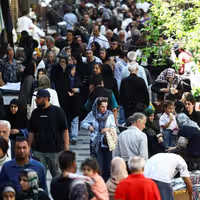
Gathering of people in Tehran call for building nuclear weapons
A group of people gathered in Tehran’s Enqelab (Revolution) Square on Friday evening following Israeli missile strikes on Iranian military targets, according to videos circulated on social media.
Footage showed participants chanting slogans in response to the attacks, including one calling for nuclear action. Among the chants heard was: “Yalla! Yalla! Nuclear bomb, yalla!” — an expression of anger amid heightened regional tensions.
Police in Iran’s Hormozgan province have identified 14 individuals accused of supporting Israel and spreading disinformation online following Israeli strikes on Iranian targets, authorities said on Saturday.
In a statement, the province's law enforcement command said the suspects were located by cyber police for allegedly "disturbing public opinion, spreading rumors, and showing support for Israel" on social media.
Officials said legal action, including summons and potential arrests, is underway in coordination with Iran’s judiciary.
According to the statement, expressing support for Israel online could carry a prison sentence of two to five years.
Iran will continue its attacks on Israel, a senior military spokesman said on Saturday, following remarks by Supreme Leader Ali Khamenei vowing to make Israel “regret” its actions.
Abolfazl Shekarchi, spokesperson for the General Staff of Iran’s Armed Forces, told state media that Tehran remains committed to retaliation.
“There is a weak belief in the minds of Israelis that eliminating military commanders will disrupt our structure,” Shekarchi said. “But our commanders will continue on their path with strength and make them regret their actions.”
Two deputy commanders of Iran’s armed forces general staff were killed in Israeli attacks, Iranian state media reported on Saturday, amid Israel’s largest wave of strikes against Iran to date.
Brigadier General Gholamreza Mehrabi, deputy head of intelligence at the Armed Forces General Staff, and Brigadier General Mehdi Rabbani, deputy chief of operations, were both killed in Israeli attacks.
“These commanders, who served during the eight years of the Sacred Defense (Iran-Iraq war), were martyred in a cowardly attack by the Zionist regime,” the Armed Forces' public relations office said in a statement
Brigadier General Gholamreza Mehrabi and Brigadier General Mehdi Rabbani
Israeli airstrikes on Iran’s nuclear infrastructure have inflicted damage on aboveground facilities but have not destroyed the deeply buried centrifuges or the country’s stockpile of near-weapons-grade uranium, the Washington Post reported on Saturday, citing nuclear experts and imagery analysis.
“We struck at the heart of Iran’s nuclear enrichment program,” Israeli Prime Minister Benjamin Netanyahu said following the attacks. However, analysts suggest that the core of Iran’s capability—particularly at hardened sites like Fordow and Natanz—remains intact.
“Until I know that Fordow is gone and until I know where that highly enriched uranium is and whether it’s usable, I consider us on the clock,” said Richard Nephew, a former US nuclear negotiator and fellow at the Washington Institute for Near East Policy.
A satellite image shows the Natanz nuclear facility in Iran in this handout image dated January 24, 2025.
Fordow and Natanz, Iran’s two main enrichment facilities, are fortified deep underground.
Experts cited by the Washington Post said only the US-made Massive Ordnance Penetrator could potentially damage them—an option not available to Israel.
“Israel can damage key Iranian nuclear facilities, but Israel can’t destroy hardened sites like Fordow without US military assistance,” said Kelsey Davenport of the Arms Control Association.
According to satellite imagery reviewed by analysts, the strikes at Natanz knocked out electrical infrastructure and destroyed a small research facility but spared the underground production site.
“They’ve disabled the facility by destroying the power substation, but they haven’t destroyed the facility in a way that would impact Iran’s long-term breakout capacity,” said Decker Eveleth, a missile and nuclear programs researcher.
Strikes were also reported at other locations, including a uranium metal facility in Isfahan, the heavy water reactor in Arak, and a military base near Tabriz. Yet analysts believe Iran’s enriched uranium and key centrifuges remain untouched.
“The centrifuge production hall at Natanz appears undamaged,” said Jeffrey Lewis of the Middlebury Institute, warning that Iran can continue to produce critical components. “So I presume they’re going to keep on making them.”
Former CIA analyst Kenneth Pollack suggested that Israel may pursue other tactics, including cyberattacks or special operations, to degrade Iran’s program further.
Experts also warned that the attacks could also strengthen hardliners in Iran pushing for an overt nuclear weapons capability. “The political momentum will doubtless shift to the bomb advocates,” said Jim Walsh of MIT.
A senior official quoted by Iran’s state broadcaster IRIB said the country’s military response to Israeli attacks will intensify and expand to include American bases in the region, warning of broader confrontation in the days ahead.
The unnamed source, citing senior military commanders, said that "the war initiated by Israel’s attacks will spread in the coming days to all areas under Israeli occupation and US bases in the region.”
The source added that Iran’s retaliatory actions will not be limited to those already taken and that future strikes “will be painful and regrettable for the aggressors.”
An Israeli police officer walks past damaged vehicles at an impact site following missile attack from Iran on Israel, in Ramat Gan, Israel, June 14, 2025.