Iran to launch third enrichment site after IAEA resolution, official says
Iran will establish a third uranium enrichment facility and upgrade centrifuges to advanced IR-6 models in response to the IAEA Board of Governors' resolution, Atomic Energy Organization spokesman Behrouz Kamalvandi said Thursday.
“Their strategic mistake is believing political pressure can force Iran to retreat from its rightful positions,” Kamalvandi told state TV.
“We had warned that our actions would be adjusted accordingly.”
Enrichment “will significantly increase,” he added, as part of Iran’s response to what Tehran calls a politically motivated move by Western powers at the nuclear watchdog.
Israeli Strategic Affairs Minister Ron Dermer and Mossad Director David Barnea will meet US Special Envoy Steve Witkoff ahead of the US-Iran nuclear negotiations in Oman, Israeli media reported Thursday.
The meeting comes as tensions rise ahead of Sunday’s scheduled talks in Muscat.
File photo of Iran's Shahid Alimohammadi enrichment complex (Fordow)
Iran has begun equipping a third secure uranium enrichment facility and fully upgrading its Fordow site with advanced centrifuges, senior officials said Thursday, following the International Atomic Energy Agency finding Tehran in breach of its non-proliferation obligations.
Atomic Energy Organization spokesman Behrouz Kamalvandi said the newly authorized site will be designed with “very high security standards” and become Iran’s third enrichment complex.
He said that first-generation centrifuges at the Fordow enrichment plant will be completely replaced with IR-6 machines, a move expected to “significantly increase Iran’s enriched uranium production capacity.”
“These steps carry both technical and strategic weight and send a clear message: the more pressure is applied, the stronger Iran’s response will be,” Kamalvandi said during a visit to the Tehran Research Reactor.
He described the IAEA's non-compliance resolution—backed by the US, UK, France, and Germany—as “coercive and unjust,” and warned Western powers against repeating failed pressure tactics.
Kamalvandi also noted that Iran’s 60% enrichment capacity has already increased sevenfold compared to previous cycles and that more capacity is now being added.
Separately, Atomic Energy Organization head Mohammad Eslami said that the location for the third enrichment facility has already been built and prepared, describing it as “a secure site from a security standpoint.” He added that with a formal letter sent to the IAEA on Thursday, “the operation to equip and install machines has now begun.”
“The enrichment industry is part of the Iranian people’s spirit and will not disappear,” Eslami said.
First resolution against Iran in 20 years
The announcement came after the International Atomic Energy Agency’s 35-nation board passed a resolution declaring Iran in non-compliance with its safeguards obligations under the Nuclear Non-Proliferation Treaty (NPT)—the first such move in nearly two decades.
The resolution text, seen by Reuters, cited “many failures to uphold its obligations since 2019” and Tehran’s lack of cooperation “regarding undeclared nuclear material and activities at multiple undeclared locations.”
The resolution was adopted with 19 votes in favor, 3 against, from Iran's allies in Russia, China and Burkina Faso, and 11 abstentions.
In a joint statement, the Iranian Foreign Ministry and the Atomic Energy Organization condemned the resolution, calling it a “politically motivated” move lacking legal and technical basis.
The statement added that Iran had consistently honored its safeguards obligations and that no evidence of diversion had been found in IAEA reports.
“This action is a repeated instrumental use of the Board, based on political motives and lacking technical and legal foundation,” the statement said.
It added, “The Islamic Republic of Iran has always remained committed to its safeguards obligations, and so far none of the Agency’s reports have referred to non-compliance or diversion in Iran’s nuclear materials or activities.”
Later Thursday, a senior IAEA official told Reuters that Iran has informed the agency of its intention to establish a new enrichment site but has not yet provided further technical details.
Iran on Thursday denounced the IAEA Board of Governors’ resolution declaring Tehran in breach of its nuclear safeguards obligations.
Foreign Ministry and Atomic Energy Organization in a joint statement called it a politically motivated move by the US and three European countries.
“This action is a repeated instrumental use of the Board, based on political motives and lacking technical and legal foundation,” the statement read.
“The Islamic Republic of Iran has always remained committed to its safeguards obligations, and so far none of the Agency’s reports have referred to non-compliance or diversion.”
The statement warned of retaliatory steps, saying that Iran “has no choice but to respond to this political resolution.”
“Orders have been issued to establish a new enrichment facility at a secure location and to replace first-generation centrifuges at Fordow with advanced IR-6 machines.”
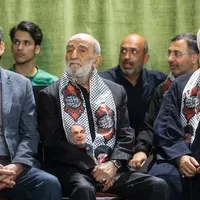
Iran's nuclear chief Mohammad Eslami (second from right) and Foreign Minister Abbas Araghchi (second from left)
The UN nuclear watchdog’s Board of Governors on Thursday passed a resolution formally declaring Iran in non-compliance with its nuclear non-proliferation obligations for the first time in almost 20 years.
"(The board) Finds that Iran's many failures to uphold its obligations since 2019 to provide the Agency with full and timely cooperation regarding undeclared nuclear material and activities at multiple undeclared locations in Iran ... constitutes non-compliance with its obligations under its Safeguards Agreement with the Agency," the International Atomic Energy Agency board resolution text seen by Reuters said.
Out of the 35 members of the Board of Governors, 19 voted in favor of the resolution, 3 voted against, and 11 abstained. Russia, China, and Burkina Faso cast negative votes.
A flag with the logo of the International Atomic Energy Agency (IAEA) waves in front of the IAEA headquarters in Vienna, Austria, March 1, 2021.
The UN nuclear watchdog's 35-nation Board of Governors passed a resolution on Thursday formally declaring Iran in breach of its non-proliferation obligations for the first time in almost 20 years.
The resolution cited Iran’s failure to cooperate with the investigations into undeclared nuclear material and activities, saying that Iran has not provided “technically credible explanations” for uranium traces found at several undeclared sites, despite multiple resolutions and years of outreach by the International Atomic Energy Agency (IAEA).
"(The board) finds that Iran's many failures to uphold its obligations since 2019 to provide the Agency with full and timely cooperation regarding undeclared nuclear material and activities at multiple undeclared locations in Iran ... constitutes non-compliance with its obligations under its Safeguards Agreement with the Agency," said the IAEA board resolution text seen by Reuters.
“The Board deeply regrets that, despite repeated calls from the Board and many opportunities offered, Iran has failed to cooperate fully with the Agency, as required by its Safeguards Agreement,” the four-page resolution added.
In its board-mandated comprehensive report published on May 31, the IAEA concluded that three of the four locations in question had been part of a previously undeclared, structured nuclear program conducted by Iran up until the early 2000s, and that some activities had involved the use of undeclared nuclear material.
Both US intelligence and the IAEA have long assessed that Iran operated a secret, coordinated nuclear weapons program that was halted in 2003, although limited activities are believed to have continued for several years after.
IAEA Director General Rafael Grossi said this week that the agency’s findings were broadly consistent with those assessments.
Iran continues to deny that it has ever pursued nuclear weapons.
Potential actionat UN Security Council
While the resolution does not immediately refer Iran to the UN Security Council, it opens the door for such a step, saying the matter is “within the competence” of the Council and that the Board will “address the timing and content” of a potential report to the UN.
The diplomats told Reuters that a second resolution would be required to make such a referral—similar to the process that followed the 2005 non-compliance declaration which led to a referral in February 2006.
Iran’s pattern of non-compliance
The text outlines a years-long pattern of obstruction and non-cooperation by Tehran. The IAEA added that Iran had repeatedly “sanitized locations” and “provided inaccurate explanations,” which the agency said appeared consistent with concealment efforts.
Specifically, the IAEA concluded that Iran had failed to declare nuclear material and related activities at three locations: Lavisan-Shian (Lavizan), Varamin, and Turquzabad. According to the agency, these sites were part of “an undeclared, structured program carried out by Iran until the early 2000s,” with some activities involving undeclared nuclear material.
“The Agency is not in a position to determine whether the nuclear material at these undeclared locations has been consumed, mixed with other declared material, or is still outside of safeguards,” the resolution said.
In a particularly stark passage, the resolution says Iran “retained unknown nuclear material and/or heavily contaminated equipment” at Turquzabad between 2009 and 2018, adding that these items were later removed and the whereabouts of which remain unknown.
IAEA warns against escalation
The resolution lays out urgent actions Tehran must take to avoid further escalation, including providing credible explanations for uranium particles found at undeclared sites, informing the IAEA of the current location of nuclear material and contaminated equipment, and allowing full access to relevant locations for sampling and inspection.
“The Board reaffirms its decision that it is essential and urgent… that Iran act to fulfil its legal obligations and clarify all outstanding Safeguards issues without delay,” it said.
The resolution stressed support for diplomacy: “The Board stresses its support for a diplomatic solution… including the talks between the United States and Iran,” and calls on all parties to constructively engage in diplomacy.
The resolution comes at a time of heightened tensions, with the US evacuating staff based in the Middle East, and Trump warning the region could become dangerous as Washington will not let Iran have nuclear weapons.
The report comes as US-Iran indirect talks appear to stall. The sixth round will be held on Sunday in Muscat, the Omani foreign minister said on Thursday.