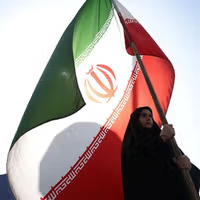
The sixth round of indirect nuclear negotiations between Iran and the United States will take place in Muscat this Sunday, June 15, Oman’s Foreign Minister Badr Albusaidi confirmed Thursday.
“I am pleased to confirm the 6th round of Iran US talks will be held in Muscat this Sunday the 15th,” Albusaidi wrote on X.

US Special Envoy Steve Witkoff is scheduled to meet Iran’s foreign minister in Muscat on Sunday to review Tehran’s response to Washington’s latest proposal, Barak Ravid of Axios reported Wednesday on X.
However, diplomatic sources have suggested the meeting may be postponed or canceled due to rising tensions between the two sides.
Iran must be permanently denied any nuclear or missile capability, US Special Envoy Steve Witkoff said Wednesday, calling it an “existential threat” to Israel, the United States, and the Persian Gulf region.
Witkoff, who was speaking at a United Hatzalah gala in New York, confirmed he had spoken with Israeli Prime Minister Benjamin Netanyahu earlier that day and praised President Donald Trump’s support for Israel.
“We must stand resolute and united against this danger and ensure that Iran never obtains the means to achieve its deadly ambitions no matter what the cost,” he said.

Israel is considering a military strike on Iran without US backing, NBC News reported on Thursday, as nuclear talks between Washington and Tehran are set to resume Sunday in Muscat, where US envoy Steve Witkoff is expected to meet Iran’s foreign minister.
Israel has grown more serious about unilateral action as Washington inches closer to a preliminary deal with Tehran, which includes provisions on uranium enrichment that Israel views as unacceptable, according to five sources cited by NBC.
“I just think maybe they don’t want to make a deal. What can I say?” President Trump said in a podcast interview earlier this week. “And maybe they do. So what does that mean? There’s nothing final.”
Michael Knights of the Washington Institute for Near East Policy told NBC that the recent US evacuation of nonessential personnel from the region was intended to signal to Iran that Trump might not stand in the way of an Israeli strike. “It’s about trying to get Iran to respect the president’s wishes,” he said.
NBC reported that while Israel would prefer US intelligence or logistical support, no American involvement is currently planned.
"While Israel would most likely prefer US military and intelligence support for strikes — especially against Iranian nuclear facilities — it showed in October that it can do a lot alone," NBC wrote.
Yemen’s Houthis are “at the highest level of preparedness for any possible American escalation against us," Newsweek reported Wednesday citing a Houthi source.
"Any escalation against the Islamic Republic of Iran is also dangerous and will drag the entire region into the abyss of war."
“Any military action by Israel against Iran’s nuclear facilities will be met with an unprecedented response from Tehran,” Iran’s state-run Al-Alam TV reported citing an Iranian official.
The official denied any military tensions between the United States and the Islamic Republic, saying, “Washington, under the influence of the Israeli lobby, is trying to display a state of alert at its military bases and diplomatic missions.”