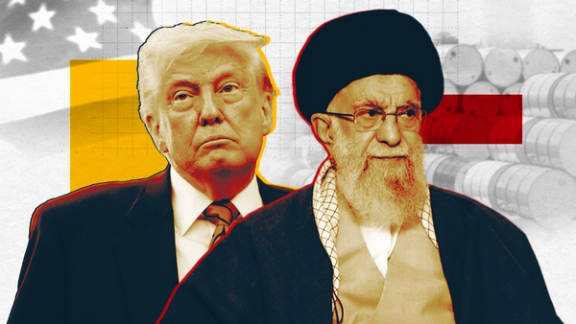
Iran and the United States are facing a deepening deadlock in nuclear negotiations, increasing the risk of military conflict, senior analyst Morad Vaisi wrote Sunday in a piece for Iran International.
Vaisi outlined ten key developments that have “darkened the prospects of reaching an agreement and made war more realistic.” He pointed to intensified rhetoric between leaders, with Supreme Leader Ali Khamenei calling Iran’s enrichment program “none of their business,” and Donald Trump responding that Iran would “never be allowed to enrich uranium.”
Vaisi wrote that no new rounds have taken place since the fifth session in Rome, describing the halt as “a clear indication of a sharp decline in the trajectory of the talks.”
Although the US briefly paused the imposition of new sanctions through a directive, it quickly reimposed them after Khamenei’s remarks, targeting financial networks tied to Iran.
Trump’s appointment of Admiral Brad Cooper as CENTCOM commander also signaled heightened readiness, Vaisi wrote, citing his experience within the region.
Vaisi added that growing European pressure on Israel over the Gaza conflict may push the Jewish state to shift the focus by escalating tensions with Iran, especially as Israeli officials warn that future opportunities to strike Iran’s nuclear facilities may be limited.
“The last hope to avoid a military confrontation,” he wrote, “may rest on a possible visit by Vladimir Putin to Tehran.”

As nuclear talks with the United States remain stalled and sanctions continue to choke its economy, Iran is intensifying its eastward pivot by leveraging its full membership in the Shanghai Cooperation Organization (SCO) to deepen economic and strategic ties across Central and South Asia, according to an analysis by Al-Monitor
Central Bank of Iran Governor Mohammad Reza Farzin this week proposed the creation of a joint SCO bank during a central bankers’ summit in Beijing. He said the initiative would reduce reliance on Western institutions like the IMF and World Bank and foster a multilateral financial platform among Eastern states.
Since joining the SCO in July 2023, Iran has pursued trade, infrastructure, and defense partnerships with members such as China, Russia, and India, positioning itself as a regional hub.
Tehran implemented a free trade deal with the Russia-led Eurasian Economic Union in May, aiming to boost trade to $12 billion and reinforce its role in transport corridors like the North-South Transport Corridor.
“Iran has always identified as a West Asia country looking with interest to Central Asia,” Roberto Neccia, an independent Iran analyst, told Al-Monitor.
“If nuclear talks with the United States fail to produce a comprehensive agreement, “Iran will increase its projection to the region, fully exploiting its potential,” said Neccia.
Geneva-based strategic adviser Torek Farhadi said, “Central Asian states are landlocked, and from a geo-economic standpoint, Iran offers them access to the Persian Gulf.”“There is no real substitute for sanctions relief — the talks remain vital.”
Amir Hamidi, an analyst speaking to Iran International, said tensions between Tehran and Washington are escalating as no date has been announced for the sixth round of nuclear talks.
Hamidi added that diplomacy can only succeed if one side retreats from its red lines — a shift that is currently absent on both sides.
A series of recent developments suggests nuclear talks between Iran and the United States have stalled, significantly increasing the risk of military confrontation, according to an analysis by Iran analyst Morad Veisi.
Veisi identifies ten key indicators of escalating tension, including: a sharp uptick in hostile rhetoric between Tehran and Washington, a complete halt in direct and expert-level negotiations, and a lack of new diplomatic initiatives.
The US has resumed sanctions targeting Iran’s financial networks, while Israel has intensified military drills and regional proxy clashes have surged, the analyst said, adding that Iran is also importing large volumes of rocket fuel chemicals, signaling continued missile program expansion.
Other red flags include the appointment of a hardline US military commander to oversee the Middle East, and a likely censure of Iran by the IAEA Board of Governors, backed by European powers.
He believes that Tehran may be underestimating the potential for direct US or Israeli military action.
A potential visit by Russian President Vladimir Putin to Tehran may offer a final diplomatic window to avert escalation, Veisi concluded.
US President Donald Trump’s recent remarks and actions suggest a dwindling interest in diplomacy with Iran, despite five rounds of indirect nuclear talks, according to an analysis published by the Tehran Times.
The Tehran Times argued that Trump's “zero-sum demands” and fresh US sanctions show a preference for pressure over compromise.
Speaking to reporters aboard Air Force One on Friday, Trump once again said that Iran cannot enrich uranium inside the country, adding, “There is not going to be enrichment [of uranium in Iran].”
“Donald Trump’s strategy regarding Iran’s nuclear program is characterized not by a sincere intent to achieve a fair and enduring agreement, but by maneuvers focused on enforcing unilateral conditions," read the article.


Since the US exited from the 2015 nuclear deal, Tehran has neither raced toward a bomb nor returned to full compliance, maintaining a state of strategic suspension that might best be described as rule at the threshold.
Grown—partly at least—out of necessity, the inaction has with time hardened into a governing doctrine: a form of power rooted less in coherent planning than in the instincts of political survival.
Iran’s rulers have learned to wield ambiguity as leverage, drawing strength not from action but its possibility. That is why they view enrichment as essential.
Maintaining near-weapons level enrichment without actual weaponization—the threshold condition—generates enough uncertainty to make Western powers cautious about Tehran’s next move. It creates a degree of deterrence without escalation.
But that effect appears to be eroding.
Internationally, the tolerance threshold for such maneuvering has narrowed. Domestically, endless uncertainty has undercut the rulers’ legitimacy and drained public resilience—driving growing numbers into apathy or protest.
Enrichment: suspension as power
Iranian officials have repeatedly denied any intention to build nuclear weapons, citing a religious ruling by supreme leader Ali Khamenei that forbade their use in 2010.
Still, after the United States exited the nuclear deal in 2018, Iran resumed enrichment and now possesses more than 274 kilograms of uranium enriched to 60 percent, according to the IAEA’s February 2025 report.
Inspectors have also confirmed that Iran has the technical infrastructure to reach weapons-grade capacity.
Nuclear experts have been debating Iran’s ‘break out time’ for many years. But the threshold status may be less of a transitional stage than it is a chosen posture: deter without provoking.
Without ever testing a bomb, Tehran has altered the regional military balance, particularly with Israel. Ambiguity has kept global powers on alert, calculating whether to cooperate with or contain Iran.
At home, this posture yields symbolic capital: scientific progress, defiance, and dignity. Enrichment has been folded into the Islamic Republic’s core narrative.
As indirect talks with the United States resume, the threshold position remains a pillar of Tehran’s strategy. But this time, the international response is sharper.
Calling for permanent inspections, proposing offshore stockpile transfers and—above all—Washington’s insistence on “zero enrichment” may suggest that the era of ambiguity is running out of road.
Sanctions: prolonging suspension
Sanctions have reinforced the threshold logic. They have damaged Iran’s economy but not collapsed it. They have left the country on the edge—in a prolonged state of uncertainty where everything seems possible, but nothing is guaranteed.
President Trump’s maximum pressure campaign has transformed sanctions: from broad embargoes to surgical strikes, targeting Iran’s critical sectors—missiles, drones, petrochemicals, dual-use technologies—applying pressure where it hurts most.
The aim, it appears, is not just to punish, but to constrict the Islamic Republic’s strategic arteries. Yet the targeted sanctions have not forced a retreat. Even as its economy bleeds and its regional allies perish, the regime’s rhetoric sharpens.
Iran’s increasingly aggressive tone against Britain, France and Germany—who can reimpose UN sanctions halted under the 2015 deal—might be a sign of self-confidence or deep unease.
Sanctions have clearly shaped Tehran’s behavior. But they have not broken its logic.
Iran’s rulers continue to see the nuclear ambiguity as their last safeguard of strategic balance, a critical bargaining chip they cannot afford to lose.
Suspension: eroding the nation
For now, Iran is unlikely to rush toward weaponization. But it is equally unwilling to dismantle its nuclear capability.
Iran's adversaries, lacking better tools, continue to rely on sanctions and vague ultimatums. Both sides, in effect, sustain the Islamic Republic’s threshold posture.
But the logic is fraying.
The United States and Europe appear to have lost patience with Tehran. Washington’s call for zero enrichment and Europe's warnings about a return of UN sanctions may signal a wish to step out of ambiguity, a will to end chronic suspension.
Domestically, too, the cost of this posture is rising.
A society long held in suspense now faces fatigue, frustration, and declining trust. What once symbolized resistance has come to represent gridlock. “Dignity” has curdled into a deadlock.
The leadership in Tehran may persist in this suspended state, but its power to dictate the terms of uncertainty is weakening. The ‘calculated ambiguity’ looks more like a trick revealed.
What once shielded the Islamic Republic is now hastening its erosion. It will either change course or collide with reality, at home and abroad.