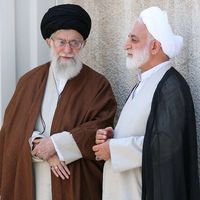
Iran was on the brink of reviving the 2015 nuclear deal during Ebrahim Raisi’s presidency, but internal forces derailed it, a conservative politician said.
“They were saying the news of the deal is coming, and this success would be credited to Raisi,” Hassan Shajaei said in a recorded discussion.
Shajaei blamed a team “whose strategy was negotiation for negotiation” for sabotaging progress.
“We ended up dealing with Trump,” he added, suggesting Biden would have been easier to reach agreement with.

Iran executed at least 157 people last month, the highest monthly figure this year, according to US-based Human Rights Activists News Agency (HRANA).
Most were executed after being convicted of murder or drug-related offenses, while others faced charges such as rape or corruption on earth.
HRANA also reported the execution of political prisoner Pedram Madani on charges of allegedly spying for Israel, as well as a public hanging in Lorestan province.
Twelve new death sentences were issued in May, including for political prisoner Mohammad-Amin Mahdavi Shayesteh and poet Peyman Farah-Avar, whose charges stemmed from protest-related writings, the group said.
Iran will soon deliver its official response to the latest US proposal, Foreign Minister Abbas Araghchi said Monday in Cairo, adding that any agreement must uphold Iran’s nuclear rights.
“Our response to the US proposal will come soon. It will reflect the positions and principles of the Iranian people and safeguard their rights,” Araghchi said at a joint press conference with Egyptian Foreign Minister Badr Abdelatty.
“Without respect for Iran’s right to enrichment, there will be no agreement,” he added.
Araghchi also warned European states against triggering the snapback mechanism. “I hope they do not make that mistake. It would be a wrong policy and would only worsen existing crises,” he said.
Any effort by the United States to block Iran’s access to nuclear technology would make a deal impossible, Iran’s Foreign Minister Abbas Araghchi said on Monday.
“If the US wants to deprive the Islamic Republic of nuclear technology, there will definitely be no agreement,” he said at a joint press conference with his Egyptian counterpart in Cairo.

Iranian Foreign Minister Abbas Araghchi said on Monday that Tehran will not accept any nuclear agreement that strips the country of its right to peaceful nuclear technology, warning that negotiations will fail if Washington insists on limiting Iran’s enrichment capabilities.
Speaking in Cairo after meeting Egyptian Foreign Minister Badr Abdelatty and International Atomic Energy Agency Director General Rafael Grossi, Araghchi said: “If the United States seeks to deprive us of nuclear technology, there will definitely be no agreement.”
He emphasized that uranium enrichment is Iran’s right under international treaties.
“The International Atomic Energy Agency must remain a technical body and not be swayed by political pressure,” he added.
Last week, the IAEA said that Iran operated a covert nuclear program using undeclared material at three sites under investigation.
Araghchi’s comments come amid nuclear talks mediated by Oman.
Also on Monday, Reuters cited an unnamed Iranian diplomat as saying that Tehran is preparing to formally reject a recent US proposal, calling it “one-sided” and “a non-starter.”
The proposal, delivered on Saturday by Oman’s Foreign Minister Badr bin Hamad Al Busaidi fails to address Tehran’s core demands—including recognition of its right to enrich uranium and the immediate lifting of US sanctions, according to Reuters.
“In this proposal, there is no change to the US position on enrichment, and no clarity on sanction relief,” the diplomat said.
He added that Iran’s nuclear negotiation committee, which reports to Supreme Leader Ali Khamenei, has assessed the proposal as incompatible with Iranian interests.
An Iranian official familiar with the matter was also cited by Iranian state-linked media as saying that Tehran does not view the latest US proposal in nuclear talks as a fair basis for agreement.
“The recent US proposal for a new nuclear deal with Iran is unacceptable,” the unnamed source was quoted as saying. “It cannot serve as a fair foundation for any potential compromise.”
Iran has consistently said that its nuclear program is for peaceful purposes. However, Western powers have accused Tehran of seeking nuclear weapons capabilities—allegations Iran denies.
Iran is the only non-nuclear weapon state enriching uranium to 60% U-235. The IAEA has consistently maintained that there is no credible civilian use for uranium enriched to this level, which is a short technical step from weapons-grade 90% fissile material.
Iran's stockpile of 60% enriched uranium had increased to 275 kg, enough to theoretically make about half a dozen weapons if Iran further enriches the uranium.
Two Iranian officials told Reuters last week that Iran might consider pausing enrichment if the US unfreezes Iranian assets and acknowledges Iran’s civilian enrichment rights as part of a broader political understanding.
Last month, Khamenei said there will be no concessions on enrichment. "Saying things like 'we won’t allow Iran to enrich uranium' is way out of line. No one is waiting for anyone’s permission," he said. "The Islamic Republic has its own policy, its own approach, and it will continue to pursue it."
Iran will not accept any proposal that undermines the rights of its people, Foreign Minister Abbas Araghchi said Tuesday in Cairo, following high-level talks with Egyptian officials.
“We do not accept any demand that contradicts the rights of the Iranian nation,” Araghchi told reporters.
The US, on Saturday, sent a proposal to Iran regarding a nuclear deal. The proposal, the first formal one from the US since negotiations began in April, was delivered by Omani Foreign Minister Badr Al-Busaidi during a visit to Tehran.