US won’t allow Iran to have any uranium enrichment, Trump says


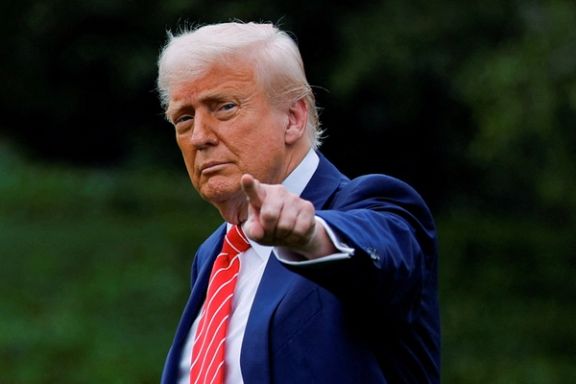
US President Donald Trump says his country will not allow Iran to have any uranium enrichment, after an Axios report said a US nuclear deal proposal would allow Tehran to keep enriching uranium temporarily.
“The AUTOPEN should have stopped Iran a long time ago from “enriching.” Under our potential Agreement — WE WILL NOT ALLOW ANY ENRICHMENT OF URANIUM!” he said on Truth Social.


A rare public clash over Iran’s top military commander has laid bare fault lines within Iran's hardline camp, exposing sensitivities over domestic and foreign policy as well as the country's ultimate taboo: the succession of a new Supreme Leader.
A news website and a newspaper widely seen as the mouthpieces of rival ultra-conservative factions clashed last week over recent controversial comments by the Chief of Staff of Iran’s Armed Forces Mohammad Bagheri.
At issue are his apparent criticism of harsh police tactics and revelation of details about Supreme Leader Ali Khamenei's confidential reply to a letter from US President Donald Trump.
“How is it that the Chief of Staff is taking such positions … despite the clear directive of the Leader of the Revolution regarding countering the enemy’s calculations?” ultra-hardline outlet Raja News wrote in an editorial last Thursday.
Quick with a response was rival daily Javan, which is linked to the Islamic Revolutionary Guard Corps (IRGC), a military body officially under Bagheri's command but whose head is chosen by Iran's Supreme Leader Ali Khamenei.
In a harshly worded commentary on Saturday, it accused Raja News of sowing factional discord which hurts national security and does not serve Khamenei.
The dispute is remarkable not just for its tone but for its target: Bagheri is one of Khamenei’s top appointees and widely seen as a stabilizing figure within Iran’s complex military establishment.
What sparked the criticism?
Iran’s ultra-hardliners—sometimes called ‘super revolutionaries’ by rival camps—first took issue with Bagheri in March, when on the occasion of Iranian New Year the Chief of Staff released a video message recorded at the historic ruins of Persepolis.
The super-revolutionaries condemned his choice of venue and outfit on social media: an ancient, pre-Islamic site rather than a religious one, and civilian clothing instead of a uniform—which the activists said signals pacifism rather than resistance.
Then came Bagheri discussing in public Khamenei’s response to Trump’s March 7 letter: that Iran was not pursuing nuclear weapons, sought peace in the region but would not abandon its civilian nuclear program and would negotiate only indirectly with the US.
Raja News criticized him for referring to the Supreme Leader instead of Foreign Minister Abbas Araghchi.
The last instance—which appears to have triggered Raja News to attack Bagheri for past remarks—came on May 25, when Bagheri urged Iran’s law enforcement to adapt to the country’s “highly complex and evolving society.”
“The police command will get nowhere if it tries to deal with it using a harsh approach, batons and daggers,” he said in a speech on a university campus in Tehran.
This was seen as a veiled critique of attempts to revive enforcement of a stalled new hijab law, which has been suspended since last September despite hardliner pressure.
Is this really about Bagheri?
The outlet at the heart of the controversy, Raja News, is linked with the far-right Paydari Party and its allies including former nuclear negotiator and presidential candidate Saeed Jalili.
The camp is known to be in a cold war with another presidential candidate, Parliament Speaker Mohammad-Bagher Ghalibaf, whose supporters joined the Bagheri fray in favor of the Commander in Chief.
“This radical group is smearing all the country’s officials, including the Leader’s appointees, with flawed arguments and hiding behind the Leader,” posted Nader Alizadeh, a pro-Ghalibaf activist, on X.
Some linked the criticism to Bagheri’s recent report on the helicopter crash that killed President Ebrahim Raisi suggesting it may have contradicted hardliner claims that the crash was a foreign plot.
Others suggested the controversy has more to do with the looming question of succession, reflecting anxieties about post-Khamenei leadership and loyalty within the armed forces.
“Obedience and absolute loyalty of the armed forces to the new Leader chosen by the Assembly of Experts will be crucial,” political analyst Mohammad-Ali Ahangaran posted on X. “This is the crux of the matter.”
The US proposals presented to Iran on Saturday would allow Tehran to maintain limited low-level uranium enrichment on its soil for a to-be-determined period of time, Axios reported citing two sources with direct knowledge.
Iran would temporarily reduce its enrichment levels to 3% after signing the deal, Axios reported, for a period agreed upon during the negotiations.
Underground enrichment sites "non-operational" for an agreed duration and enrichment capability would be limited to levels necessary for civilian nuclear reactor use as determined by the International Atomic Energy Agency (IAEA).
The proposal would only ease US sanctions on Iran after it "demonstrates real commitment" in the view of the United States and the IAEA."(A) strong system for monitoring and verification" would be implemented, Axios added.
Snap inspections by the IAEA as part of its so-called additional protocol would also be agreed.
The White House, Axios added, did not deny any details of the proposal it reported.
US President Donald Trump and Israeli Prime Minister Benjamin Netanyahu discussed the ongoing nuclear talks with Iran during a phone call on Monday, White House Press Secretary Karoline Leavitt said.
Both of the nuclear deal proposals the United States recently put forward are unacceptable to Tehran, said Abolfazl Zohrehvand, a member of the Iranian parliament’s National Security and Foreign Policy Committee.
"From what I know, the first proposal is that uranium enrichment be completely halted, and if Iran wishes to continue nuclear activities, a consortium should be established with Saudi Arabia, the UAE, Qatar, and the Americans on one of the (Persian Gulf) islands, under US control," Zohrehvand said.
Iran would be given a defined share in this consortium, he added, but no enrichment would take place on Iranian soil.
The lawmaker said the second proposal involves Iran suspending enrichment for a period of time, pending a final decision on the future of its nuclear program.

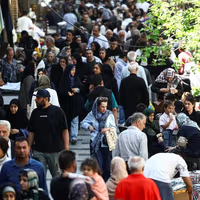
As Tehran insists in nuclear talks on its right to enrich uranium, many Iranians wonder why this right that has cost us so much in terms of sanctions and squeezed livelihoods has been elevated over the lost ones we actually care about.
The slogan “nuclear energy is our absolute right” emerged in the early 2000s, as tensions over Iran’s program escalated and international pressure mounted. It was printed on official banners and chanted in state-sponsored rallies.
But it was never a grassroots demand.
“I want to throw up when I hear the phrase nuclear energy,” says Babak, a software engineer in his mid-forties. “Everyone I know feels the same—it reminds them of high prices and empty pockets.”
It’s easy to see that the grudge runs far deeper and wider than the nuclear program.
“This nuclear standoff has made the wall between us and the rest of the world much taller. Every time (Foreign Minister Abbas) Araghchi says ‘non-negotiable’, he triggers a collective trauma: the lives we’ve lost to his ilk’s stupid posturing.”
They showed some reason with the 2015 deal, Babak says, but it was all undone when President Donald Trump pulled the U.S. out.
The chants about nuclear rights died out with that agreement. The term ‘enrichment’ crawled back to technical reports where it belongs.
Now, amid talks with the United States, the government is reviving it, calling enrichment “a non-negotiable right of the Iranian nation.”
Pride, what pride?
But the message holds little weight for many Iranians who increasingly feel their interests and those of Iran’s rulers are mutually exclusive.
“How am I benefiting from this technology, this so-called right?” my neighbour Sonia asks as she breastfeeds her baby in stifling afternoon heat during the daily power cut.
“Isn't one supposed purpose of nuclear energy generating electricity? Why are we having more power cuts with every passing year, then? Why is the share of nuclear power in our grid a literal zero?”
Sonia’s questions are rarely, if ever, discussed in Iran’s media. The nuclear program is a source of national pride, we’re told, and not being proud of it is a crime.
The disconnect between rulers and ruled is nearly complete—so is the gap between official claims and lived experience.
“Their contempt for us people is unreal. And it’s matched by ours for them,” Sonia concludes, her baby now fast asleep. “It’s gotten to a point where many oppose a deal that might improve their lives, because it would benefit the Islamic Republic far more.”
It’s about them, not us
Not everyone is so antagonistic toward the government. Some—more among the older generations, in my experience—are equally critical of regional and world powers.
Retired chemistry teacher Kazem is one of them. He’s the only one of four friends playing chess in the park who is willing to talk to me.
“The Americans first said low-level enrichment would be ok,” he says, “but then changed their position to ‘zero enrichment’, perhaps under pressure from hawks or (Israeli prime minister) Netanyahu.”
“I dislike most of what the government does, but on this one I think it’s the others in Europe and America who are being unreasonable and blocking a potential path forward.”
Kazem’s friends shake their heads in disagreement. One murmurs something to the effect that no sane man believes a word that “this bunch”, Iranian officials, say.
The distrust, in my view, is at the heart of every position that most ordinary Iranians take in relation to those who rule the country.
“The idea of peaceful nuclear energy is a total lie. Yes, it does have many applications—in medicine, for example. But show me just one hospital that’s benefiting from what’s being done in Natanz and Fordow.”
Reza is a technician at a private hospital in Tehran. He says he agrees with the official line about nations’ right to peaceful nuclear energy.
“But this has nothing to do with the nation,” he says, voice rising. “It’s about them, (supreme leader) Khamenei, the (Revolutionary) Guards and the leeches sucking Iran dry and sending the riches to their brood in Canada.
“If it was about the nation, the nation would have been consulted about it. Has anybody ever asked you if you’d rather have centrifuges or a decent car?”