One of the ideas proposed by the US to break the deadlock in Iran nuclear talks "is that the US recognizes Iran's right to enrich uranium, while Iran fully suspends its uranium enrichment," Axios reported citing sources.
The other idea is "to establish a regional consortium that will enrich uranium for civilian nuclear programs under IAEA and US monitoring," the report added.
Iran's Foreign Minister Abbas Araghchi had a phone conversation with the UN nuclear watchdog's director general Rafael Grossi to discuss the latest IAEA report on Iran, Iran's Foreign Ministry said.
"During the phone call, Araghchi highlighted Iran’s ongoing cooperation with the Agency, saying all of the country’s nuclear activities are conducted under the Agency’s supervision and within the framework of the Safeguards Agreement, with no diversion of nuclear materials or activities."
"He called on the Agency’s Director General to reflect the realities in a way that prevents certain parties from misusing this international body to advance their political agendas against the Iranian nation," according to the Iranian Foreign Ministry's readout of the call.
Iran's foreign minister also called on the IAEA director general "to clarify Tehran’s cooperation with the Agency during next week’s Board of Governors meeting and to warn of the consequences of any political action."
Araghchi stressed that "Iran will respond appropriately to any improper moves by European parties. The responsibility for any fallout will lie with those who use the Agency and its mechanisms as tools to advance their political agenda against Iran," the readout said.

"Iran's Supreme Leader Ali Khamenei has formed a team that sets the policies for the nuclear negotiations," senior Iranian lawmaker Esmaeil Kowsari told state TV.
"Before each round of talks, Iranian negotiators meet separately with that team and with the Parliament’s National Security and Foreign Policy Committee to hear their views," said Kowsari, who is a member of the committee.
The first formal US proposal to Tehran for elements of a nuclear deal includes "a series of bullet points but not a full draft of an agreement," the New York Times reported on Saturday, citing officials familiar with the diplomatic exchanges.
The proposal "calls for Iran to cease all enrichment of uranium and proposes the creation of a regional consortium to produce nuclear power that would involve Iran; Saudi Arabia and other Arab states; and the United States."

White House Press Secretary Karoline Leavitt said on Saturday that President Donald Trump’s special envoy, Steve Witkoff, has sent a “detailed and acceptable proposal” to Iran regarding a nuclear deal, and emphasized that it is in Iran’s best interest to accept it.

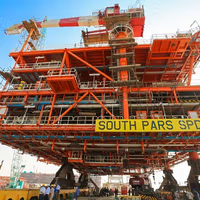
A gas leak at a refinery in Fars Province on Saturday resulted in the deaths of two workers and left nine others injured, state-run media outlets reported citing local officials.
"Nine of the injured were promptly transferred to hospitals in Shiraz and Zarqan with the help of emergency response teams," said Hojjatollah Rezaei, the deputy governor of Fars for political and security affairs.
He said the injured workers are fortunately in stable condition.
“The two victims suffered severe inhalation of hazardous substances, which led to suffocation and ultimately cost them their lives,” Rezaei confirmed.
The Shiraz refinery is operating without interruption, the official said, adding that an investigation into the cause of the incident is currently underway.
The Shiraz Refinery (also known as SORC) is a crude oil refinery located on the Shiraz-Isfahan road. It is designed to process 40,000 barrels of crude oil per day, equivalent to 2 million tons per year.
The required crude oil feed is supplied via a 230-kilometer, 10-inch pipeline from the Gachsaran oil fields.