Iran's Foreign Minister Abbas Araghchi had a phone conversation with the UN nuclear watchdog's director general Rafael Grossi to discuss the latest IAEA report on Iran, Iran's Foreign Ministry said.
"During the phone call, Araghchi highlighted Iran’s ongoing cooperation with the Agency, saying all of the country’s nuclear activities are conducted under the Agency’s supervision and within the framework of the Safeguards Agreement, with no diversion of nuclear materials or activities."
"He called on the Agency’s Director General to reflect the realities in a way that prevents certain parties from misusing this international body to advance their political agendas against the Iranian nation," according to the Iranian Foreign Ministry's readout of the call.
Iran's foreign minister also called on the IAEA director general "to clarify Tehran’s cooperation with the Agency during next week’s Board of Governors meeting and to warn of the consequences of any political action."
Araghchi stressed that "Iran will respond appropriately to any improper moves by European parties. The responsibility for any fallout will lie with those who use the Agency and its mechanisms as tools to advance their political agenda against Iran," the readout said.



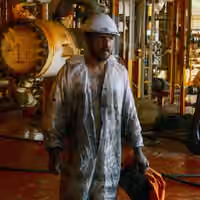
A gas leak at a refinery in Fars Province on Saturday resulted in the deaths of two workers and left nine others injured, state-run media outlets reported citing local officials.
"Nine of the injured were promptly transferred to hospitals in Shiraz and Zarqan with the help of emergency response teams," said Hojjatollah Rezaei, the deputy governor of Fars for political and security affairs.
He said the injured workers are fortunately in stable condition.
“The two victims suffered severe inhalation of hazardous substances, which led to suffocation and ultimately cost them their lives,” Rezaei confirmed.
The Shiraz refinery is operating without interruption, the official said, adding that an investigation into the cause of the incident is currently underway.
The Shiraz Refinery (also known as SORC) is a crude oil refinery located on the Shiraz-Isfahan road. It is designed to process 40,000 barrels of crude oil per day, equivalent to 2 million tons per year.
The required crude oil feed is supplied via a 230-kilometer, 10-inch pipeline from the Gachsaran oil fields.

Iran has strongly rejected as unbalanced and politically motivated the latest report by the International Atomic Energy Agency (IAEA) which accuses Tehran of running an undeclared nuclear program using unreported material.
Details of the UN nuclear watchdog's report were released by Reuters earlier in the day, at a delicate moment as Tehran and Washington have engaged in multiple rounds of negotiations in recent weeks over a potential nuclear agreement that US President Donald Trump is seeking to finalize.
In a joint statement on Saturday, the Iranian Foreign Ministry and the Atomic Energy Organization of Iran (AEOI) accused IAEA Director General Rafael Grossi of "repeating groundless accusations based on forged documents provided by the Zionist regime (Israel)."
“The allegations raised by the IAEA are based on claims regarding a handful of undeclared activities and locations from decades ago,” the statement read. “Iran has repeatedly declared that it has never had any undeclared nuclear site or activity.”
In 2018, Israel officially claimed responsibility for the theft of Iran's nuclear documents from a warehouse in Tehran's Shourabad area – with Benjamin Netanyahu revealing that Israel had obtained 55,000 pages and 55,000 digital files through an intelligence operation.
Iran's Saturday statement condemned what it called the IAEA’s double standards regarding Israel. “The report relies on unverified information from a regime that is not even a party to the NPT, possesses nuclear weapons, and openly threatens Iran’s peaceful nuclear facilities"
The statement also criticized the IAEA's report for failing to accurately reflect Iran’s cooperation with the Agency. “Despite acknowledging Iran’s cooperation, the report does not portray the real level of engagement. Iran has provided access, allowed sampling, and offered extensive explanations on the sites in question."
Tehran accused Western powers of exploiting the Agency for political ends. “The United States, the United Kingdom, France, and Germany have repeatedly violated their commitments under the JCPOA and Resolution 2231. At the same time, they continue to impose illegal sanctions and pressure Iran in violation of international law.”
Sharp rise in highly enriched uranium stockpiles
The IAEA, in a separate report sent to member states on Saturday, revealed a sharp rise in Iran’s stockpile of enriched uranium. As of May 17, Iran held 408.6 kilograms of uranium enriched to 60 percent, an increase of 133.8 kilograms since February, the report said. Material enriched to that level is a short technical step from weapons-grade purity.
The Iranian government on Saturday stressed the peaceful nature of its nuclear program and reaffirmed its intention to continue working with the Agency within the framework of its legal obligations.
“Iran’s enrichment program is exclusively for peaceful purposes, under full IAEA oversight and in line with the Comprehensive Safeguards Agreement,” the statement added.
Iran warned that any attempt to use the report against it during the upcoming Board of Governors meeting would trigger a response.
“Should some states misuse the report or Iran’s transparent cooperation to increase pressure, the Islamic Republic will take appropriate measures to protect its legitimate rights and interests,” the statement said.
Iran's Foreign Ministry and Atomic Energy Organization said in a joint statement that the director general of the UN nuclear watchdog "has repeated past biased and baseless accusations in his new report, citing forged Israeli documents."
The statement said the new report does not reflect the true level of cooperation between Tehran and the International Atomic Energy Agency (IAEA).
A senior Iranian lawmaker said on Saturday that if talks with the United States do not succeed, they will serve to make clear to the public that Washington is responsible for any failure.
“If negotiations lead nowhere, people will understand the US is to blame,” said Rouhollah Abbaspour, a member of parliament from Bouin Zahra. He added that Iran has always been open to talks based on national interests, but said past experience shows the US cannot be trusted to keep its word.
Abbaspour said Iran’s foreign policy should remain balanced, with negotiations pursued alongside efforts to strengthen regional and economic ties to reduce pressure from sanctions.

Iran operated a covert nuclear program using undeclared material at three sites under investigation, the International Atomic Energy Agency said in a confidential report shared with member states ahead of its board meeting in June.
“These three locations, and other possible related locations, were part of an undeclared structured nuclear program carried out by Iran until the early 2000s,” the report said, adding that “some activities used undeclared nuclear material.”
The report comes at a delicate moment, as Tehran and Washington have engaged in multiple rounds of negotiations in recent weeks over a potential nuclear agreement that US President Donald Trump is seeking to finalize.
The document, obtained by Reuters, was prepared following a November request by the IAEA’s Board of Governors.
UN nuclear agency flags sharp rise in Iran’s high-level uranium
The IAEA, in a separate report sent to member states on Saturday, said a sharp rise in Iran’s stockpile of enriched uranium. As of May 17, Iran held 408.6 kilograms of uranium enriched to 60 percent, an increase of 133.8 kilograms since February. Material enriched to that level is a short technical step from weapons-grade purity.
“Iran is the only non-nuclear weapon state enriching to this level,” IAEA Director General Rafael Grossi has repeatedly said. On Saturday, he again urged Iran to cooperate “fully and effectively with the agency.”
Both IAEA reports said Iran’s high-level enrichment was “of serious concern,” noting it is the only country enriching to that level without having nuclear weapons.
Western powers move toward censure
Western governments are also preparing a resolution that would formally declare Iran in breach of its non-proliferation commitments for the first time since 2005. Reuters cited diplomats on Friday as saying the United States will lead the drafting of the motion, to be submitted at the board’s quarterly meeting beginning June 9.
“We expect the comprehensive report to be tough, but there were already no doubts over Iran not keeping its non-proliferation commitments,” a European official told Reuters.
The last time the IAEA board took such action, in 2005, it led to Iran’s referral to the UN Security Council and triggered a round of international sanctions.