The chance of success in the talks between Iran and the US is “as slim as a camel passing through the eye of a needle,” Reformist commentator Ahmad Zeidabadi wrote on Telegram.
Warning of difficult days ahead, he said open political analysis would become restricted and writers like himself may no longer be able to speak freely or continue as before.


President Donald Trump’s tour of Arab capitals this month aimed to draw a contrast between their pro-Western, prosperity-driven policies and Tehran's Islamic ideology and opposition, former Palestinian peace negotiator Ghaith al-Omari said.
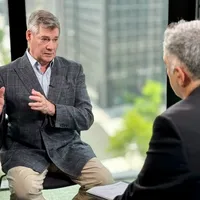
As Arab states astride the Persian Gulf prosper, Iran remains mired in grievance, repression and decline, according to former Palestinian peace negotiator Ghaith al-Omari on Eye for Iran.
“The Persian Gulf is non-ideological. Their leaders say, ‘My job is how to make life better for my people.’ This is completely incompatible with the ideological mindset—including in Iran,” al-Omari said.
As Saudi Arabia and the UAE surge ahead—reimagining their economies and societies—Iran clings to a narrative rooted in the past.
“What is the narrative coming from the Iranian regime? It’s a narrative of grievance... rooted in the past, in both past grievances and past glory... not a view of prosperity.”
Al-Omari said the Middle East is undergoing a seismic shift, with Persian Gulf countries becoming the “center of gravity” in the region—and Trump recognizing and seizing that opportunity.
Decades of neglect
During his speech at the US-Saudi Investment Forum in Riyadh on May 13, 2025, President Trump drew a sharp contrast between the trajectories of Saudi Arabia and Iran. The president anccused Iran’s leadership for mismanaging the country and funding terrorism, while praising the transformation of its neighbors.
“Iran's decades of neglect and mismanagement have left the country plagued by rolling blackouts lasting for hours a day. All the time, you hear about it. While your skill has turned dry deserts into fertile farmland, Iran's leaders have managed to turn green farmland into dry deserts, as their corrupt water mafia—it's called the water mafia—causes droughts and empty riverbeds,” said Trump.
His remarks resonated with many Iranians, long critical of Tehran's failures. The speech reinforced a new US posture in the region—one that rewards progress and punishes destabilization.
Trump’s Persian Gulf tour also produced sweeping economic and defense agreements.
A $142 billion arms deal was signed, the largest defense cooperation agreement in US-Saudi history. It includes cutting-edge warfighting technology and signals a shift in US strategic posture.
Saudi Arabia committed to investing $600 billion in the United States across energy, defense, mining, and other sectors.
Taken together, these moves represent a strategic pivot: away from traditional diplomacy, and toward a model focused on mutual economic and security interests.
And one in which Iran—after its unprecedented direct missile attack on Israel last year—is increasingly isolated and weakened.
Even Syria adapts—leaving Tehran more isolated
Even Syria—long seen as a spoiler in regional affairs—is signaling a shift.
"Syria has been a spoiler in the region since the 1970s," said al-Omari. "Now Syria is not a spoiler."
Trump's outreach to Damascus, despite its authoritarian legacy, underscores the extent to which even old adversaries are repositioning themselves in a changing Middle East. As others pivot toward stability and integration, Tehran's confrontational stance risks leaving it behind.
Qatar
Qatar was also a focal point of Trump’s tour.
Qatar Airways agreed to purchase up to 210 planes from Boeing. Trump described it as “the largest order of jets in the history of Boeing.”
He also accepted a Boeing 747-8 aircraft from the Qatari government, valued at roughly $400 million. Trump said it would be “stupid” to turn it down, framing it as a donation to the US Department of Defense, not for personal use. The move sparked backlash, even among Trump’s own supporters.
Al-Omari criticized Qatar’s influence strategy, noting its financial clout and controversial alliances.
“Qatar is a very problematic actor. Qatar has been the supporter of Hamas, the supporter of Muslim Brotherhood, the supporter of disruption throughout the region.”
He added that while Persian Gulf countries all have relations with Iran, “Qatar has partnership with Iran in many ways. That’s different.”
Trump made headlines when, during a state dinner in Doha, he said: “Iran should say a big thank you to the Emir, because he's fighting for them.”
He also reportedly asked the Qatari government to push Iran toward a nuclear deal.
“The Qataris like these problematic relations to be behind the scenes, to be hush-hush," said al-Omari on Eye for Iran, "Trump being Trump, he doesn't like to play this subtle behind the scenes game. He says it as it is."
A new era of American diplomacy
Al-Omari said Trump’s approach marks a sharp departure from previous presidents like Barack Obama.
“Trump sees the region through a transactional lens. Obama focused on moral lectures. Trump prefers investment and deals—but keeps military options on the table, especially when it comes to Iran.”
The administration wants Iran to integrate into this future-oriented regional order—but warns of consequences if it doesn’t.
“There’s an opportunity for Iran if it wants to take it,” said al-Omari. “The region is changing—but not at any price.”
You can watch the full episode of Eye for Iran featuring Ghaith al-Omari on YouTube or listen on any major podcast platform like Spotify, Apple, Amazon Music or Castbox.


The Conservative Political Action Conference announced the launch of CPAC for Iranians in Exile, a platform it says enables the Iranian diaspora to engage with senior Trump administration officials to oppose Tehran.
The project, launched by CPAC in partnership with the United Against Nuclear Iran (UANI), aims to mobilize members of the Iranian diaspora to advocate for human rights, religious freedom, and increased pressure on the Islamic Republic.
CPAC has been a key driver of grassroots support for US President Donald Trump by organizing popular conferences. UANI is an influential advocacy group whose chairman is former Republican presidential candidate Jeb Bush.
“We want to get together all these great voices in the exile community and put a real pressure point on the regime in Iran,” CPAC organizer Matt Schlapp told Iran International.
“There should be great unity amongst people who believe in freedom, religious tolerance, human rights to really put pressure on Iran.”
Schlapp said CPAC is committed to helping create a “new version of the maximum pressure campaign,” referring to the Trump administration’s policy against Tehran.
In 2018, during his first term in office, Trump withdrew the United States from the Obama-era nuclear agreement with Iran, known as the Joint Comprehensive Plan of Action (JCPOA), and imposed his so-called "maximum pressure" sanctions on Tehran.
The sanctions effectively reduced Iran’s oil exports to as little as 150,000 barrels per day. However, oil sales rebounded to at least 1.5 million barrels per day during the Biden administration.
In February this year, Trump reinstated the maximum pressure campaign, aiming to reduce Iran’s oil exports to zero, "deny Iran all paths to a nuclear weapon, and counter Iran’s malign influence abroad."
Since early April, Iran and the US have held five rounds of negotiations mediated by Oman to resolve the dispute over Tehran's nuclear program. The two sides have agreed to hold a sixth round in the near future, American officials said on Friday.
Iranian diaspora's engagement with Trump administration
UANI, which co-launched the initiative, said in a press release that the project will offer a forum for "civil and respectful debate" across the diverse Iranian diaspora.
“The group will provide direct access to policymakers, including senior Trump administration officials, and support those in the diaspora who oppose the Islamist ideology of the Ayatollahs and who support Iran’s territorial integrity," the statement added.
Jason Brodsky, the UANI's policy director, told Iran International that “CPAC for Iranians in Exile will provide the diverse Iranian diaspora with a unique platform to engage with senior Trump administration officials and US policymakers in Washington to discuss Iran policy and an Iran free from the Ayatollah.”
UANI chairman Mark Wallace also said “The Iranian people, who have suffered under the Ayatollah’s rule for 46 years, have not had a consistent platform to be heard. This initiative is an effort to change that and ensure their voices are not just heard but engaged with.”
The CPAC for Iranians in Exile website calls the platform "a defining opportunity for the Iranian people in their courageous fight to end the despotic rule of the Ayatollah and his cronies."
"All of us are committed to see the end of the Ayatollah’s totalitarian Islamist dictatorship."
CPAC for Iranians in Exile says it will be hosting its inaugural conference later this year in Washington DC with the participation of senior US administration officials and policymakers.
The fifth round of Iran-US talks in Rome was constructive, a senior Trump administration official said on Friday.
“We made further progress, but there is still work to be done,” the official told reporters in a statement, adding that both sides agreed to meet again “in the near future.”
The US was represented in the talks by Steve Witkoff and State Department policy planning director Michael Anton, according to the official.
"It seems to me that all parties believe it was a constructive meeting, which has not yet led to a conclusion," Italian Foreign Minister Antonio Tajani told reporters after the fifth round of Iran-US talks in Rome.
Evidently, he added, there are still elements on which the parties have not agreed.
"An agreement would be essential to arrive at a less tense situation throughout the Middle East: we continue to work patiently in this direction, trying to talk to everyone because a nuclear escalation is not in anyone's interest," Tajani told reporters in Mexico City.
Tajani said he had told his counterpart today that "we are working to reach an agreement, but everyone must make an effort, starting with Tehran, in light of the problem related to the atomic weapon: he has always told me that they do not want to build it, but there must be a guarantee not only for today but also for the future".

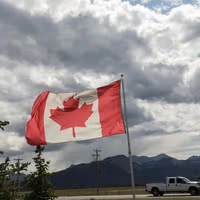
The resumption of diplomatic relations between Canada and Iran—severed by Ottawa in 2012—remains unlikely, statements this week from both governments indicated, as tensions and mutual distrust fester.
Responding to a query from Iran International TV on Thursday, Canada’s foreign ministry stated that Iran must undergo “significant changes to its behavior both domestically and internationally” before the restoration of diplomatic ties can be considered.
Iranian Foreign Ministry Spokesman Esmail Baghaei on Tuesday put the onus on Canada to make the first move to restore relations.
“I think the first step they need to take is to unravel the many sanctions and restraints they have imposed on themselves and on our bilateral relations,” Baghaei told CBC News at a press briefing in Tehran on Tuesday.
In its sharply worded statement, however, Canada condemned Iran for what it called Tehran's destabilizing activities in the Middle East, proliferation of drone and ballistic missile technologies, and lack of transparency surrounding its nuclear program.
Ottawa also expressed “deep concern about Iran's failure to uphold its international human rights obligations” and said it will continue to increase pressure on Iran and implement further measures “for as long it continues its unacceptable conduct.”
Canada further called on Iran to fulfill its legal non-proliferation obligations, honor its political commitments under the nuclear agreement framework, and fully cooperate with the International Atomic Energy Agency (IAEA).
At the same press briefing, Baghaei accused Ottawa of turning a blind eye to Israel’s actions while portraying Iran as a threat.
“Is Iran committing genocide? Has Iran occupied another country? Is Iran enjoying the full support of Canada and other Western countries to commit the colonial erasure of a whole nation?” he said.
Designation of Iran's Revolutionary Guards and sanctions
Canada has sanctioned numerous Iranian entities and individuals since 2012 for human rights violations, support for terrorism, ballistic missile and nuclear programs and the IRGC’s downing of Ukraine’s Flight PS75 in January 2020.
Ottawa officially designated Iran’s Islamic Revolutionary Guard (IRGC) as a terrorist organization in June 2024, over a decade after designating its foreign operations branch the Quds Force as a terrorist entity.
On March 7 Canada slapped fresh sanctions on several individuals and entities in connection with the IRGC’s weapons production and sales.
Strained relations for decades
Canada’s relations with Iran took a major hit in 2003 following the death of Canadian-Iranian photojournalist Zahra Kazemi in Iranian custody under suspicious circumstances.
Evidence suggested she had been tortured, but Iran rejected Canada’s demand for an independent investigation by international observers.
A turning point came in September 2012 when Canada closed its embassy in Tehran and expelled all Iranian diplomats from Ottawa.
At the time, Canada cited Iran’s support for Syria’s Bashar al-Assad, its non-compliance with nuclear obligations, threats against Israel, support for terrorism, human rights violations and disregard for the safety of foreign diplomats.
The move came a few months after the 2011 vigilante attack and vandalization of the British embassy and its residential complex in Tehran in reaction to UK’s decision to impose further economic sanctions on Iran over its nuclear program.
After the 2015 election of Prime Minister Justin Trudeau’s Liberal government, there was cautious optimism about re-engagement, especially following the Iran nuclear deal (JCPOA). Canada eased some sanctions in alignment with the agreement.
However, hopes of rapprochement were dashed in January 2020, when the IRGC shot down Flight PS752, killing 55 Canadian citizens and 30 permanent residents.
Iran said it had unintentionally downed the civilian aircraft amid heightened tensions with the US following the assassination of IRGC Quds Force Commander Qasem Soleimani.
Canada officially banned the entry of senior Iranian government officials in November 2022, cancelling dozens of visas and visa applications. The ban was expanded in September 2024 by retroactively applying the inadmissibility to any senior official who served in the Iranian government since June 23, 2003 when Zahra Kazemi was killed in Iranian custody.
Iranian-Canadians
Baghaei also told CBC that the lack of diplomatic ties harms the hundreds of thousands of Iranians living in Canada and contributing to its economy.
In the 2021 Canadian Census, over 280,000 individuals, or around 0.8 percent of the total Canadian population, identified themselves as Iranian or Persian.
The Iranian dissident diaspora in Canada frequently organizes protests in major cities to denounce the Iranian government and the IRGC, and to express solidarity with political prisoners and pro-democracy movements in Iran.