Italian foreign minister says Iran-US talks constructive but gaps remain
"It seems to me that all parties believe it was a constructive meeting, which has not yet led to a conclusion," Italian Foreign Minister Antonio Tajani told reporters after the fifth round of Iran-US talks in Rome.
Evidently, he added, there are still elements on which the parties have not agreed.
"An agreement would be essential to arrive at a less tense situation throughout the Middle East: we continue to work patiently in this direction, trying to talk to everyone because a nuclear escalation is not in anyone's interest," Tajani told reporters in Mexico City.
Tajani said he had told his counterpart today that "we are working to reach an agreement, but everyone must make an effort, starting with Tehran, in light of the problem related to the atomic weapon: he has always told me that they do not want to build it, but there must be a guarantee not only for today but also for the future".
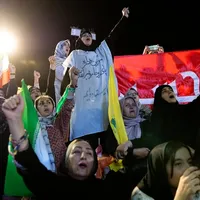
Iranians mark the second anniversary of the Woman, Life, Freedom movement in Toronto in September 2024
The resumption of diplomatic relations between Canada and Iran—severed by Ottawa in 2012—remains unlikely, statements this week from both governments indicated, as tensions and mutual distrust fester.
Responding to a query from Iran International TV on Thursday, Canada’s foreign ministry stated that Iran must undergo “significant changes to its behavior both domestically and internationally” before the restoration of diplomatic ties can be considered.
Iranian Foreign Ministry Spokesman Esmail Baghaei on Tuesday put the onus on Canada to make the first move to restore relations.
“I think the first step they need to take is to unravel the many sanctions and restraints they have imposed on themselves and on our bilateral relations,” Baghaei told CBC News at a press briefing in Tehran on Tuesday.
In its sharply worded statement, however, Canada condemned Iran for what it called Tehran's destabilizing activities in the Middle East, proliferation of drone and ballistic missile technologies, and lack of transparency surrounding its nuclear program.
Ottawa also expressed “deep concern about Iran's failure to uphold its international human rights obligations” and said it will continue to increase pressure on Iran and implement further measures “for as long it continues its unacceptable conduct.”
Canada further called on Iran to fulfill its legal non-proliferation obligations, honor its political commitments under the nuclear agreement framework, and fully cooperate with the International Atomic Energy Agency (IAEA).
At the same press briefing, Baghaei accused Ottawa of turning a blind eye to Israel’s actions while portraying Iran as a threat.
“Is Iran committing genocide? Has Iran occupied another country? Is Iran enjoying the full support of Canada and other Western countries to commit the colonial erasure of a whole nation?” he said.
Designation of Iran's Revolutionary Guards and sanctions
Canada has sanctioned numerous Iranian entities and individuals since 2012 for human rights violations, support for terrorism, ballistic missile and nuclear programs and the IRGC’s downing of Ukraine’s Flight PS75 in January 2020.
Ottawa officially designated Iran’s Islamic Revolutionary Guard (IRGC) as a terrorist organization in June 2024, over a decade after designating its foreign operations branch the Quds Force as a terrorist entity.
On March 7 Canada slapped fresh sanctions on several individuals and entities in connection with the IRGC’s weapons production and sales.
Strained relations for decades
Canada’s relations with Iran took a major hit in 2003 following the death of Canadian-Iranian photojournalist Zahra Kazemi in Iranian custody under suspicious circumstances.
Evidence suggested she had been tortured, but Iran rejected Canada’s demand for an independent investigation by international observers.
A turning point came in September 2012 when Canada closed its embassy in Tehran and expelled all Iranian diplomats from Ottawa.
At the time, Canada cited Iran’s support for Syria’s Bashar al-Assad, its non-compliance with nuclear obligations, threats against Israel, support for terrorism, human rights violations and disregard for the safety of foreign diplomats.
The move came a few months after the 2011 vigilante attack and vandalization of the British embassy and its residential complex in Tehran in reaction to UK’s decision to impose further economic sanctions on Iran over its nuclear program.
After the 2015 election of Prime Minister Justin Trudeau’s Liberal government, there was cautious optimism about re-engagement, especially following the Iran nuclear deal (JCPOA). Canada eased some sanctions in alignment with the agreement.
However, hopes of rapprochement were dashed in January 2020, when the IRGC shot down Flight PS752, killing 55 Canadian citizens and 30 permanent residents.
Iran said it had unintentionally downed the civilian aircraft amid heightened tensions with the US following the assassination of IRGC Quds Force Commander Qasem Soleimani.
Canada officially banned the entry of senior Iranian government officials in November 2022, cancelling dozens of visas and visa applications. The ban was expanded in September 2024 by retroactively applying the inadmissibility to any senior official who served in the Iranian government since June 23, 2003 when Zahra Kazemi was killed in Iranian custody.
Iranian-Canadians
Baghaei also told CBC that the lack of diplomatic ties harms the hundreds of thousands of Iranians living in Canada and contributing to its economy.
In the 2021 Canadian Census, over 280,000 individuals, or around 0.8 percent of the total Canadian population, identified themselves as Iranian or Persian.
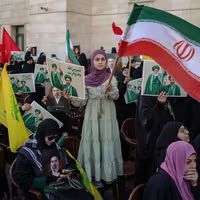
The Iranian dissident diaspora in Canada frequently organizes protests in major cities to denounce the Iranian government and the IRGC, and to express solidarity with political prisoners and pro-democracy movements in Iran.
Iran's foreign minister says the Omani top diplomat "had some proposals for removing the obstacles, and it was agreed that further expert work would be carried out on them in the respective capitals."
"These proposals could potentially offer a solution," Araghchi told reporters after the fifth round of talks with the US, which he called "one of the most professional rounds so far."
"I hope that in the next one or two sessions we can reach solutions that will make the negotiations progress," he said.
Araghchi told reporters that "the negotiations are too complex to be resolved in just two or three sessions."
"The fact that we are currently on a reasonable track is itself considered progress. I hope that in the next one or two sessions, given the better understanding that now exists regarding Iran's positions, we can reach solutions that are workable."
"We're not at that stage yet, but we're not without hope either," he added.
Iran's foreign ministry spokesman said negotiations between Iran and the United States in Rome "are still underway at the expert level in a calm yet professional atmosphere."
"Iran's Foreign Minister Abbas Araghchi is also holding talks with his Omani counterpart," Esmaeil Baghaei told Iran’s state TV.
He confirmed that US chief negotiator Steve Witkoff had left the venue due to flight scheduling but added that the talks continue with Omani mediation.
The Iranian negotiating team has been instructed not to proceed with any talks that include proposals to halt or reduce uranium enrichment to zero, Iran International has learned.
According to information obtained by Iran International, a formal directive was issued to the delegation ahead of the fifth round of indirect negotiations with the United States in Rome.
The order said any discussion of ending enrichment is off-limits, and negotiators are required to reject such proposals outright.
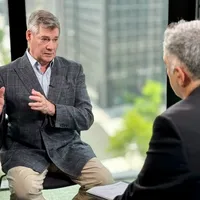
Foreign Minister Abbas Araghchi’s televised interview, aired the night before the talks began, was part of this coordinated approach.
The appearance, organized in consultation with the Supreme National Security Council and the sanctions negotiations committee, aimed to publicly reinforce Tehran’s red lines and manage expectations over a possible failure of the Rome talks.
The messaging also sought to frame the US as responsible should the talks collapse, by emphasizing Iran’s refusal to abandon what it views as its core nuclear rights.
Pedestrians walk in front of a political baA street scene in Tehran
US-Iran talks appear unlikely to lead to an agreement if the United States continues to insist that Tehran dismantle its uranium enrichment program, CNN cited two Iranian sources as saying.
Iran’s participation in the fifth round of talks in Rome on Friday is solely to gauge Washington’s latest stance rather than pursue a potential breakthrough, the sources cited by CNN added.
“The media statements and negotiating behavior of the United States has widely disappointed policy-making circles in Tehran,” CNN quoted the two Iranian sources as saying in a joint message.
“From the perspective of decision-makers in Tehran, when the US knows that accepting zero enrichment in Iran is impossible and yet insists on it, it is a sign that the US is fundamentally not seeking an agreement and is using the negotiations as a tool to intensify pressure.”
They added that while some Iranian officials initially hoped for a “win-win” compromise, a consensus has since formed that the Trump administration is pushing the talks toward deadlock.
Asked by a CNN reporter about the sources' comments before publication on Thursday, US state department spokesperson Tammy Bruce said the resumption of talks was the most important thing.
"It's gossip," she told reporters. "Some people don't have an interest in (talks' success), and that's where you get unnamed sources from.
"What is the story and what matters is that everyone is at the table in Rome."
With the current US position, the sources told CNN, the negotiations are becoming unproductive and may not continue much longer.
The sources said Tehran no longer takes seriously US efforts to distance itself from Israel’s position and believes the American proposals follow the agenda of Israeli Prime Minister Benjamin Netanyahu, who has demanded that Iran be barred from all uranium enrichment.