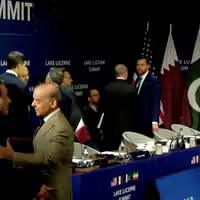
Tehran has not yet decided whether to attend the upcoming round of negotiations, said Iran’s Foreign Minister Abbas Araghchi on Wednesday.
“We are still assessing whether to participate,” he added, noting that Iran is evaluating if “productive negotiations can take place at the proposed time and venue.”
“We have already answered unreasonable requests, and such unusual remarks do not help the talks,” he added.
“Our position is completely clear: enrichment will continue, with or without an agreement,” Araghchi said.
“If the other parties want transparency regarding Iran’s peaceful program, we are ready—but they must also lift the unjust sanctions imposed on us based on those claims.”
“If they make further demands and try to deprive us of our rights, there will be no room for acceptance,” he added.

Iran’s conservative daily Kayhan sharply criticized former President Hassan Rouhani over his recent remarks that the 2005 election “changed the course of our nuclear path,” accusing his government of naivety and capitulation in earlier negotiations.
In that election Mohammad Khatami, the outgoing president, stepped down after two rounds and Mahmoud Ahmadinejad won the runoff race with Ali Akbar Hashemi Rafsanjani.
The paper wrote that Rouhani’s team, during talks under President Mohammad Khatami, accepted a voluntary suspension of uranium enrichment based on European promises, only to be misled for over two years.
“Eventually, they were told by European officials that the best guarantee Iran could offer was a permanent suspension,” Kayhan said.
The editorial accused Rouhani and his allies of failing to recognize public dissatisfaction with what it called 16 years of “elitist governance and foreign policy humiliation.”
The paper argued that the deal reached under Rouhani administration stalled Iran’s nuclear industry without lifting economic sanctions, calling the outcome “a trap set by the West.”

Foreign Ministry spokesman Esmail Baghaei on Wednesday called on all sides involved in negotiations with Iran to support a fair outcome based on international law.
“It is clear to everyone that what the Islamic Republic of Iran presents as its principled positions are in line with international law and Iran’s needs,” Baghaei told ILNA.
“We expect all relevant parties to help reach a reasonable and logical agreement.”


Iran’s parliament on Wednesday approved a 20-year strategic partnership with Russia, signaling a further tightening of ties between the two countries in both defense and economic matters.
The bill passed with 191 votes in favor, 8 against, and 2 abstentions out of 201 ballots cast, according to state media.
The agreement, initially signed by Russian President Vladimir Putin and Iranian President Masoud Pezeshkian on January 17, was ratified by Russia’s State Duma in April.
While the pact does not include a mutual defense clause, it commits both nations to enhanced military-technical cooperation, joint military exercises, and coordination in the face of what they define as shared security threats.
“The strategic treaty is vital from economic, security, geopolitical, and diplomatic perspectives,” said Tehran lawmaker Hamid Rasai during the parliamentary debate. “Both Iran and Russia are under heavy Western sanctions. This partnership can help reduce dependence on the dollar and strengthen national and military security.”
Rasai added that Russia could potentially provide Iran with advanced weapons systems, including air defense technologies, fighter jets, and naval equipment.
Another MP, Mohammad Reza Ahmadi from Rasht, voiced support for the pact, saying, “It is in our interest to align with those who oppose America.”
The development comes against the backdrop of deepening military collaboration since the outbreak of the Ukraine war in 2022.
Western governments have accused Iran of supplying drones and missiles for Russia’s use on the battlefield, leading to economic sanctions, a charge Tehran has consistently denied.
Economically, the pact aims to ease bilateral trade and financial transactions, with provisions to expand interbank cooperation and promote the use of national financial instruments.
The move comes as both Tehran and Moscow remain under extensive Western sanctions.
Last week, a separate free trade agreement between Iran and the Russia-led Eurasian Economic Union came into effect, reducing tariffs to boost trade flows between the two economies.

Three Iranian officials told Reuters that the country’s clerical leadership lacks a coherent fallback strategy if nuclear negotiations with the United States and Europe collapse.
While Iran may turn to China and Russia as a “Plan B,” the sources described the option as tenuous, citing China’s economic friction with Washington and Russia’s military focus on Ukraine.
“The plan B is to continue the strategy before the start of talks. Iran will avoid escalating tensions, it is ready to defend itself,” one senior official said.
A second warned, “Without lifting sanctions to enable free oil sales and access to funds, Iran’s economy cannot recover.”
All three sources emphasized that while Tehran will resist Western demands, it currently has “no better option” than a new deal to avert further crisis.

The United States is in no position to launch a new war despite its recent threats toward the Islamic Republic, said Hamidreza Taraqqi, a senior member of Iran’s Motalefeh Party.
“They are not people of war, because their conditions do not allow them to start another conflict,” he said.
Taraqqi accused US officials of using public threats to influence global opinion; while “privately recognizing they lack the power to deny Iran its rights.”
He added that regional countries fear a new war, except Israel, which he said, "depends on war for survival."